


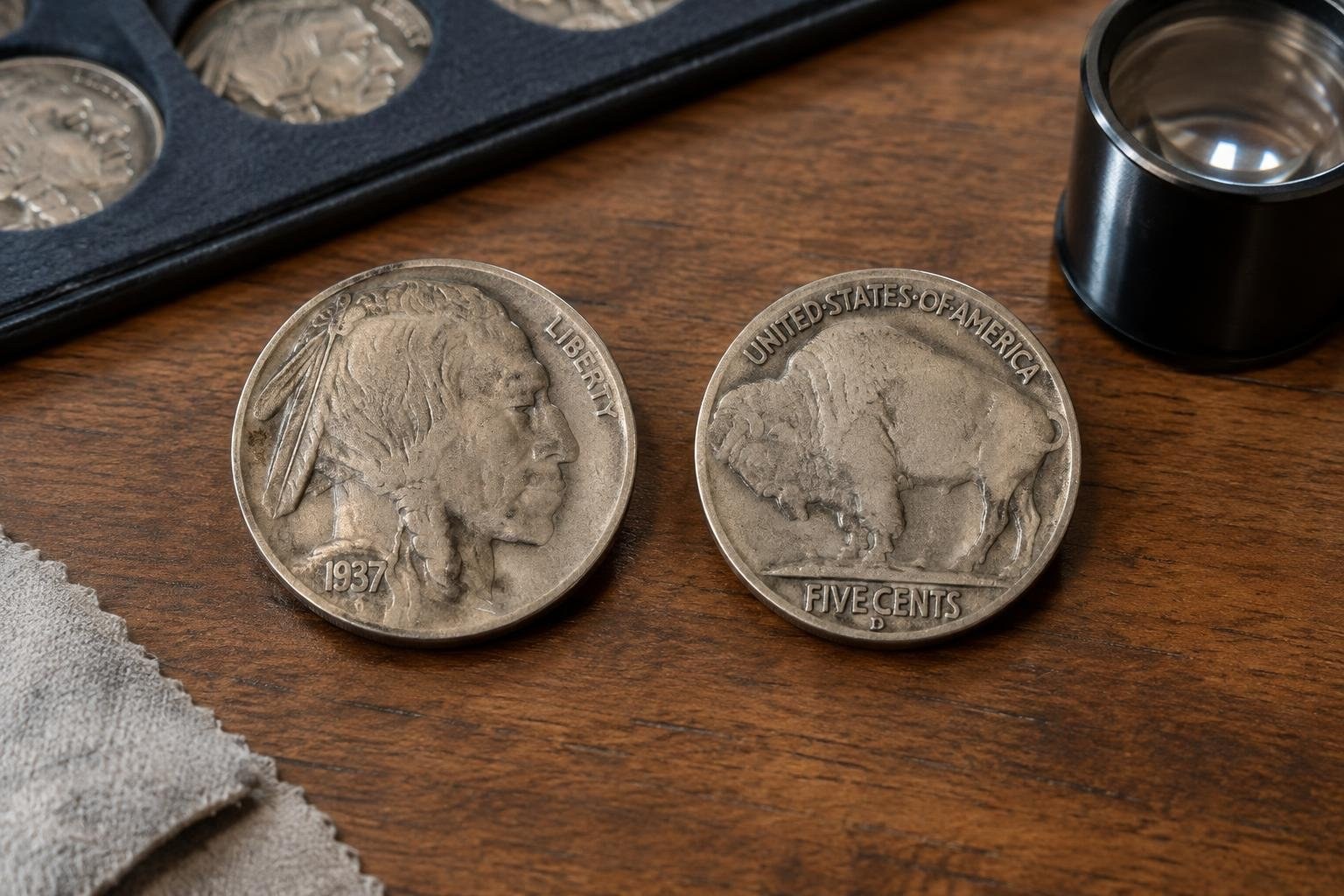
Buffalo nickels, also called Indian Head nickels, were issued from 1913 through 1938. Designed by James Earle Fraser, the five-cent coin is recognizable for its portrait and bison design. Whether you found one in a drawer, inherited a group, or are building a collection, the date, mintmark, condition, authenticity, and collector demand all deserve attention. This guide explains how to identify a Buffalo nickel, what can affect its value, and how to make careful buying or selling decisions without relying on unsupported price promises.
Buffalo nickel basics: what to know
The Buffalo nickel, also known as the Indian Head nickel, is a U.S. five-cent coin issued from 1913 through 1938. Sculptor James Earle Fraser designed it. The obverse shows a Native American portrait, and the reverse features a bison. The series was struck at Philadelphia, Denver, and San Francisco. Sources report that more than 1.2 billion were minted across those facilities, but a large total production does not tell you whether a particular date and mintmark is scarce in a collectible condition.
That distinction matters: the series is historically recognizable, but not every example is rare or valuable. Start with the individual coin rather than assuming age alone determines price.
How to identify the date and mintmark
Begin with the date on the portrait side. Then inspect the reverse below the words FIVE CENTS for a mintmark. Philadelphia coins have no mintmark; D identifies Denver and S identifies San Francisco. Record what you can actually see rather than filling in worn or uncertain digits by guesswork.
Use good, diffuse light and magnification if needed, but do not scrape, rub, or use chemicals to make a date or mintmark clearer. If either feature is illegible, note that in your inventory. A coin professional may be able to assess what remains visible, but a completely unreadable date limits identification.
Photograph both sides in focus. Keep the image and the physical coin together in your records so you can distinguish it from other similar pieces.
Signs a Buffalo nickel may need expert review
A closer review may be useful if a Buffalo nickel has a readable date and mintmark, unusually strong detail, an unusual appearance, or a family history suggesting it was set aside as a collectible. It can also make sense when you are considering a purchase, planning an insurance inventory, or deciding whether to sell a group.
These are reasons to ask for an assessment, not proof that a coin is rare. Common warning signs of an unreliable conclusion include a valuation based only on a photograph, a claim that every old coin is valuable, or a promise of a high price before the coin’s condition and authenticity are examined.
If the coin is heavily worn, damaged, or missing a readable date, still record it accurately. Do not discard an unfamiliar coin solely because it looks ordinary.
Buffalo nickel pricing: what a quote means
There is no single dependable price for every Buffalo nickel. A useful evaluation identifies the coin as precisely as possible, considers its condition and authenticity, and explains what kind of value is being discussed. An asking price, an estimated retail figure, and a dealer’s purchase offer are not interchangeable.
Ask for the basis of any quote. Is it a proposed amount to buy your coin, a guide value, or a seller’s listed price? Is the assessment conditional on in-person examination or authentication? If you are comparing offers, compare offers for the same coin and condition, not a dealer’s offer against another seller’s asking price.
Online listings can show what sellers are asking, but an asking price alone does not establish what a buyer paid.
What affects a Buffalo nickel’s collector value
Several factors can separate two coins with the same date. The mintmark, how much design detail remains, the coin’s surface condition, signs of cleaning or damage, authenticity, and collector demand may all affect its appeal. The date and mintmark help identify the issue; condition describes the coin’s state of preservation.
For a practical first look, note whether the date is readable, whether major design details remain, and whether the surfaces show obvious scratches, discoloration, or alterations. This is a preliminary observation, not a formal grade. Avoid assigning a precise grade from a quick glance or a single image.
When a value seems unusually high, ask what exact variety or condition supports that conclusion and how it was established. A specific explanation is more useful than a general statement that the coin is rare.
Collecting and selling options: tradeoffs to compare
Collectors can approach the series in different ways: assemble a broad date-and-mintmark set, focus on a smaller selection of dates, or buy individual coins chosen for condition or personal interest. A modest, clearly defined collecting goal can help prevent impulse purchases and keep comparisons relevant.
When considering a coin, compare the same date and mintmark, similar condition, and similar presentation. A coin in a holder with a grade label should not automatically be treated as equivalent to another coin with the same label; authenticity, holder integrity, and the coin’s actual appearance still matter. Certification is a tool for assessment, not a guarantee of a particular resale price.
For selling, compare more than one qualified option when practical. A direct dealer offer prioritizes a straightforward purchase, while selling through another channel may involve additional effort, time, or costs. Confirm the terms before choosing.
What to expect from an evaluation, including timing
A sound evaluation usually starts with the coin’s visible features, followed by a discussion of condition, authenticity concerns, and a value basis. For a group, an evaluator may first sort coins by type, date, and mintmark, then examine pieces that appear to merit closer attention. Ask what the evaluation includes before handing over a collection.
Timing depends on the number of coins, whether the pieces need individual examination, and whether additional authentication or grading is being considered.
Before proceeding, clarify any charges, submission steps, payment terms, and what happens if you decline an offer. Keep a record of which coins you leave for review and obtain a written receipt when applicable.
How to choose a qualified coin provider
Choose someone who can explain how they identified the coin and how they reached a valuation, rather than relying on pressure or unsupported claims. Ask whether the person is making an offer to buy the coin or giving an independent assessment. Those roles can involve different incentives, so clarity helps you understand the conversation.
For a valuable-looking or disputed coin, consider seeking another informed opinion before making an irreversible decision. Ask what evidence supports a claimed variety, whether authentication is recommended, and what the costs and risks of further review would be. A trustworthy provider should allow reasonable questions and should not require you to decide immediately.
Do not treat a professional title, a display case, or a website claim as proof by itself. Evaluate the explanation, written terms, and handling process.
Credentials, terms, and safe coin handling
The Buffalo nickel, also known as the Indian Head nickel, is a U.S. coin designed by James Earle Fraser and issued from 1913 through 1938. Do not assume that a seller’s promise or a grading label guarantees a future price. Ask for written terms covering any fees, custody of coins, return process, and payment before agreeing to a transaction.
Protect the coin from avoidable handling damage. Hold it by the edges when necessary, keep it away from abrasive surfaces, and do not clean or polish it. Do not use destructive tests. If you suspect a coin is counterfeit or altered, stop handling it beyond what is necessary and seek a knowledgeable review. These precautions preserve the option of further examination.
Ways to manage costs without risking the coin
You can reduce avoidable expense by organizing coins before requesting an evaluation. Group them by date and mintmark, photograph both sides, and note which dates are hard to read. This makes it easier to discuss a collection without paying for unnecessary work on every coin.
Ask about the total cost before paying for grading, authentication, shipping, insurance, or other services. Professional grading may be worth considering when the coin’s likely collector interest justifies the expense, but a fee is not a way to make a coin more valuable by itself. Seek a preliminary opinion before submitting a coin whose date, condition, or authenticity is uncertain.
Never try to save money by cleaning a coin, buying an unverified tool or treatment, or relying on a seller’s unsupported promise. Preserving the coin’s original state is usually the safer choice.
Mistakes, red flags, and a practical checklist
Common mistakes include assuming age equals rarity, confusing an asking price with a purchase offer, accepting a precise grade from a poor photograph, and paying for grading before understanding the likely benefit. Cleaning is especially risky: polishing, rubbing, chemical treatment, or other surface alteration can permanently affect a collectible coin’s appearance and evaluation.
- Record the date and mintmark as visible, without guessing.
- Photograph the obverse and reverse before moving coins between holders.
- Keep original holders, labels, envelopes, notes, and purchase records.
- Ask what a quoted price represents and what conditions apply.
- Get another opinion if a claim or offer seems inconsistent with the explanation.
- Do not rush because someone says the opportunity will disappear immediately.
These steps do not establish a coin’s value, but they help preserve useful information and make comparisons clearer.
Inherited collections and estate preparation
If you inherited Buffalo nickels or found them among a larger collection, preserve the group before making decisions. Keep coins with their original holders, envelopes, labels, receipts, certificates, and family notes. Do not clean the coins or separate items that appear to have been stored together.
Photograph the group and make a simple inventory, noting dates and mintmarks only when readable. Store the collection securely while you arrange an evaluation, and limit unnecessary handling. For a large holding, ask how it will be inventoried, where it will be kept during review, how transportation and payment are handled, and whether you can review the results before deciding what to sell.
Unfamiliar coins should be reviewed before disposal. A brief, organized record can help heirs compare advice and retain a useful account of what was evaluated.
Frequently asked questions
What is a Buffalo nickel?
Buffalo nickel is the familiar name for the U.S. five-cent coin also called the Indian Head nickel. It was designed by James Earle Fraser and issued from 1913 through 1938.
Where is the mintmark on a Buffalo nickel?
The date is on the obverse, the side showing the portrait. The mintmark, if present, is on the reverse below the words FIVE CENTS. Philadelphia coins have no mintmark; D and S indicate Denver and San Francisco, respectively.
Are all Buffalo nickels valuable?
Not necessarily. The series includes many dates and mintmarks, and collector value depends on factors such as condition, authenticity, and demand. An old coin is not automatically rare or valuable.
What makes a Buffalo nickel valuable?
A clear date helps identify a coin, but it is only one part of an evaluation. Mintmark, grade, surface condition, authenticity, and current collector demand can also matter.
Should I clean a Buffalo nickel before selling it?
Do not clean, polish, scratch, or chemically treat it. Keep it in its current holder or place it in a suitable protective holder, and seek an informed evaluation if the coin may be collectible.
How can I compare offers for Buffalo nickels?
Compare offers for the same coin and condition, and ask whether each figure is a purchase offer, an asking price, or an estimated retail value. These figures describe different sides of a transaction.
Should I have my Buffalo nickel professionally graded?
A professional grading service may be worth considering when a coin’s potential value and condition justify the fees and submission process. For a common or heavily worn coin, get an informed preliminary assessment first.
People Also Ask
What years were Buffalo nickels made?
Buffalo nickels were issued from 1913 through 1938. The series was designed by James Earle Fraser.
Which mints made Buffalo nickels?
The three mint locations were Philadelphia, Denver, and San Francisco. Philadelphia coins carry no mintmark; Denver coins use D and San Francisco coins use S.
What should I do if the date is worn off my Buffalo nickel?
A missing date makes precise identification harder. Avoid using chemicals or abrasive methods to reveal it; ask a knowledgeable coin professional to examine the coin safely.
Is an Indian Head nickel the same as a Buffalo nickel?
The name is often used for the same coin. Indian Head nickel refers to the portrait on the front, while Buffalo nickel refers to the bison on the reverse.
Can I collect Buffalo nickels by date and mintmark?
Yes. Buffalo nickels can be collected by date, mintmark, condition, or other set-building goals. Decide what collecting approach suits your interest and budget before buying.
Why do Buffalo nickel prices differ between sellers and dealers?
A seller’s asking price is not the same as a dealer’s purchase offer or a completed sale price. Ask what a quoted figure represents and compare offers for coins in similar condition.
How should I handle inherited Buffalo nickels?
Keep the coin and any original packaging, labels, paperwork, or collection notes together. Avoid cleaning it, and have unfamiliar coins reviewed before selling a group.
Buffalo nickels are best approached one coin at a time: identify the date and mintmark, preserve the surfaces, and assess condition before deciding what to buy or sell. The design is familiar, but a coin’s date, condition, authenticity, and collector demand can make its value differ substantially from another coin that looks similar. Organize what you have, ask clear questions, and compare offers on the same basis. Visit CashForCoins.net to request an offer for your coins or bullion.
Your next step
Visit CashForCoins.net to request an offer for your coins or bullion.
Get a custom offer for your coins or Bullion!View Live offers for Gold & Silver Coins
Last reviewed and updated October 15, 2026 by the Cashforcoins Editorial Team.
Sources
- US Buffalo Nickels (1913-1938) for sale | eBay
- Buy Buffalo Nickels (1913-1938) | Littleton Coin
- Buffalo Nickels | Rare Coin Wholesalers, a S.L.Contursi Company
- Buffalo Nickel (1913-1938) Value | JM Bullion™
- Buffalo Nickels – Mount Vernon Coin
- Buy Buffalo Nickels (Indian Head Nickels) | Profile Coins
- Buffalo Nickel Values & Prices | Greysheet
- Buffalo Nickels (1913-1938) | Complete Collector's Guide | L&C Coins