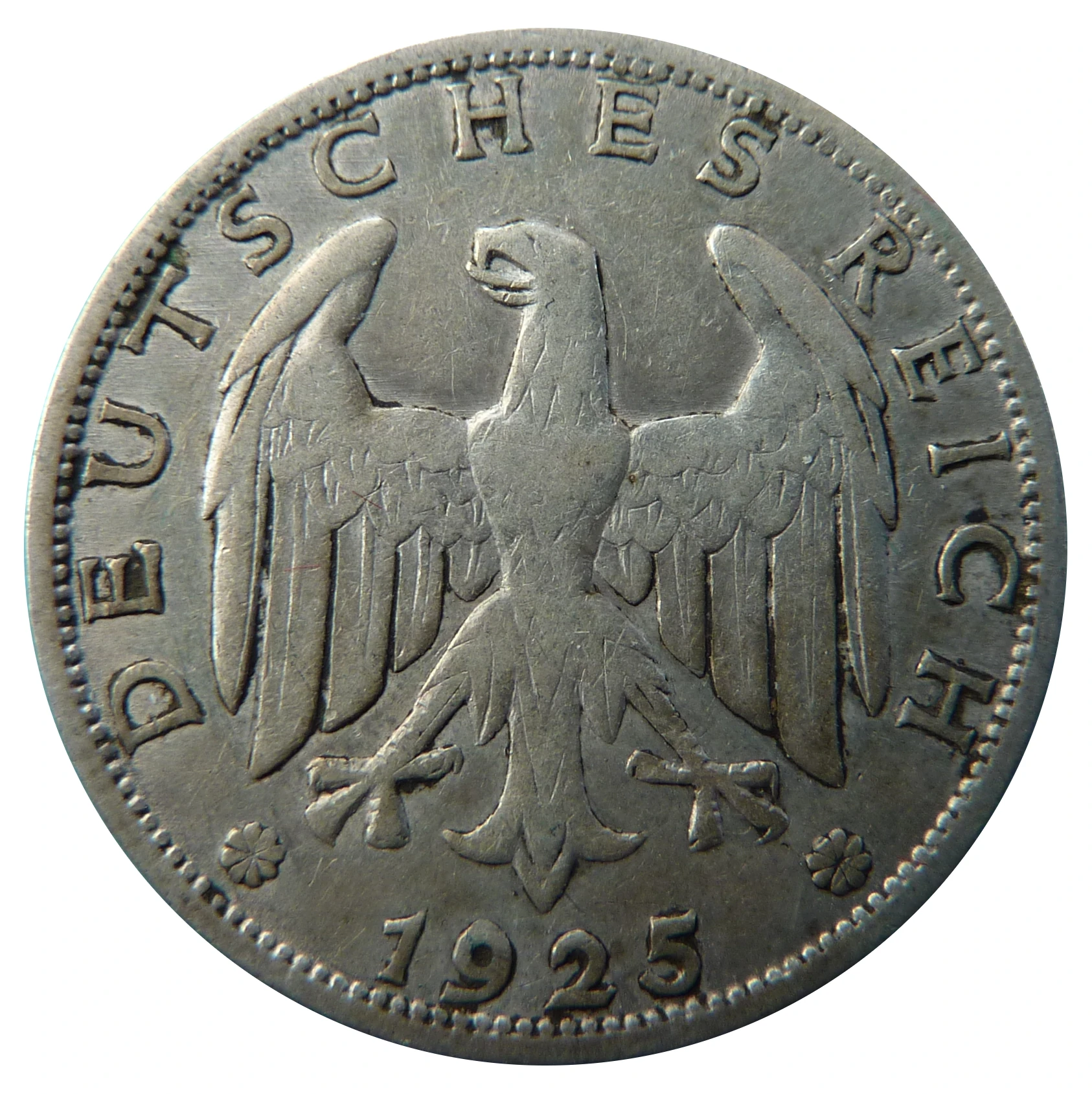
German Empire silver half marks in this reference use the reference’s designated .0804 fine silver troy ounce per matching coin, with 2.777-g nominal gross mass and .900 fineness. The accepted annual list is 1905–1909 and 1911–1919. The genuine reference photographs show a 1915-A half mark; Weimar half Reichsmarks and replicas are outside this profile.
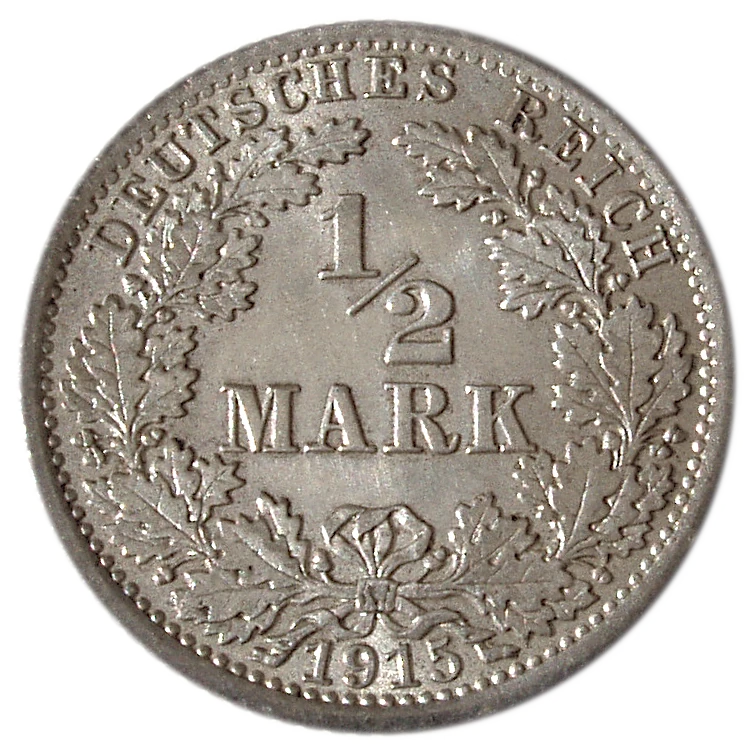
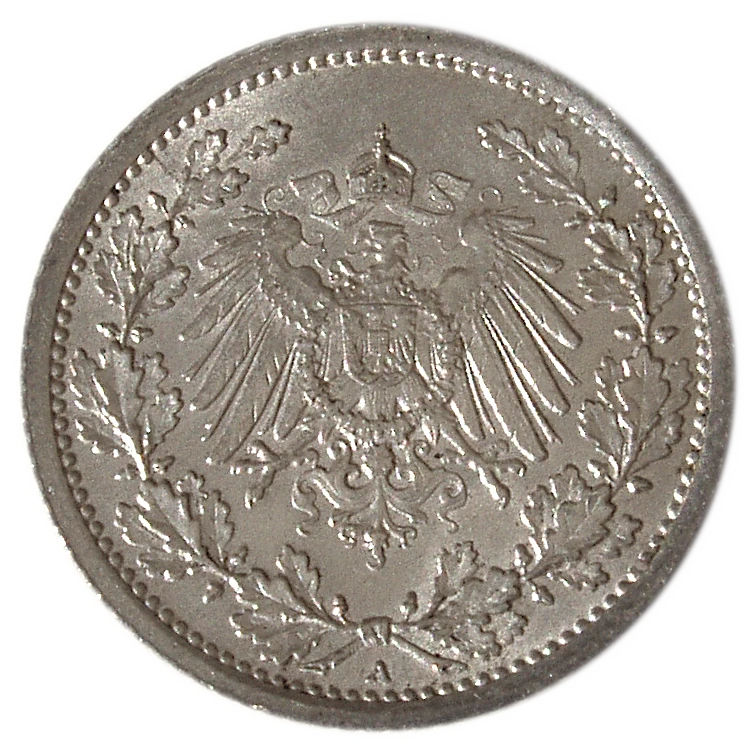
Obverse — Genuine 1915-A KM17 half mark. NobbiP / Wikimedia Commons / Public domain (PD-self); whole-face WebP conversion at downloaded dimensions · Image source · Public domain (PD-self)Reverse — Genuine 1915-A KM17 half mark. NobbiP / Wikimedia Commons / Public domain (PD-self); whole-face WebP conversion at downloaded dimensions · Image source · Public domain (PD-self)
When a fresh spot bid is available, melt values use fine-metal content × spot bid. CashForCoins guide buying offers use the separately configured percentage for each metal. Selected rare/numismatic coins require an appraisal. Dollar amounts remain unavailable when a fresh quote or buying percentage is missing.
Verified coin specifications
Country
Germany
Face denomination
1/2 Mark
Composition
90% silver; remaining alloy metals not independently verified
Gross weight (grams)
2.777
Fineness
0.9
Fine-metal weight (troy oz)
0.0804
Diameter (mm)
20
Mint
Multiple German mints; exact dated letter required
Mint mark
A; D; E; F; G; J
Restrikes
Later standards, patterns and replicas excluded
Issue years
1905–1909, 1911–1919
Fourteen specific annual dates for KM17; no 1910 annual row. Aggregate proof ranges do not establish missing dates. The anomalous 1808/7-J row stays unresolved without a guessed correction. Design, mint and finish still require attribution; later standards and replicas are excluded.
Source precision
The designated reference world-silver melt table specifies 2.777 g gross mass, .900 fineness and .0804 fine silver troy ounce. The KM17 dated table instead displays 2.7700 g and .0802 ASW. This guide retains the designated melt values without averaging or claiming the discrepancy is resolved. The reference supplies a 20-mm catalogue diameter. Thickness, edge and the identity of the remaining alloy metals are not independently verified. Catalogue figures are nominal references, not an assay or authentication of a customer specimen.
Calculate this coin’s metal content
Formula: specified fine-metal troy ounces × quantity. Dollar melt value additionally requires an approved current metal price.
Obverse: identify the front
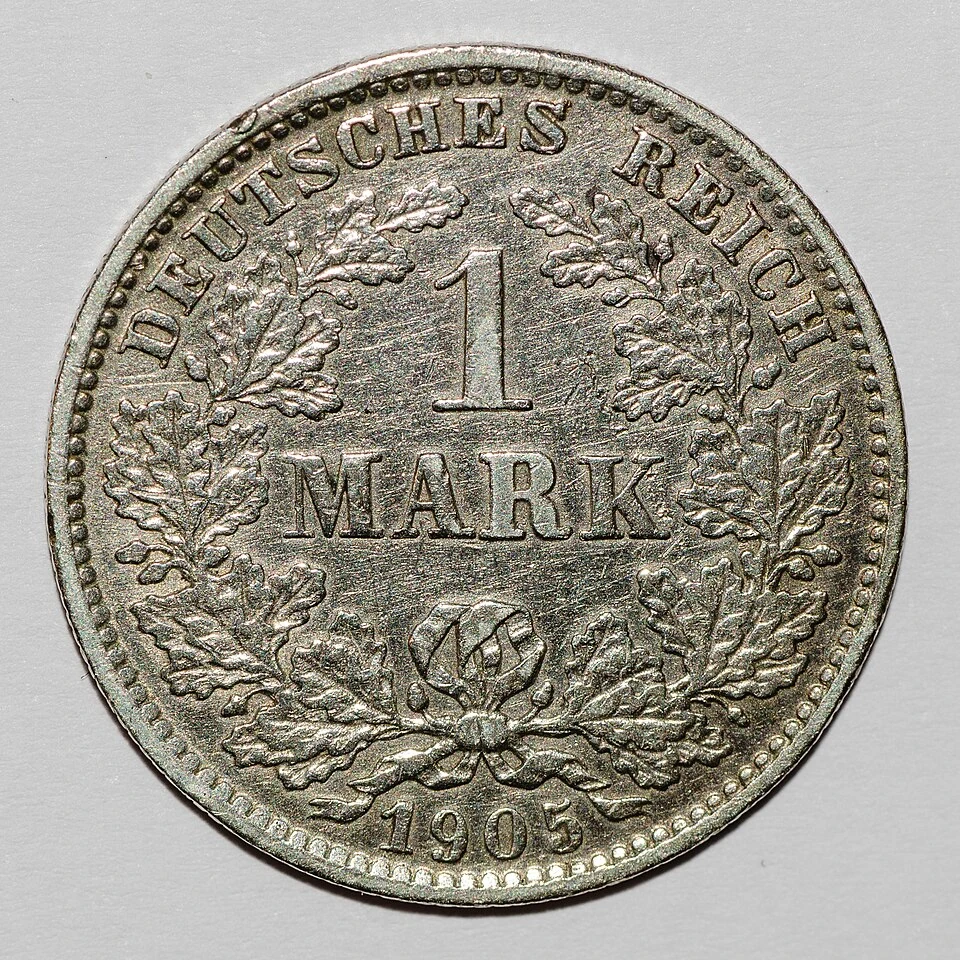
The illustrated denomination face reads 1/2 MARK inside a wreath, with DEUTSCHES REICH around the upper rim and the complete 1915 date below. The reference identifies denomination within a wreath as the KM17 obverse. Preserve the fraction when photographing a coin: a full-mark denomination belongs to a heavier standard. Historical Commons captions call this an Empire Reichsmark, but the actual coin reads MARK and the guide uses that visible denomination.
Reverse: identify the back
The reverse photograph shows the crowned imperial eagle with a central shield and the A mint letter below. This is the opposite face of the illustrated 1915 half mark. The whole border and worn surface remain visible. A letter in a reference photograph illustrates that particular piece only; it does not prove the mint, finish, silver content or authenticity of an unrelated coin supplied for appraisal.
History and purpose
The reference groups Empire half marks under the broad 1905–1919 melt heading and supplies a separate KM17 annual record. The finer annual list reveals a gap in 1910, an anomalous out-of-period row and proof ranges that cannot be treated as an exhaustive year-by-year catalogue. The word MARK on the coin is also useful for distinguishing this denomination from later Reichsmark references. The guide keeps these identification details alongside the controlling melt standard.
How to identify this variant
Confirm 1/2 MARK, the Empire eagle and an accepted annual date before counting. The reference gives a 20-mm catalogue diameter, while the controlling gross mass is 2.777 g. A nominal measurement is an identification aid, not a laboratory determination of .900 fineness. Later Weimar half Reichsmarks, plated imitations, replicas and coins with unreadable attribution require separate review. Preserve any dark finish rather than cleaning it to match a reference photograph.
Understanding its metal content
One matching half mark contributes .0804 reference fine silver troy ounce; three total .2412 ounce and 8.331 nominal gross grams. The dated table’s .0802 ASW is disclosed but does not replace the user-designated melt source. Calculate each standard separately in a mixed lot and do not count the complete gross mass as silver. These theoretical figures do not promise the recoverable content of worn or altered specimens.
Dates, varieties and composition changes
Accepted issue years: 1905–1909, 1911–1919. These are the specific annual dates verified in the inspected records, not a guarantee of every mint/finish combination or an expansion of aggregate proof ranges. Retain the full dated type when identifying a coin.
Confirmed annual issues and unresolved catalogue rows
KM17 half mark
Fourteen distinct annual dates are supported: 1905–1909 and 1911–1919. No 1910 annual row is present. Explicit mint letters A, D, E, F, G and J occur, with different dated combinations. Aggregate 1905–1919 proof rows do not verify an individual missing date. The anomalous 1808/7-J entry is outside the family period and remains unresolved, rather than being silently changed to a guessed date.
Overdates and surface finish
The reference lists several overdates, including 1909/5-D, 1911/05-D, 1916/616-D and 1919/1619-D. Such catalogue varieties require the actual digits to be attributed. Its notes describe a dark treatment on some 1918–1919 coins intended to discourage hoarding; this does not mean all examples of those years have the same finish or that colour proves authenticity.
Melt value versus collector value
Keep the exact year, mint letter, design, finish and provenance with each piece. A catalogue overdate or proof entry must be attributed on the actual coin; it does not turn every similar example into that variety. Reference metal content alone does not determine collector interest or grade. Preserve old labels and packaging with the correct coin, avoid cleaning, and request specialist assessment where a variety, unusual surface or condition could affect its value.
Authenticity and condition
Provide photographs of both complete faces and the edge, together with measured mass and diameter when available. Include every visible date digit, the full denomination and mint letter. Matching the illustrations is an identification aid, not proof of authenticity or an assay. Wear, plating, alteration and mistaken attribution require examination of the actual specimen. Keep unresolved pieces separate until the type and nominal composition can be established.
Selling this coin
Sort identified Empire half marks away from full marks and later Reichsmark denominations before entering quantity. The existing quote form carries the selected profile and quantity with your photographs and notes. Live dollar pricing remains unavailable. Reference ounces describe theoretical silver content and are not a purchase offer, collectible valuation or promise of recoverable metal.
Sources and calculation methodology
The designated reference world-silver melt table specifies 2.777 g gross mass, .900 fineness and .0804 fine silver troy ounce. The KM17 dated table instead displays 2.7700 g and .0802 ASW. This guide retains the designated melt values without averaging or claiming the discrepancy is resolved. The reference supplies a 20-mm catalogue diameter. Thickness, edge and the identity of the remaining alloy metals are not independently verified. Catalogue figures are nominal references, not an assay or authentication of a customer specimen. Actual annual rows and independent photograph permissions were inspected on 2026-10-11. NobbiP’s two Commons pages include a public-domain self-release. The genuine 756-pixel PNG faces are converted to WebP at their downloaded dimensions. The source calls the coin a Reichsmark; the visible 1/2 MARK legend and the reference KM17 denomination control this guide’s name. No coin artwork is generated, enlarged, changed or cropped away. Unresolved dates and source discrepancies remain explicit rather than silently corrected.
Common questions
Which issue years are confirmed?
The accepted annual dates are 1905–1909, 1911–1919. Aggregate proof ranges do not establish individual missing dates. The anomalous 1808/7-J entry is not silently corrected.
How much reference silver do three matching coins contain?
Three matching coins contain .2412 fine silver troy ounce using the designated reference melt figure. The result is theoretical content, not a purchase offer.
Can I count later German coins with the same denomination?
Later Weimar coins and other composition standards require exact type identification and their separate calculator profile. Denomination, colour or a similar design alone does not establish silver content.
We use cookies to offer you a better browsing experience, analyze site traffic and personalize content. Read about how we use cookies and how you can control them in our Privacy Policy. If you continue to use this site, you consent to our use of cookies.