


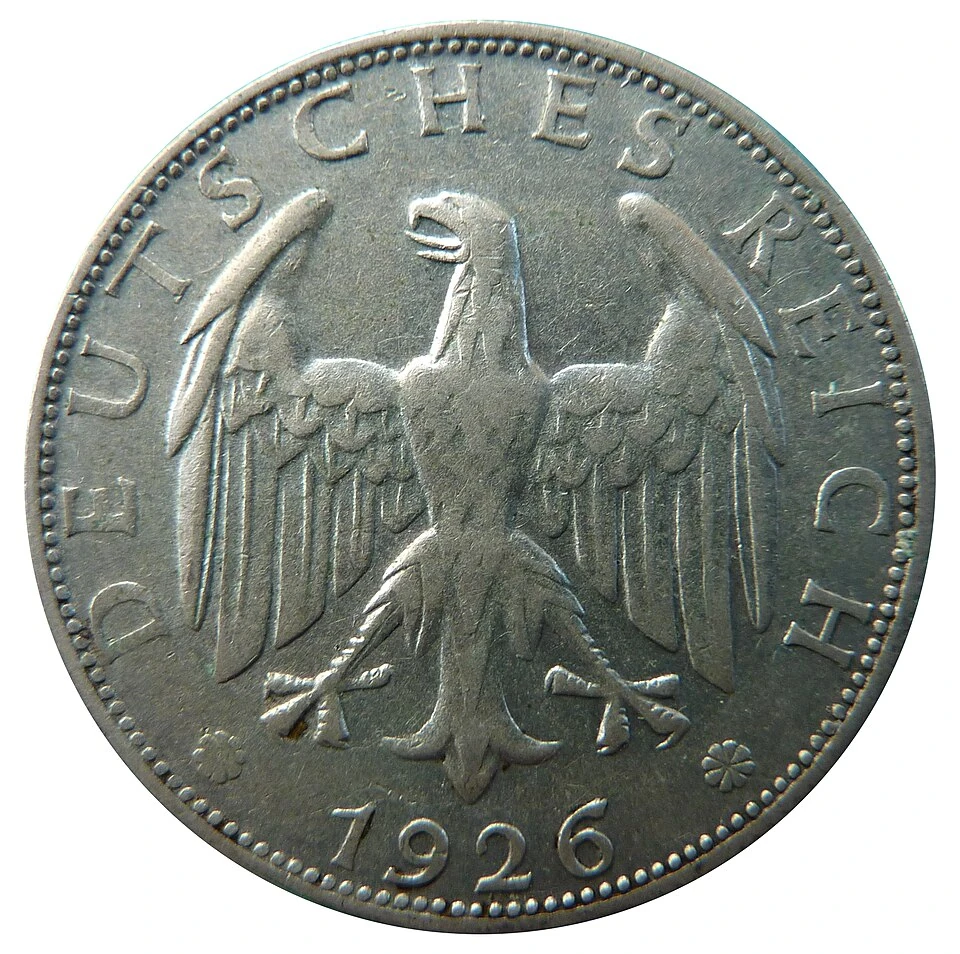
Weimar Silver 2 Reichsmark — .500 KM45
Photo credits and rights on the linked coin profile.
Germany • 50% silver; remaining alloy metals not verified
Issue years: 1925–1927, 1931
Fine silver: 0.160700 troy oz
Germany • 1 Mark / 1 Reichsmark
German Weimar silver Mark and Reichsmark coins in this guide contain .0804 reference fine silver troy ounce per identified 5-g, .500 piece. Four actual years are supported: 1924–1927, across two different denomination/design types that overlap in 1925. The licensed photographs show a genuine 1925-A one-Reichsmark, not the earlier MARK design.
When a fresh spot bid is available, melt values use fine-metal content × spot bid. CashForCoins guide buying offers use the separately configured percentage for each metal. Selected rare/numismatic coins require an appraisal. Dollar amounts remain unavailable when a fresh quote or buying percentage is missing.
Four actual years: Mark KM42 1924–1925 and Reichsmark KM44 1925–1927. Designs overlap in 1925. Mint/finish combinations differ; undated common-proof rows add no year. Earlier .900 marks, later base-metal coins, patterns and replicas are excluded.
Formula: specified fine-metal troy ounces × quantity. Dollar melt value additionally requires an approved current metal price.
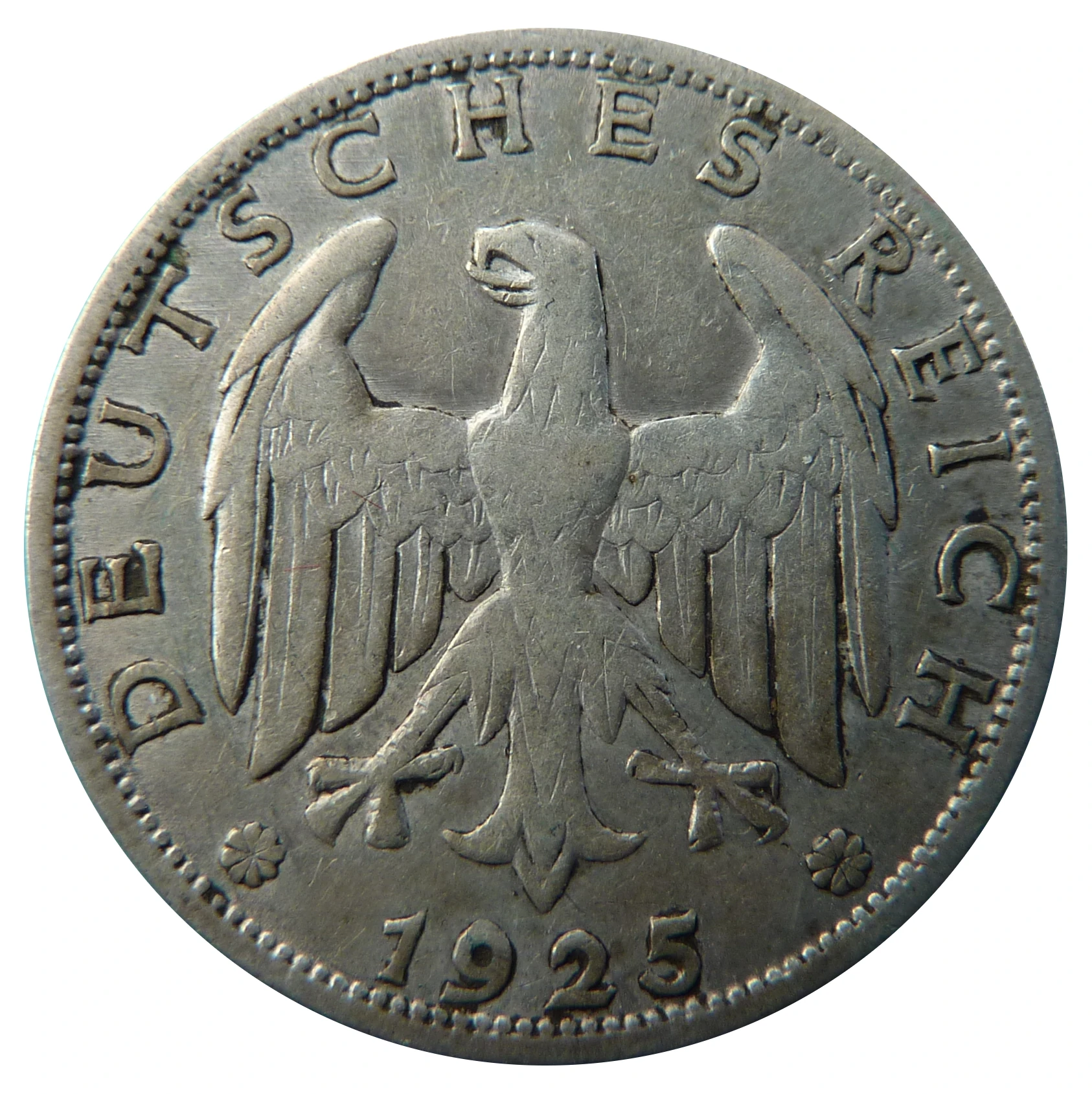
The illustrated one-Reichsmark obverse shows an eagle with spread wings, DEUTSCHES REICH around the rim and 1925 below. The eagle is above the date, matching reference’s KM44 convention. This is not the earlier KM42 front: that type puts the denomination above the date on its obverse. Photograph both faces because a front/back label in a historical image description can be inconsistent, and the actual artwork is more useful for identifying this transition.
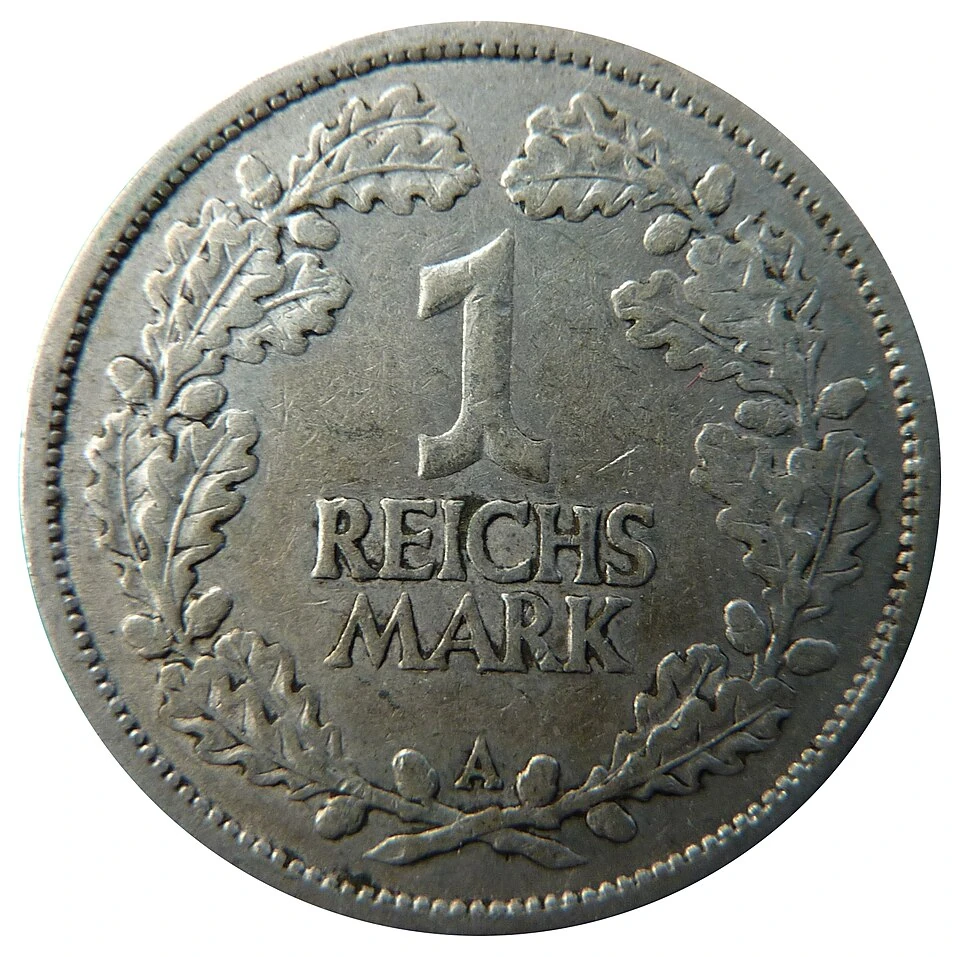
The photographed reverse has 1 above REICHS MARK inside a leafy wreath, with A at the bottom. Read the full denomination: an earlier MARK piece is a different supported type and larger two-Reichsmark coins use different nominal gross mass. The photograph illustrates the 1925-A catalogue family only. A letter visible in a reference photo does not demonstrate the mint, finish or provenance of another piece supplied for appraisal.
The reference separates the Weimar one-unit coinage into KM42 Mark and KM44 Reichsmark records. Their shared .500 fineness and 5-g mass allow the same designated .0804 reference-ounce calculation, while the artwork and actual dated mint combinations remain distinct. This denomination transition is why the guide records both types rather than presenting one uninterrupted design. Earlier Empire silver marks and later base-metal Reichsmarks retain separate composition identities and are not absorbed by a similar name.
First read 1 MARK or 1 REICHS MARK and the full date, then match the eagle and denomination layout to KM42 or KM44. The source-backed nominal standard is 5 g and .500 silver for both. The reference supplies 23 mm for KM42 but no diameter for KM44; this combined guide therefore avoids a single claimed diameter. Keep actual measured dimensions with the exact type. Do not identify purity from colour, approximate size or a 1925 date alone.
One matching coin contributes .0804 reference fine silver troy ounce; three total .2412 ounce and 15 nominal gross grams. Nominal fine-silver mass is 5 g × .500 = 2.5 g per coin. The calculator uses the designated reference ounces consistently, rather than treating all gross mass as silver. A mixed lot of earlier .900 marks and these .500 issues requires separate rows so each composition receives its own correct metal calculation.
The actual combined year list is 1924–1927. Mark KM42 covers 1924–1925 and Reichsmark KM44 covers 1925–1927, so the shared 1925 year needs exact design attribution. Mint and proof rows differ by type; no missing mint-year combination is filled in by interpolation. The reference’s annual entries describe catalogue varieties, not a promise that any particular coin is a proof or a certified variety. The comparison below gives the supported dated boundaries.
The annual list has 1924 A, D, E, F, G and J, plus a 1924-E proof; 1925 appears with A and D. An undated common-date proof row does not add an issue year. The denomination reads MARK. Its source convention puts denomination/date on the obverse and an eagle on the reverse.
1925 and 1926 are listed with A, D, E, F, G and J; 1927 has A, F and J. Explicit proof rows include 1925-A and 1926-E. The obverse has the eagle above the date; the reverse has REICHS MARK within a wreath. The pictured 1925-A belongs to this second design.
Earlier Empire marks belong to a separate .900 silver reference. Later base-metal one-Reichsmark coins, patterns, replicas and other denominations are excluded. A 1925 date alone does not choose between the two supported designs, and a mint mark alone does not prove finish.
Retain the exact year, mint letter, denomination, design and finish with each coin. Catalogue proof entries do not establish that a worn example is a proof. A reference photograph is not a grade assessment, and metal content does not determine collector interest. Keep original packaging, old attribution notes and provenance with the correct piece. Avoid cleaning surfaces to expose lettering. Request an assessment of the actual coin where a dated variety, unusual finish or condition could affect its value.
Provide clear images of both whole faces and the edge, plus measured mass and diameter when available. Include the complete date, mint letter and all denomination lettering. Matching an illustration is an identification aid, not proof of authenticity or a laboratory assay. Wear, plating, alteration and a wrongly attributed type cannot be resolved from a reference photograph. Separate uncertain pieces for specialist review before including them in a counted metal-content lot.
Sort the supported .500 one-unit coins by MARK versus REICHS MARK design and dated mint before entering quantity. Keep .900 Empire marks, gold marks, later base-metal Reichsmarks and unresolved pieces separate. The existing quote form can carry the verified denomination and quantity with your photographs and notes. Live dollar pricing remains unavailable. Reference silver ounces are theoretical content, not a purchase offer, collectible valuation or a promise of recoverable metal from the actual worn coins.
The designated reference world-silver melt table specifies 5 g gross mass, .500 fineness and .0804 fine silver troy ounce for the 1924–1927 Mark/Reichsmark family. KM42 and KM44 agree on those fields. The reference gives 23 mm for KM42 but no diameter for KM44, so the shared diameter field is intentionally empty. Thickness, a shared edge specification and remaining alloy-metal identities are not verified. Nominal specifications do not establish an assay or authentication of a customer coin. Actual annual rows were inspected on 2026-10-11, and undated common-proof entries were not expanded into years. Jobel’s two independent Commons file pages release the illustrated faces under CC0 1.0. The downloaded whole-face photographs are converted to WebP at their actual dimensions, without upscaling, cropping away the coin, replacing artwork or changing the depicted date. Side assignment follows the visible eagle/date and denomination/wreath layouts; inconsistent old Commons descriptions are retained as research context rather than copied into the guide.
KM42 Mark lists 1924–1925 and KM44 Reichsmark lists 1925–1927. Their shared 1925 date requires design attribution; mint-year and finish combinations differ.
Three matching 5-g/.500 pieces total .2412 fine silver troy ounce, using the reference’s .0804 per coin.
Earlier .900 Empire marks and later base-metal Reichsmarks require separate profiles. The two included Weimar designs share this nominal metal standard but still need exact identification.
Content maintained by CashForCoins. Last substantive record update: 2026-10-11. Report a specification or attribution issue through our contact page.
Photo credits and rights on the linked coin profile.
Germany • 50% silver; remaining alloy metals not verified
Issue years: 1925–1927, 1931
Fine silver: 0.160700 troy oz
Photographs can help identify your coin. An appraisal may consider authenticity, condition and collector demand as well as metal content.
Request a photo appraisal View current silver coin buying information
