
Australian_Threepence-3.jpg)
Australian_Threepence-4.jpg)
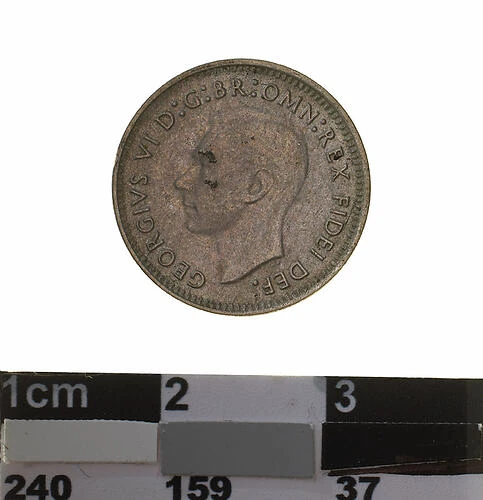
Australian Half-Silver Threepence — 1947–1964 Issues
Photo credits and rights on the linked coin profile.
Australia • 50% silver; 50% alloy remainder
Issue years: 1947–1964
Fine silver: 0.022700 troy oz
Australia • Threepence (3 pence)
A matching Australian sterling threepence contains .0419 reference fine silver troy ounce at the 1.41 g/.925 standard. The verified dated scope comprises eight issue years: 1910 and 1938–1944. The genuine photographs show a 1943-D George VI coin with three wheat stalks. The 1910 Edward VII portrait and arms reverse are a separate design within the same matching nominal standard. Match the date, design, denomination and source-supported specification before calculating a holding.
When a fresh spot bid is available, melt values use fine-metal content × spot bid. CashForCoins guide buying offers use the separately configured percentage for each metal. Selected rare/numismatic coins require an appraisal. Dollar amounts remain unavailable when a fresh quote or buying percentage is missing.
Eight actual annual years across matching 1.4100-g/.9250/.0419-oz KM18 and KM37. The George V KM24 table reports conflicting 1.3200-g/.9250/.0393-oz inputs and is excluded pending clarification. No 1945 annual row occurs in the inspected matching types. Mint and proof combinations remain year-specific; the photographs represent 1943-D only. Later .500 issues and replicas require separate identification.
Formula: specified fine-metal troy ounces × quantity. Dollar melt value additionally requires an approved current metal price.
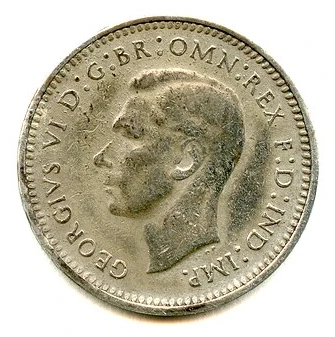
The genuine 1943-D obverse shows George VI’s bare head facing left and a surrounding royal legend retaining IND IMP. The reference credits T. H. Paget for KM37. The 1910 KM18 obverse instead shows Edward VII’s bust facing right and credits G. W. de Saulles. These faces are distinct identification cues; the photographed George VI design does not illustrate an Edward VII coin or establish any specimen’s alloy or authenticity.
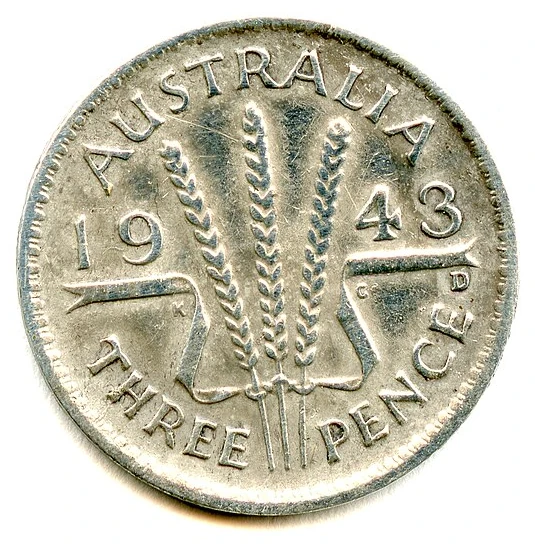
The photographed reverse reads AUSTRALIA and THREE PENCE. Three wheat stalks divide the visible date 1943, with a D mintmark beneath the right date half. The reference credits George Kruger Gray for KM37. The 1910 KM18 reverse instead shows arms and credits W. H. J. Blakemore. A wheat reverse alone cannot distinguish the earlier .925 and later .500 standards; retain the full date and both faces.
The 1910 Edward VII type precedes the George V family; the matching George VI sterling type begins in 1938. This guide excludes the intervening KM24 table because the reference reports different nominal mass and fine-ounce inputs there. The George VI table ends in 1944 and does not list 1945. Later .500 silver threepence begins in the separately reviewed 1947 family. Missing years remain explicit instead of being filled from a broad series span.
Identify a complete THREE PENCE reverse, the appropriate royal portrait, a listed date and any mintmark. Matching KM18/KM37 use a 16 mm nominal diameter and 1.41 g gross mass. KM18 specifies a plain edge; this KM37 reference does not separately document an edge, so no shared edge measurement is inferred. The D on the photographed 1943 reverse identifies its dated mintmark variety. A scale or photograph alone does not verify .925 silver, finish or authenticity.
One matching coin contributes .0419 reference fine silver troy ounce; three contribute .1257 fine silver ounces and 4.23 nominal gross grams. The calculator retains the reference’s rounded ASW rather than substituting a photographed specimen’s measured mass. Later 1.41 g/.500 threepence contributes .0227 reference ounce and must remain separate. The conflicting KM24 input is .0393 ounce and is not silently normalized or approved by this guide. Wear, assay and an actual purchase offer may differ from nominal reference content.
Specific source-supported issue years: 1910, 1938–1944. KM18 lists 1910(L) regular and proof entries. KM37 lists 1938(m), including a separate proof row; 1939–1941(m); 1942(m), 1942D and 1942S; 1943(m), 1943D and 1943S; and 1944S, with two S-mintmark varieties noted. Preserve these dated mint and finish combinations instead of assuming that every combination exists. Parenthesized mint labels do not imply a visible letter on every coin; the 1943-D photographs show their actual D.
Preserve each coin’s date, mintmark, surfaces and any documented proof attribution. The nominal silver calculation does not measure collector value. The reference’s separately listed 1910 and 1938 proofs require independent finish identification; a polished coin is not thereby a proof. Keep the two 1944-S mintmark varieties distinct when attribution is supported. Avoid cleaning and retain provenance, original packaging or reputable certification.
Provide complete obverse, reverse and edge photographs with measured mass and diameter when available. These licensed 1943-D faces show an individual worn coin and its design; they do not certify another specimen, establish grade, assay silver or verify proof manufacture. Mismatched portraits, omitted dates, plated pieces, tokens and replicas need separate investigation before applying a nominal melt calculation.
Sort matching sterling threepence separately from postwar .500 coins and unresolved George V references. Keep the actual date and mint attribution with each photo pair. The existing photo-appraisal link carries the selected quantity into the established enquiry form without making a purchase offer. Dollar melt pricing remains unavailable until an approved provider supplies it; fine-metal content is educational reference information.
The reference’s designated melt group gives 1.41 g/.925/.0419 fine silver troy ounce. Dated KM18 and KM37 independently match 1.4100 g/.9250/.0419 oz and 16 mm. Their actual annual rows supply 1910 and 1938–1944. KM24 gives a conflicting 1.3200 g/.9250/.0393 oz reference and is excluded pending clarification. The broad 1910–1945 group heading does not establish continuous issuance, a 1945 issue, or matching mass for every portrait. Both matching reference annual/specification/design tables and the conflicting George V table were inspected on 2026-10-11. The displayed years come from specific annual rows, including documented proof entries. Sardaka’s paired genuine 1943 photographs have independently verified CC BY-SA 4.0 releases. White margins are cropped while retaining each complete face, then converted to WebP without enlargement or retouching. The derivative photographs retain the same licence and attribution. No reference price, mintage or article is reproduced.
Content maintained by CashForCoins. Last substantive record update: 2026-10-12. Report a specification or attribution issue through our contact page.
Photo credits and rights on the linked coin profile.
Australia • 50% silver; 50% alloy remainder
Issue years: 1947–1964
Fine silver: 0.022700 troy oz
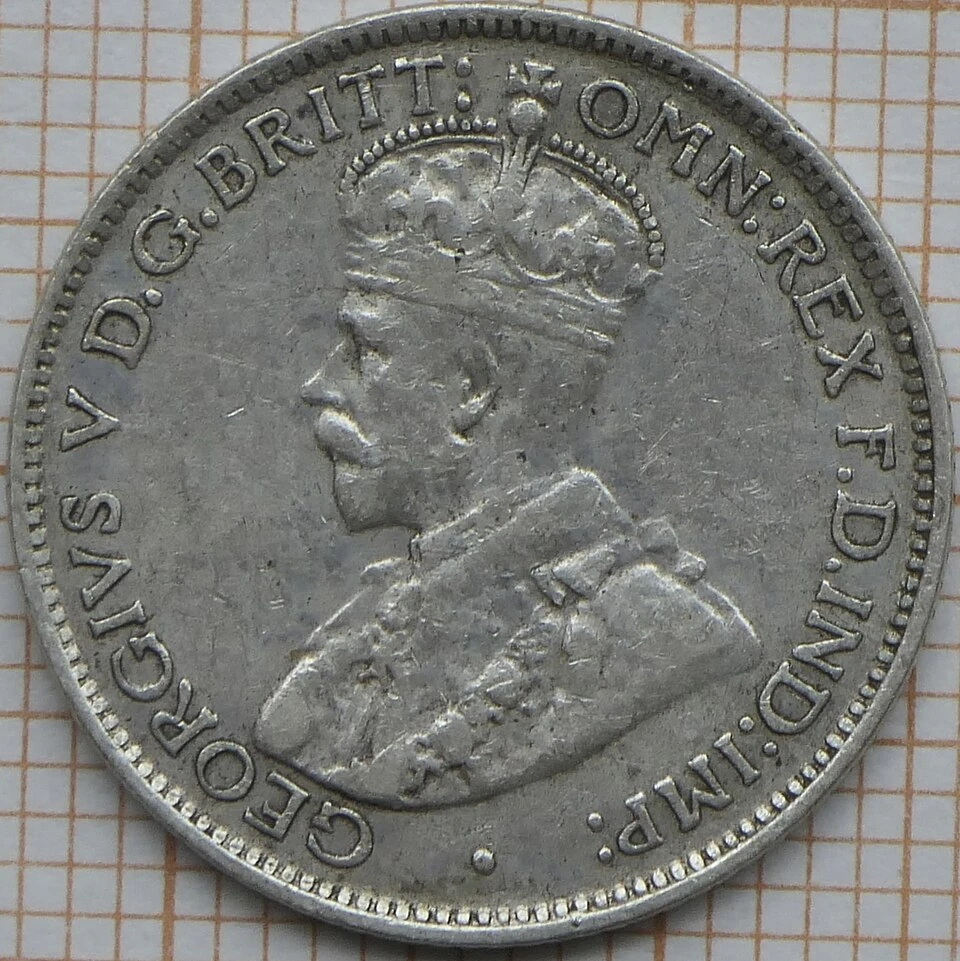
Photo credits and rights on the linked coin profile.
Australia • 92.5% silver; remaining alloy metals not independently verified
Issue years: 1911–1912, 1914, 1916–1928, 1934–1936
Fine silver: 0.083900 troy oz
Photographs can help identify your coin. An appraisal may consider authenticity, condition and collector demand as well as metal content.
Request a photo appraisal View current silver coin buying information
