
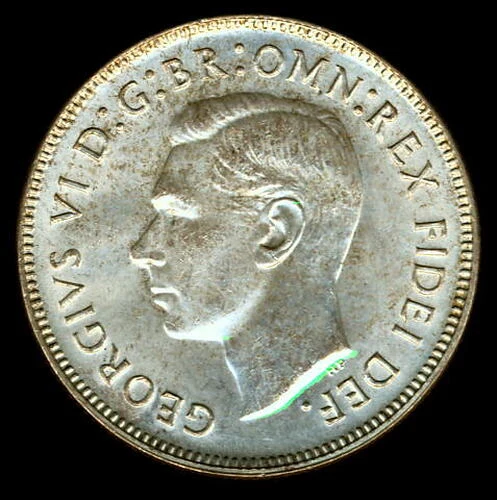
Australian Half-Silver Florin — 1946–1963 Issues
Photo credits and rights on the linked coin profile.
Australia • 50% silver; 50% alloy remainder
Issue years: 1946–1947, 1951–1954, 1956–1963
Fine silver: 0.181800 troy oz
Australia • Threepence (3 pence)
Australian half-silver threepence coins contain .500 silver by nominal fineness. The reference reports 1.41 g gross mass and .0227 fine silver troy ounce per matching coin. Confirmed issue years run continuously from 1947 through 1964 across four portrait and legend types. A threepence is three predecimal pennies. The genuine photographs show a 1952 Melbourne George VI working strike, not every design or finish in the family.
When a fresh spot bid is available, melt values use fine-metal content × spot bid. CashForCoins guide buying offers use the separately configured percentage for each metal. Selected rare/numismatic coins require an appraisal. Dollar amounts remain unavailable when a fresh quote or buying percentage is missing.
Eighteen confirmed annual dates across four .500 silver types. George VI loses IND IMP in 1949; Elizabeth II begins in 1953 and adds F D in 1955. The reference lists both regular and proof 1951 PL issues; a mint code does not establish finish. Earlier sterling, tokens, patterns and later replicas are excluded.
Formula: specified fine-metal troy ounces × quantity. Dollar melt value additionally requires an approved current metal price.
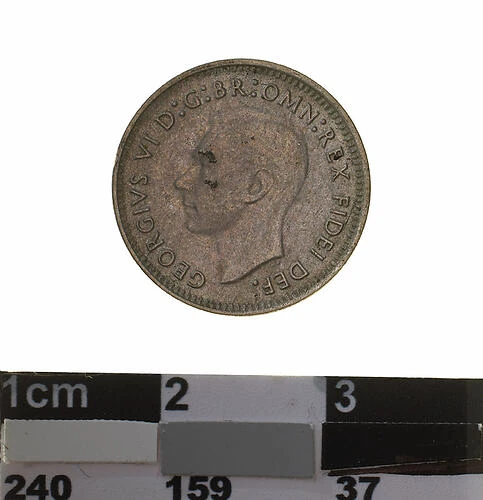
The illustrated portrait faces left, with GEORGIVS VI around the rim and a legend ending FIDEI DEF. HP appears beneath the neck. The reference credits T. H. Paget for George VI’s portrait and identifies the KM44 legend without IND IMP. The later Elizabeth II types show Mary Gillick’s laureate bust facing right. Read the actual monarch and legend rather than assuming every wheat-reverse threepence belongs to this half-silver group.
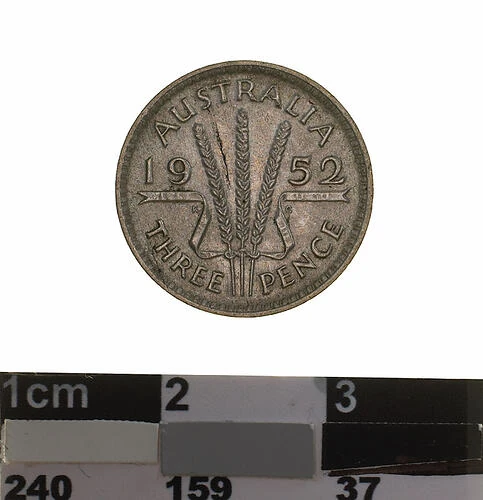
Three upright wheat ears divide the illustrated date into 19 and 52. AUSTRALIA appears above and THREE PENCE below, with the stalks bound by a curved ribbon and KG at the ribbon. The reference credits George Kruger Gray for the reverse. The actual denomination, country and full split date distinguish this example from other small silver coins; the wheat image by itself does not determine alloy, year or authenticity.
The reference distinguishes the half-silver Australian threepence beginning in 1947 from the earlier sterling family. The four supported types span George VI and Elizabeth II. The 1949 legend drops IND IMP; the 1955 Elizabeth II legend adds F D. The annual tables confirm the final 1964 date within this scope. Museums Victoria records the illustrated coin as working strike NU5498, issued in 1952 and minted in Melbourne.
Confirm AUSTRALIA and THREE PENCE, read the full date on both sides of the wheat, and match the portrait and legend to the appropriate dated type. The nominal reference is 1.41 g with a 16-mm diameter and plain edge. Document actual measurements separately. An earlier wheat-reverse George VI threepence can be sterling, while a British brass threepence has a different design and metal standard. Similar size or colour alone cannot identify silver content.
One matching half-silver threepence contributes .0227 reference fine silver troy ounce. Three matching coins total .0681 reference ounce and 4.23 nominal gross grams. Nominal silver mass is 1.41 g × .500 = .705 g per coin. Use the reference’s reported ASW consistently; gross mass includes the alloy remainder. Separate earlier sterling coins and unidentified pieces before counting. This reference amount is not a current dollar price or an assay result.
Confirmed issue years are 1947, 1948, 1949, 1950, 1951, 1952, 1953, 1954, 1955, 1956, 1957, 1958, 1959, 1960, 1961, 1962, 1963 and 1964. The four the reference dated tables jointly cover every year in the 1947–1964 display. Catalogue (m) is a Melbourne attribution, not an assumed literal mark. The KM44 table includes PL-marked 1951 regular and proof entries. The presence of a proof row does not establish that an individual coin is a proof.
Bare head faces left with the wheat reverse. The reference confirms both dates at .500 fineness; the older sterling KM37 is a different composition scope.
The obverse drops IND IMP. The reference lists Melbourne issues and 1951 PL-marked regular and proof entries. PL is an issue attribution, not proof status by itself.
Mary Gillick’s laureate bust faces right. The wheat design continues; the reference lists regular and proof entries in each year.
F D is added to the legend. All ten annual dates are listed, with proof rows through 1963. A date alone does not establish finish.
Preserve the actual date, portrait, legend, mint attribution and finish when documenting a collection. Proof status and condition may matter independently of reference silver content. The 1951 PL attribution should be recorded separately from any proof determination. Keep supporting packaging and certificates with the matching coin, and avoid cleaning surfaces. The museum specimen is a working strike and supplies identification imagery rather than a grade or price for a customer’s coin.
Photograph the entire portrait face, the complete wheat face and the actual edge. Record observed mass and diameter with appropriate tools, and distinguish those observations from nominal values. Correct lettering and approximate size are useful evidence but do not prove authenticity or silver purity. Keep altered, plated, replica or unresolved pieces outside the counted lot pending examination. These genuine museum photographs do not authenticate another coin or substitute for testing its composition.
Sort Australian half-silver threepence apart from earlier sterling issues, sixpence and larger denominations, foreign threepence and tokens. Count only coins identified to the supported .500 family. Use the existing appraisal form with clear faces, the full split date, any PL attribution and real measurements when available. Current dollar melt prices remain unavailable. The educational silver calculation does not establish a purchase offer, numismatic premium or guaranteed payment.
The reference’s designated world-silver melt reference and four dated half-silver types agree on 1.41 g nominal gross mass, .500 fineness and .0227 reference fine silver troy ounce. The dated tables give 16 mm diameter. Museums Victoria measures the illustrated individual working strike at 1.419 g and 16 mm; its measured mass does not replace the nominal standard. The museum identifies a plain edge. No thickness is verified. Reported ASW is rounded reference content, not an assay of an individual coin. Earlier sterling types, tokens and patterns are outside this calculation. All eighteen issue years were read from the four actual the reference annual tables, with portrait, legend and finish distinctions retained. Each image-specific Museums Victoria reuse panel permits CC BY 4.0 and credits Naomi Andrzejeski. Media 215545 visibly shows the George VI portrait; 215546 shows the dated wheat reverse. Source images and separate rights observations are retained. WebP conversion keeps the original 483 × 500 pixels and photographic scale without upscaling, invented detail or design alteration.
The reference’s .500 silver KM44 type reports .0227 fine silver troy ounce and 1.41 g nominal gross mass per coin. Three matching coins total .0681 reference silver ounce. Identify the actual coin before applying this amount.
The four the reference dated types jointly confirm every year from 1947 through 1964. George VI and Elizabeth II portrait and legend types differ within that sequence. The year list does not establish every mint and finish combination.
No. The reference’s KM44 annual table lists both regular and proof 1951 PL entries. Record the mint attribution and evaluate finish separately. The supported silver standard remains .500 fineness and .0227 reference ASW.
Content maintained by CashForCoins. Last substantive record update: 2026-10-11. Report a specification or attribution issue through our contact page.
Photo credits and rights on the linked coin profile.
Australia • 50% silver; 50% alloy remainder
Issue years: 1946–1947, 1951–1954, 1956–1963
Fine silver: 0.181800 troy oz
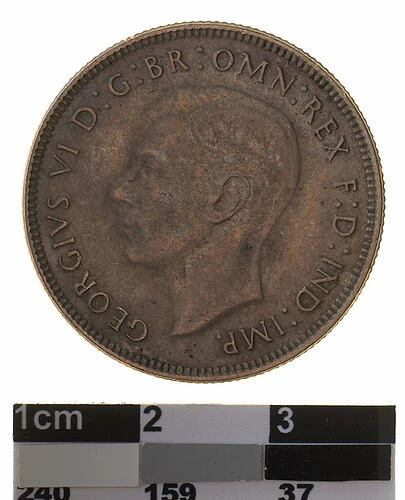
Photo credits and rights on the linked coin profile.
Australia • 92.5% silver; 7.5% alloy remainder
Issue years: 1910–1928, 1931–1936, 1938–1945
Fine silver: 0.336300 troy oz
Photographs can help identify your coin. An appraisal may consider authenticity, condition and collector demand as well as metal content.
Request a photo appraisal View current silver coin buying information
