
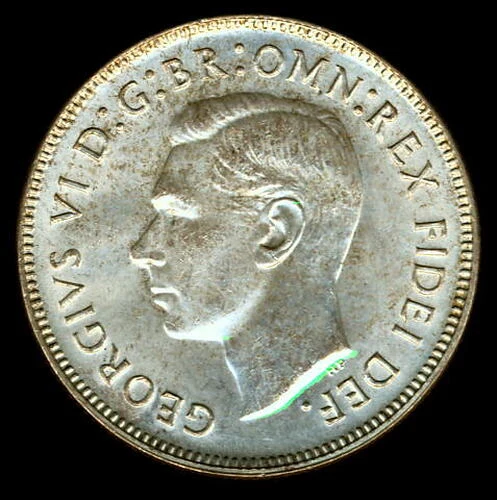
Australian Half-Silver Florin — 1946–1963 Issues
Photo credits and rights on the linked coin profile.
Australia • 50% silver; 50% alloy remainder
Issue years: 1946–1947, 1951–1954, 1956–1963
Fine silver: 0.181800 troy oz
Australia • Florin (2 shillings)
Australian sterling florins use .925 silver and 11.31 g nominal gross mass. The specified reference melt-table reference is .3363 fine silver troy ounce per matching coin. Confirmed issue dates are 1910–1928, 1931–1936 and 1938–1945, including a proof-only 1920 entry. A florin is two predecimal shillings. This group includes changing portraits, arms designs and commemoratives; the genuine photographs show a 1945 George VI Melbourne working strike.
When a fresh spot bid is available, melt values use fine-metal content × spot bid. CashForCoins guide buying offers use the separately configured percentage for each metal. Selected rare/numismatic coins require an appraisal. Dollar amounts remain unavailable when a fresh quote or buying percentage is missing.
Thirty-three listed dates across five sterling types, including proof-only 1920. The annual tables do not list 1929–1930 or 1937. Centenary KM33 bears the face date 1934–35; the reference labels its annual rows -1934, so no separate annual centenary designs are inferred. Patterns, experimental alloys and later .500 florins are excluded; actual mint, design and finish still require attribution.
Formula: specified fine-metal troy ounces × quantity. Dollar melt value additionally requires an approved current metal price.
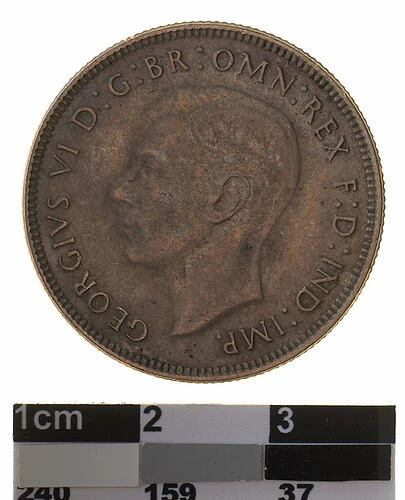
The photographed obverse has George VI’s bare head facing left. Its legend includes GEORGIVS VI, F D and IND IMP, with HP initials beneath the neck. The reference attributes this portrait to T. H. Paget. Earlier included coins differ: Edward VII faces right on KM21, while George V faces left on KM27 and the commemorative types. Check the actual portrait, legend and reverse together rather than using a monarch alone to infer alloy.
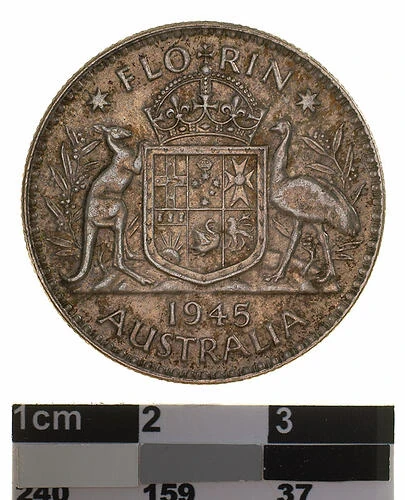
The illustrated reverse shows FLORIN, the date 1945 and AUSTRALIA around crowned arms, with a kangaroo to the left and an emu to the right. The reference identifies the later arms designer as George Kruger Gray. Earlier KM21/KM27 arms use the Blakemore design. The 1927 Canberra commemorative and the centenary’s rider holding a torch have distinct reverses. The scale below these genuine museum images belongs to the source photograph, not to another coin submitted for appraisal.
The dated references separate Edward VII, George V and George VI issues within the sterling standard. Canberra’s 1927 commemorative and the Victoria/Melbourne centenary have their own catalog types. Museums Victoria identifies the photographed 1945 florin as the final sterling year before the .500 standard begins in 1946. Its separate 1945 alloy-trial record demonstrates why a matching year and denomination alone cannot establish the circulating alloy.
Read AUSTRALIA, FLORIN and the actual date, then match the portrait and reverse to the appropriate dated type. Compare real measurements to the 11.31-g and 28.5-mm nominal references, keeping wear and individual variation separate from the published standard. A 1946–1947 florin can retain George VI and arms but belongs to the half-silver profile. A trial alloy, altered piece or unidentified replica must be withheld from the counted sterling lot until examined.
The selected melt-table amount is .3363 reference fine silver troy ounce per coin. Three matching sterling florins total 33.93 nominal gross grams and 1.0089 reference silver ounces. Nominal silver mass is 11.31 g × .925 = 10.46175 g per piece. The reference’s dated tables show .3364 ounce instead; those rounded source figures are explicitly distinguished, and this calculator consistently follows the specified melt reference. Gross grams are not pure-silver grams.
The thirty-three confirmed date entries span 1910–1928, 1931–1936 and 1938–1945. The reference lists 1920 only as a Star proof, not a regular issue. The five dated tables do not list issues in 1929–1930 or 1937. The centenary’s face date 1934–35 is a commemorative dual date, not evidence of two different annual designs. Mint codes, proofs and design attribution must be checked on the actual piece; parenthetical catalog codes are not assumed literal mint marks.
Crowned portrait faces right; the earlier arms reverse is attributed by the reference to W. H. J. Blakemore. Regular and proof rows are listed.
Crowned portrait faces left with the earlier arms. The reference lists 1920 only as a Star proof entry, so it is not a regular circulation date. London, H, M, Melbourne and Sydney table notations vary by actual issue.
A separate commemorative marks the opening of Parliament House. The reference lists regular and proof rows; it must be distinguished from the 1927 arms florin.
The reference renders its two annual rows as -1934 and -1934 Proof. Museums Victoria records the commemorative as 1934–1935 and describes the dual date on the coin. This does not establish separate single-date centenary designs.
Bare head faces left and the redesigned arms reverse is attributed to George Kruger Gray. Every year 1938–1945 is listed; 1942–1944 have S entries as well as Melbourne issues. The photographs show a 1945 Melbourne working strike.
Document the regular arms, Canberra and centenary designs separately even though this guide uses their common sterling reference. Proof attribution, mint mark, die details, condition and provenance can affect collectible significance independently of metal. The rare-finish entries in a reference table do not identify a customer coin as proof. Keep relevant certificates with the exact coin and avoid cleaning surfaces before appraisal. No current collector premium or grade is assigned by the museum illustration.
Provide clear photographs of both complete faces, the date and legend, and the actual edge. Record real weight and diameter independently of nominal specifications. The museum’s 1945 66%-silver trial has a deliberately different alloy and is excluded here; other unresolved patterns need their own attribution. Similar dimensions, a familiar monarch or a readable sterling-era date do not prove composition or authenticity. Do not include plated, altered, replica or uncertain pieces in a verified sterling count.
Sort sterling Australian florins apart from .500 florins, crowns, other denominations and foreign two-shilling coins. Count only identified matching pieces for this reference calculation. Preserve the existing appraisal workflow with both faces, finish and mint information, and measurements when available. Dollar melt pricing is currently unavailable, so no dollar estimate is invented. The calculated fine-metal reference is educational and does not establish a purchase offer or a coin’s collectible value.
The reference’s designated melt table reports .925 silver, 11.31 g nominal gross mass and .3363 reference ASW for Australian sterling florins. The five the reference dated-type tables instead display .3364 oz with the same mass and fineness. This calculator consistently uses the requested melt-table .3363 figure and does not silently substitute or average those rounded references. Dated types report 28.5 mm diameter and a reeded edge. Museums Victoria measures its 1945 working strike at 11.284 g and 28.5 mm; that individual measurement does not replace nominal mass. No thickness is verified. Patterns and later .500 florins are excluded. The five annual tables were read directly for the date union and proof distinctions. The museum centenary record resolves its visible dual date without inventing separate annual designs. A distinct museum alloy-trial record supports the pattern exclusion. Both image-specific reuse panels independently permit CC BY 4.0 and credit Naomi Andrzejeski / Museums Victoria. The original photographs were visually checked: media214828 shows the portrait; media214829 shows the 1945 arms reverse. WebP conversion retains the genuine scale, dimensions and design without upscaling.
The circulating sterling reference is .925 fineness, 11.31 g nominal mass and .3363 fine silver troy ounce in the designated reference melt table. The reference dated tables show .3364 ounce; this calculator consistently uses .3363. The separate 66%-silver trial is excluded.
No. The reviewed dated types list 1910–1928, 1931–1936 and 1938–1945. The 1920 entry is proof-only. They do not list issues for 1929–1930 or 1937. The centenary bears a 1934–35 commemorative dual date.
Keep their quantities separate. The sterling group uses .3363 reference silver ounce here; the .500 group uses .1818 ounce. A shared George VI portrait or similar size cannot establish the alloy, and patterns require separate identification.
Content maintained by CashForCoins. Last substantive record update: 2026-10-11. Report a specification or attribution issue through our contact page.
Photo credits and rights on the linked coin profile.
Australia • 50% silver; 50% alloy remainder
Issue years: 1946–1947, 1951–1954, 1956–1963
Fine silver: 0.181800 troy oz
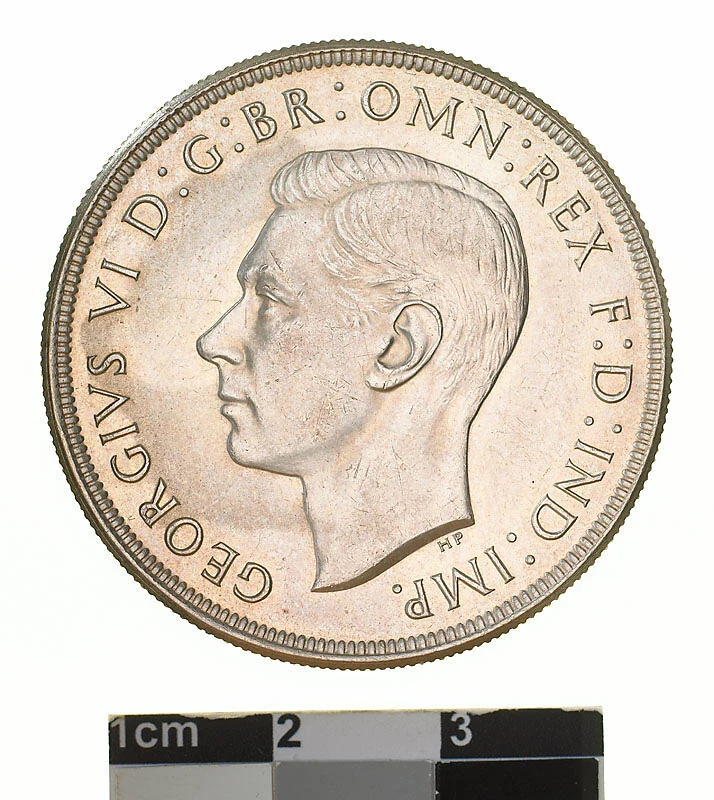
Photo credits and rights on the linked coin profile.
Australia • 92.5% silver; 7.5% alloy remainder
Issue years: 1937–1938
Fine silver: 0.841000 troy oz
Photographs can help identify your coin. An appraisal may consider authenticity, condition and collector demand as well as metal content.
Request a photo appraisal View current silver coin buying information
