


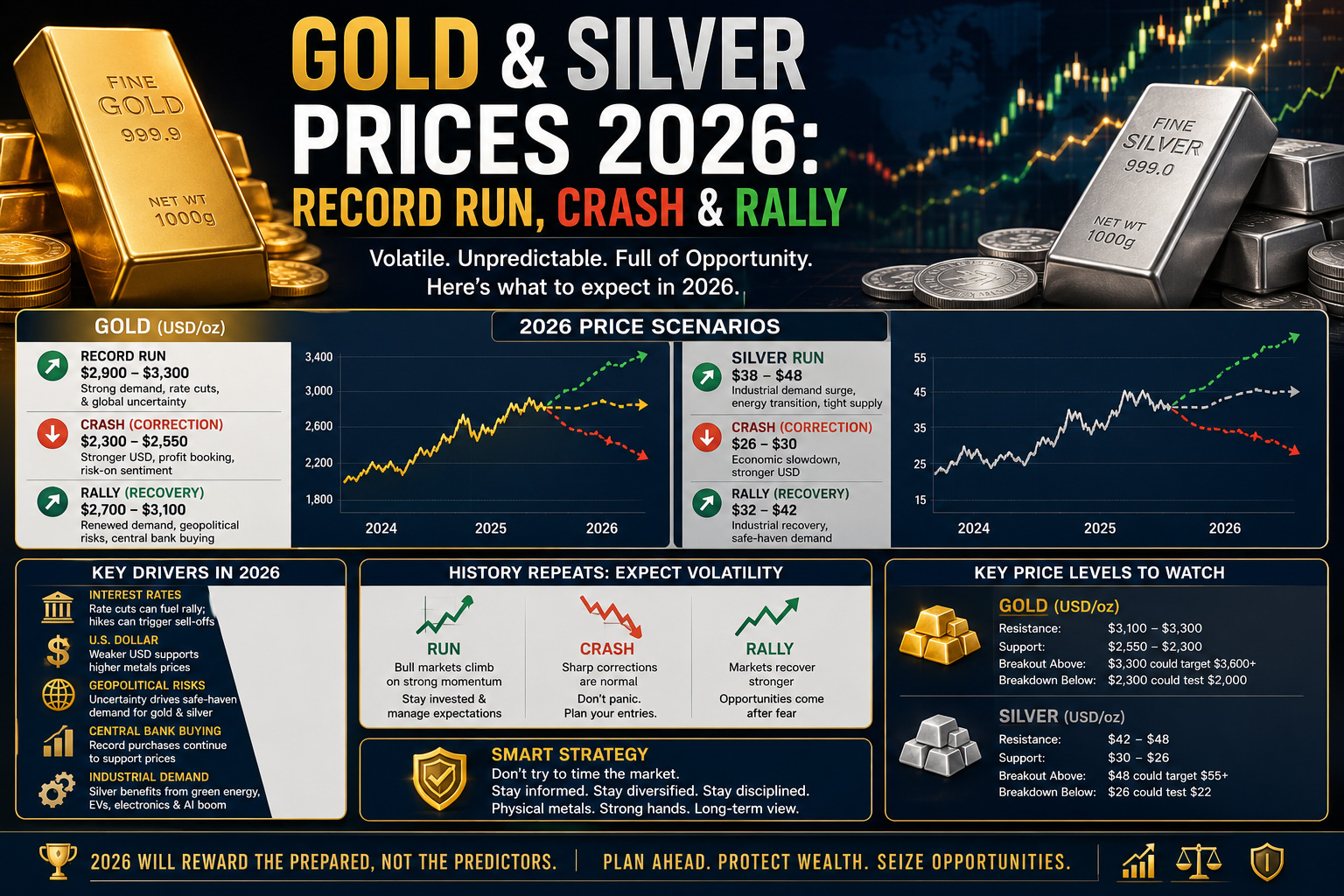
Gold and Silver’s Wild 2026 Ride: The Record Run, the Brutal Pullback—and Why Precious Metals Are Running Again
Author Tome Fierra
Updated August 10, 2026
Few periods in modern precious-metals history have delivered a ride quite like 2026.
Gold and silver entered the year with enormous momentum after an already remarkable 2025. Then the rally accelerated dramatically. Record highs seemed to arrive almost daily. Gold surged through $4,500, $5,000 and eventually $5,500 per ounce. Silver blasted through $90, then $100, and ultimately above $120 per ounce.
For a brief period, it appeared that precious metals had entered an almost unstoppable repricing cycle.
Then came the reversal.
Gold fell by nearly 30% from its January peak. Silver suffered an even more dramatic decline, losing roughly half of its value from its record high. Investors who had chased the rally suddenly discovered that even a powerful secular bull market can produce extraordinarily violent corrections.
Now the metals are moving again.
As of August 10, spot gold has climbed back to roughly $4,377 per ounce, its highest level in about nine weeks, while silver has recovered to approximately $65.50 per ounce. The comeback does not mean the January highs have been reclaimed—they have not—but it does raise an important question:
Was the first-half collapse the end of the precious-metals boom, or merely a massive correction inside a much larger structural bull market?
Understanding the answer requires looking at what actually happened during one of the most extraordinary commodity cycles in decades.
The Setup: Precious Metals Entered 2026 With Enormous Momentum
The 2026 story really began in 2025.
Gold had already experienced an extraordinary year, driven by geopolitical uncertainty, concerns about sovereign debt, continued central-bank accumulation, questions about the long-term purchasing power of major currencies, and increased investor interest in assets outside the traditional financial system.
Silver’s performance was even more explosive.
By January 2026, investors were no longer debating whether precious metals were in a bull market. The discussion had shifted to how far—and how quickly—the rally could go.
Gold and silver benefited from several forces working at the same time:
- Global geopolitical uncertainty
- Concerns surrounding government debt and fiscal deficits
- Central-bank diversification into gold
- Expectations surrounding Federal Reserve monetary policy
- Uncertainty regarding the future value of the U.S. dollar
- Strong Asian precious-metals demand
- Momentum and speculative investment
- Tightness in portions of the physical silver market
- Growing public awareness of precious metals as portfolio assets
Silver also benefited from something gold does not have to the same degree: substantial industrial demand.
Silver is not simply a monetary metal. It is widely used in electronics, electrical applications, automobiles, solar technology, data centers and emerging AI-related infrastructure. The Silver Institute expects many of these structural applications to continue supporting silver consumption even as high prices encourage manufacturers—particularly in solar—to reduce the amount of silver used in individual products.
The combination of monetary demand, physical investment demand, industrial consumption and speculative enthusiasm created an explosive environment.
And in January, it exploded.
January 2026: Gold and Silver Go Vertical
On January 13, silver reached a then-record price above $92 per ounce, while gold traded above $4,600. Only ten days later, silver broke the once-unimaginable $100-per-ounce barrier.
It did not stop there.
On January 26, silver reached approximately $117.69, while gold continued setting new records above $5,000.
Then came January 29.
Gold touched an extraordinary intraday record of $5,594.82 per ounce.
Silver reached an all-time high of approximately $121.64 per ounce.
Gold had risen about 24% in January alone before the reversal began.
These were not normal commodity-market moves.
The World Gold Council later described the first half of 2026 as one of the most dramatic starts to any year in gold-market history. Gold established 12 new all-time highs and realized volatility temporarily exceeded 50%, far above its 20-year historical average.
But markets rarely move vertically forever.
The very speed that attracted investors to gold and silver also created the conditions for a powerful correction.
The Turning Point: When Everyone Wanted Precious Metals
One of the greatest paradoxes in investing is that the strongest price increases often create the greatest short-term risk.
Once an asset becomes universally recognized as a winner, several things can happen.
Long-term investors continue buying—but momentum traders, leveraged speculators, options traders and short-term participants pile in as well.
That changes the character of the market.
Instead of prices being driven primarily by fundamental demand, they increasingly become driven by expectations that tomorrow’s price will be higher than today’s.
Silver was particularly vulnerable.
By late January, silver had risen more than 60% during 2026 alone after an enormous advance the previous year. Reuters reported increasingly aggressive forecasts while simultaneously warning that sharp corrections were becoming more likely.
Gold showed the first warning sign on January 29.
After touching $5,594.82, gold suddenly reversed and fell more than 5% from its intraday peak. Profit-taking had begun almost immediately.
That was the beginning of a much larger reset.
Why Gold and Silver Pulled Back So Hard
There was no single cause behind the correction. Several forces changed simultaneously.
- Interest-Rate Expectations Changed
Gold does not produce interest.
When Treasury yields and real interest rates rise, investors have a greater incentive to own yield-producing assets rather than non-yielding bullion.
During the first half of 2026, markets increasingly questioned whether monetary policy would become as accommodative as precious-metals investors had hoped.
Inflation remained a concern.
Higher energy prices complicated the picture.
And expectations grew that interest rates could remain elevated—or potentially rise.
By June, increasingly hawkish expectations surrounding the Federal Reserve were directly pressuring precious metals.
- The Dollar Strengthened
Gold and silver are globally traded commodities primarily priced in U.S. dollars.
A stronger dollar makes an ounce of gold or silver more expensive for buyers using euros, yen, yuan and other currencies.
That can reduce international demand at the margin.
The dollar’s strengthening became an important contributor to gold’s June decline below $4,000.
- Investors Took Profits
This should not be underestimated.
Imagine an investor who bought silver at $30, $40 or $50 watching it trade above $120.
At some point, enormous paper profits become real selling pressure.
The same applied to gold investors sitting on gains accumulated throughout 2024, 2025 and early 2026.
Long-term bullish fundamentals do not prevent investors from taking profits.
In fact, extraordinary profits frequently encourage them.
- Speculative Positions Unwound
Momentum works in both directions.
During a rapidly rising market, leveraged money can amplify gains.
When prices reverse, stop-losses, margin requirements, algorithmic trading and momentum strategies can amplify losses.
Silver is particularly susceptible because its market is considerably smaller than gold’s and because it combines investment demand with industrial-market sensitivity.
The result is historically greater volatility.
- Investment Flows Weakened
Gold ETF flows became an important part of the correction.
The World Gold Council reported approximately $8.9 billion of outflows from physically backed gold ETFs during June, with holdings declining by 74 tonnes during the month.
Reuters subsequently reported that gold ETFs experienced a roughly 45-tonne outflow during the second quarter and that central-bank demand during the first half was the weakest since 2022.
That did not eliminate the long-term central-bank story, but it removed part of the immediate buying pressure that had helped drive gold higher.
Gold Falls From $5,595 to Below $4,000
The correction eventually became severe.
On June 24, spot gold fell approximately 3.3% in a single session to $3,973.79 per ounce, its lowest price since November 2025.
From January’s $5,594.82 high, that represented a decline of approximately 29%.
In dollar terms, gold had surrendered more than $1,600 per ounce from its peak.
For an asset commonly perceived as stable, a nearly 30% decline in less than five months was dramatic.
But silver made gold’s correction look relatively modest.
Silver’s Collapse: From $121 to the High $50s
Silver’s decline demonstrated why seasoned precious-metals investors often describe silver as “gold on steroids.”
Silver reached approximately $121.64 on January 29.
By March, it had already fallen to roughly $60.94—almost exactly half of its record price.
The metal stabilized temporarily, but another bout of weakness took prices back below $60 during late June.
Around June 29, silver traded near $58.39, with an intraday range extending as low as approximately $56.10.
Measured from January’s $121.64 record to $58.39, silver had declined approximately 52%.
That is an extraordinary correction.
Yet the underlying physical silver market had not suddenly become oversupplied.
Quite the opposite.
The Silver Deficit Never Disappeared
One of the most important facts for long-term silver investors is that the price correction did not eliminate the structural supply deficit.
According to the Silver Institute’s World Silver Survey 2026, global silver demand is projected at roughly 1.11 billion ounces this year.
Mine production is expected to remain approximately flat, and the global silver market is projected to post a 46.3-million-ounce structural deficit.
That would continue a multiyear pattern of silver demand exceeding newly available supply.
That does not mean silver prices must rise every month.
Commodity prices can remain disconnected from long-term supply-and-demand fundamentals for surprisingly long periods.
But persistent deficits matter.
Inventories ultimately serve as the bridge between what the world consumes and what mines and recycling operations provide.
The Silver Institute also expects investment demand for silver bars and coins to strengthen in 2026, while industrial applications related to data centers, AI technologies and automobiles remain important structural demand sources.
There is an important counterweight.
At sufficiently high prices, manufacturers look for ways to use less silver.
Solar manufacturers have already been “thrifting”—reducing the amount of silver required per cell—and in some cases exploring substitution. High prices can also reduce jewelry and silverware demand.
Silver therefore lives in two worlds.
It is simultaneously:
A monetary and investment asset driven partly by inflation, currencies, interest rates and fear.
And:
An industrial commodity driven by manufacturing, technology, energy and economic growth.
That dual identity explains both its remarkable upside potential and its enormous volatility.
The Summer Reset
By late June, sentiment toward precious metals had changed dramatically.
In January, investors feared missing the rally.
Five months later, many feared buying at all.
That psychological reversal is typical of major corrections.
Yet beneath the falling prices, several long-term forces remained.
Central banks were still gold buyers.
Government debt had not disappeared.
Fiscal uncertainty had not disappeared.
Global geopolitical tensions had not disappeared.
Silver’s structural deficit had not disappeared.
Physical bullion had not stopped functioning as an alternative store of wealth.
And investor interest in precious metals had hardly vanished.
The World Gold Council’s July midyear analysis argued that gold’s decline toward $4,000 had brought the metal much closer to levels consistent with the prevailing macroeconomic environment. It identified renewed economic weakness, lower interest-rate expectations, geopolitical shocks and dip-buying as potential catalysts for another move higher.
By August, several of those catalysts began appearing.
August 2026: Gold and Silver Start Running Again
The renewed rally accelerated during the first full week of August.
On August 5, gold surged more than 4% in a single session, reaching approximately $4,253 per ounce. Falling Treasury yields and a weaker dollar helped trigger gold’s strongest daily advance since February. Silver simultaneously rose about 4.4% to roughly $62.11.
Then employment data provided another catalyst.
A weaker-than-expected U.S. labor report increased concerns about economic momentum and helped push investors back toward precious metals.
By August 10, spot gold had climbed to roughly $4,376.56 per ounce, its highest level since early June.
Silver rose approximately 3.1% that day to around $65.50 per ounce.
China supplied another bullish signal.
China’s central bank increased its gold reserves in July by the largest amount since October 2023, according to data cited by Reuters.
Just as importantly, market psychology changed.
The January rally had produced fear of missing out.
The June decline produced fear of further losses.
The August recovery is beginning to produce fear of missing out again.
That does not guarantee another trip to record highs.
But it shows how quickly precious-metals sentiment can reverse.
Is This the Beginning of the Next Leg Higher?
Possibly—but the answer depends on what happens next.
Gold remains more than 20% below its January spot-market record despite the recent rally.
Silver remains nearly 50% below its January high.
That means both metals have substantial distance to travel before the market can claim that the correction has been completely erased.
Several factors could support additional gains.
A weaker economy
Weak employment, slower growth or deterioration in financial conditions could increase demand for defensive assets and reduce expectations for restrictive monetary policy.
Falling bond yields
Lower yields reduce the opportunity cost associated with owning gold.
A weaker U.S. dollar
Dollar weakness tends to make precious metals more affordable internationally.
Renewed central-bank accumulation
Official-sector buying has become an increasingly important long-term component of the gold market.
Geopolitical instability
Gold has historically benefited when investors seek assets perceived as independent of governments, banking systems and individual currencies.
Continued silver supply deficits
Silver’s persistent structural deficits could become increasingly important if investment demand and industrial demand accelerate simultaneously.
But there are risks as well.
Higher inflation could force monetary authorities to remain restrictive.
A stronger dollar could pressure metals.
Higher Treasury yields could compete with gold.
A slowing global economy could weaken industrial silver consumption.
And another wave of speculative enthusiasm could push prices upward too quickly, creating the conditions for another major correction.
That is perhaps the greatest lesson of 2026:
A powerful bull market does not move in a straight line.
What the 2026 Market Means for People Who Already Own Gold or Silver
The price moves have created an unusual situation.
Many Americans own gold or silver that they acquired decades ago.
Others inherited coins from parents or grandparents.
Some own old U.S. silver coins without realizing how much metal value they contain.
Others bought American Gold Eagles, Silver Eagles, Morgan dollars, Peace dollars, gold bars or silver rounds years ago when metal prices were dramatically lower.
At today’s elevated precious-metals prices, collections that once seemed relatively modest can represent meaningful amounts of money.
But there is an important distinction between bullion value and numismatic value.
A common gold coin may trade primarily according to the value of the gold it contains.
A scarce date, rare mintmark, exceptionally high-grade coin or historically important piece may be worth substantially more than its melt value.
That is why owners should avoid simply assuming that every old coin should be valued by multiplying its metal content by today’s spot price.
Before selling, identify what you have.
Consider factors including:
- Metal content
- Weight and purity
- Date
- Mintmark
- Condition
- Rarity
- Professional grading
- Collector demand
- Current bullion value
- Dealer bid/ask spreads
Especially with inherited collections, rare coins should be evaluated before being treated merely as scrap metal.
Thinking About Selling Gold, Silver or Coins?
After the extraordinary rise in precious-metal values during 2025 and 2026, many owners are understandably wondering whether this is an opportunity to turn part of a long-held collection into cash.
There is no single “correct” time to sell.
Some people sell because prices are historically elevated.
Others rebalance their assets.
Some inherited a collection they have no interest in maintaining.
Others simply want liquidity.
Whatever the reason, understand what you own and what buyers are actually paying—not merely the headline spot price.
CashForCoins.net specializes in offers for gold coins, silver coins, bullion, rare coins and estate collections and allows sellers to submit photographs or coin lists for an estimate.
➜ Have Gold, Silver, Bullion or Coins to Sell?
Get an estimate from CashForCoins.net
For common-date gold and silver coins, market-based bids can also help sellers understand the relationship between spot metal prices and actual dealer purchase prices.
Looking to Buy Gold or Silver?
The correction also changed the calculation for buyers.
Someone purchasing silver around $60-$65 is entering at a dramatically different price than a buyer who chased silver above $100 in January.
Likewise, gold around the low-to-mid $4,000s is far below January’s nearly $5,600 spot-market record.
That does not automatically make either metal “cheap.”
Price and value are not the same thing.
Prospective buyers should understand:
- Spot price
- Dealer premiums
- Bid/ask spreads
- Sovereign coins versus private-mint products
- Gold versus silver allocation
- Bars versus coins
- Storage
- Liquidity
- Authentication
- Numismatic premiums
- Time horizon
For those researching physical ownership and the role of gold and silver as stores of value, BullionBankers.com provides precious-metals information, bullion education and resources for buyers.
➜ Interested in Buying Gold, Silver or Bullion?
Visit BullionBankers.com to research precious metals, bullion products and buying opportunities.
The Bigger Picture: 2026 May Be Remembered as a Repricing, Not Simply a Rally
One of the mistakes investors make is evaluating a market solely from its highest price.
Silver at $65 looks terrible compared with $121.
But viewed over a longer horizon, $65 silver remains historically extraordinary.
Gold at $4,300-plus looks disappointing compared with nearly $5,600.
Viewed against prices from only a few years earlier, it represents an entirely different valuation regime.
That distinction matters.
Markets occasionally undergo what can best be described as repricing events.
The asset does not merely rally and return to where it started. Instead, investors begin evaluating it within a fundamentally different range.
Whether gold and silver are undergoing such a long-term repricing remains to be seen.
But 2026 has provided compelling evidence that the market is wrestling with unusually powerful structural forces.
Government debt.
Currency uncertainty.
Central-bank reserve diversification.
Geopolitical conflict.
Changing interest-rate expectations.
Physical investment demand.
Asian demand.
Industrial silver consumption.
AI and data-center infrastructure.
Energy-transition technology.
And questions about what constitutes a reliable long-term store of wealth.
Those forces are unlikely to disappear simply because prices corrected.
Frequently Asked Questions About Gold and Silver in 2026
How high did gold go in 2026?
Spot gold reached an all-time intraday high of approximately $5,594.82 per ounce on January 29, 2026. U.S. February gold futures settled that day at $5,318.40.
How high did silver go in 2026?
Spot silver reached an all-time high of approximately $121.64 per ounce on January 29, 2026.
How far did gold fall from its record?
Gold fell to approximately $3,973.79 on June 24, representing a decline of roughly 29% from its January spot-market record.
How far did silver fall?
Silver declined from approximately $121.64 in January to the upper-$50s in late June, a correction of roughly 50% or more depending on the intraday price used.
Why did precious metals fall so sharply?
The pullback resulted from a combination of profit-taking, changing Federal Reserve expectations, higher interest-rate expectations, dollar strength, declining investment flows and the unwinding of speculative positions. Silver’s greater volatility and exposure to industrial demand magnified its decline.
Why are gold and silver rising again?
The August recovery has been supported by softer economic data, lower Treasury yields, movements in the dollar, renewed buying momentum, Chinese central-bank gold purchases and investor positioning ahead of inflation and Federal Reserve developments.
Is there still a silver shortage?
“Shortage” can be misleading because silver remains available for purchase. However, the broader market is experiencing a structural supply deficit, meaning total demand exceeds newly available supply. The Silver Institute expects a roughly 46.3-million-ounce deficit in 2026.
Is silver mainly an investment metal?
No. Silver is both a precious metal and an important industrial commodity. It is used in electronics, electrical equipment, automobiles, solar technology, data-center infrastructure and other applications. That dual role makes silver fundamentally different from gold.
Why does silver move more dramatically than gold?
Silver’s market is smaller, and demand comes from both investment and industrial users. That combination can produce larger percentage moves when investor sentiment, manufacturing expectations or speculative positioning changes rapidly.
Are old silver coins worth more now?
In many cases, higher silver prices significantly increase the intrinsic metal value of older U.S. silver coins. But collectible coins may also possess numismatic value beyond their silver content, so potentially rare coins should be evaluated individually.
Should I sell my gold or silver while prices are high?
That is a personal financial decision based on purchase price, liquidity needs, tax considerations, diversification and long-term objectives. Owners considering a sale should first determine exactly what they own and compare actual market bids.
Those looking to obtain an offer for gold, silver, bullion or collectible coins can request an estimate from CashForCoins.net.
Is now a good time to buy gold or silver?
No one can know the short-term direction of commodity prices. Gold and silver remain significantly below their January 2026 records but substantially above historical levels from earlier periods. Buyers should consider premiums, spreads, liquidity, diversification and their time horizon rather than making decisions based solely on short-term predictions.
Those interested in physical precious metals can visit BullionBankers.com for bullion education and buying resources.
Final Thoughts: The Precious-Metals Bull Market Just Gave Investors a Lesson in Volatility
The first eight months of 2026 have provided almost every lesson the precious-metals market can teach.
Gold demonstrated that even the world’s best-known safe-haven asset can lose nearly 30% from a record high.
Silver demonstrated that a metal with excellent long-term fundamentals can still lose half its market value during a correction.
January showed what happens when fundamental demand and speculative momentum combine.
The following months showed what happens when interest-rate expectations change, the dollar strengthens and leveraged enthusiasm reverses.
And August is now demonstrating how quickly the market can turn again.
Gold has recovered from below $4,000 to approximately $4,377.
Silver has rebounded from the upper-$50s into the mid-$60s.
Neither has returned to its January peak.
But neither market looks anything like it did only a few years ago.
The question for the remainder of 2026 is therefore not simply whether gold or silver rises tomorrow.
The larger question is whether the world is assigning a permanently higher value to scarce, tangible monetary assets in an era of expanding sovereign debt, geopolitical uncertainty, changing global reserve preferences and unprecedented demand for certain strategic metals.
If the answer is yes, the extraordinary events of 2026 may ultimately be remembered not as the end of a precious-metals boom—but as one volatile chapter in a much larger repricing of gold and silver.
Own Gold, Silver or Coins You May Want to Sell?
Record precious-metal prices can make previously overlooked coins, bullion and inherited collections considerably more valuable.
Visit CashForCoins.net to get an estimate for your gold, silver, bullion or coins.
Interested in Owning Physical Gold or Silver?
Learn more about bullion, precious-metal ownership and available buying opportunities.
Visit BullionBankers.com to explore gold and silver bullion.
Precious metals can be volatile, and past price performance does not guarantee future results. This article is provided for educational and informational purposes and should not be interpreted as individualized investment, tax or financial advice.