
.jpg)
.jpg)
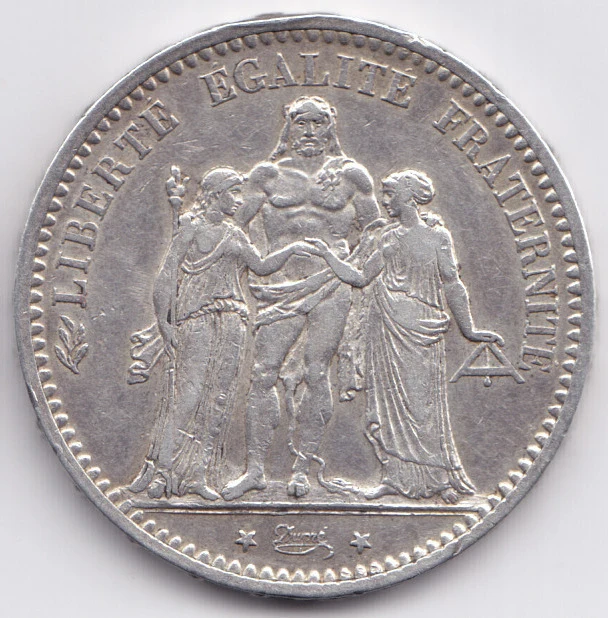
French Hercules Five Francs — Third Republic Silver
Photo credits and rights on the linked coin profile.
France • 90.000% silver; balance copper
Issue years: 1870–1878, 1889 (proof)
Fine silver: 0.723400 troy oz
France • 1 franc
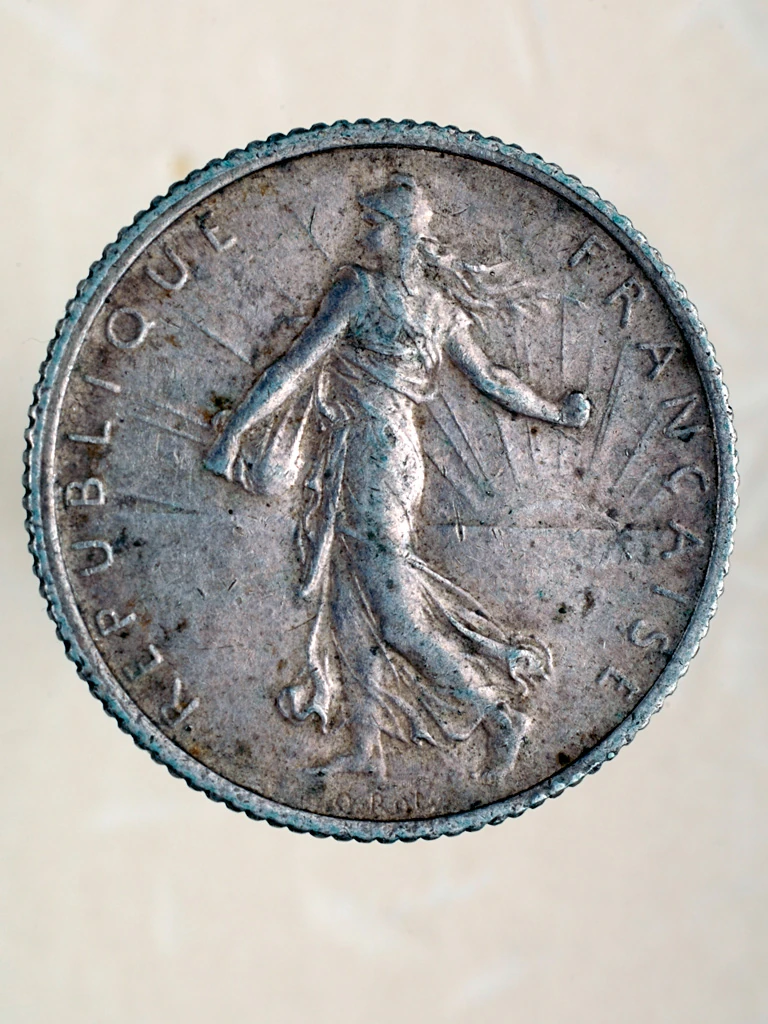
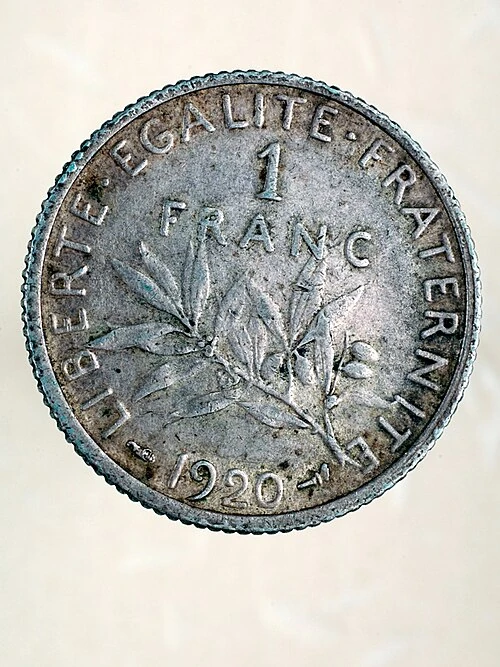
The supported French silver one-franc family has 5 g nominal gross mass, .835 fineness and .1342 reference fine silver troy ounce per matching coin. The reference confirms 33 distinct issue years across Cérès and Sower types: 1871–1873, 1878, 1881, 1887–1889, 1894–1895 and 1898–1920. Two Cérès dates are proof-only. Both genuine photographs show a 1920 Sower franc, with its complete denomination and date visible on the reverse.
When a fresh spot bid is available, melt values use fine-metal content × spot bid. CashForCoins guide buying offers use the separately configured percentage for each metal. Selected rare/numismatic coins require an appraisal. Dollar amounts remain unavailable when a fresh quote or buying percentage is missing.
Thirty-three confirmed years across Cérès KM822.1/KM822.2 and Sower KM844.1/KM844.2. Cérès 1878 and 1889 are proof-only; large/small A and K occur in 1871–1872. Sower includes matte proofs in 1898 and 1900 and separate 1914-C. Gaps are not filled from the broad envelope. Earlier francs, later base-metal coins, patterns and replicas are excluded.
Formula: specified fine-metal troy ounces × quantity. Dollar melt value additionally requires an approved current metal price.
The illustrated obverse shows the full-length Sower walking left and scattering seed, with RÉPUBLIQUE FRANÇAISE around the rim. Clothing, ground lines and the figure are visible even on the worn example. Earlier Cérès issues instead have a laureate head facing left. These are different designs at the supported same metal standard; the photographs do not illustrate a Cérès coin. Read the actual portrait, legend and reverse together before choosing a type.
The photographed reverse reads 1 FRANC above a leafy branch and 1920 below, with LIBERTÉ ÉGALITÉ FRATERNITÉ around the border. This separates the denomination from the face date clearly. The reference describes the earlier Cérès reverse as the denomination within a wreath. Check the complete date and any mint letter on the actual coin. Similar republican wording appears on other denominations and metals, so a motto alone cannot establish the one-franc silver standard.
The four supported the reference types organize this family into Cérès and Sower designs rather than a single continuously issued portrait. Cérès annual rows start in 1871 and include sparse later dates through 1895, with separate Paris and Bordeaux mint-letter tables. Sower annual rows begin in 1898 and continue through 1920, with a separate 1914-C type. This guide follows those dated records and excludes earlier French francs and later base-metal replacements, even when their denomination also reads one franc.
Read 1 FRANC, the whole face date, the portrait or sowing figure and any mint letter. Match the coin to a supported type and annual entry; the retained 1871–1920 URL range is only the broad family envelope. The reference gives 5 g nominal gross mass, 23 mm and a reeded edge for all four included types. Photograph the actual edge and record measured mass and diameter separately. Wear, colour and approximate dimensions do not prove silver purity or authenticity.
A matching coin contributes .1342 reference fine silver troy ounce. Three matching francs total .4026 reference ounce and 15 nominal gross grams. Nominal silver mass is 5 g × .835 = 4.175 g per coin. Gross mass includes the remaining alloy and is not pure silver weight. The reference rounds its published ASW to four decimal places; this calculator uses that supplied value consistently. Exclude unresolved, plated, replica or differently composed francs from the counted lot before applying the calculation.
The 33 confirmed annual dates are 1871, 1872, 1873, 1878, 1881, 1887, 1888, 1889, 1894, 1895 and every year from 1898 through 1920. The broad envelope must not fill gaps such as 1874–1877, 1879–1880, 1882–1886, 1890–1893 or 1896–1897. Proof-only 1878 and 1889 remain real dated issues but are not regular circulation entries. Large/small mint letters, matte proofs and the separate 1914-C require examination of the actual piece.
Actual annual dates are 1871, 1872, 1878, 1881, 1887, 1888, 1889, 1894 and 1895. The 1878 and 1889 rows are proof-only. Large A and small A varieties appear for 1871 and 1872. The portrait faces left; a wreath surrounds the reverse denomination.
All three dates are listed. Large K and small K varieties appear in 1871 and 1872; 1873 has its own row. A K-marked piece requires this attribution rather than the Paris A table. The same nominal .835 silver specification applies.
Every annual date in this interval has a regular row. The reference separately lists matte-proof rows in 1898 and 1900. The sowing figure replaces the Cérès head, with a leafy branch on the reverse. The paired 1920 photographs illustrate this design.
The separate type table lists only 1914-C. It has the same 5 g, .835 and .1342-ounce reference specification. Inspect the actual mint letter; an ordinary 1914 Sower is not automatically the C variety.
Record the date, Cérès or Sower design, mint letter and finish before considering collector value. A scarce mint-letter variety or a documented proof needs its own attribution; the normal worn 1920 illustration does not establish proof surfaces or a grade. Keep provenance, packaging and certificates with the relevant coin. Do not clean surfaces to make the design easier to see. Metal content is one reference characteristic, while a collectible assessment depends on the actual object and its condition.
Provide clear photographs of both whole faces and the actual edge, along with the visible date, legends and any mint letter. Preserve measured dimensions separately from the reference nominal specifications. Matching the Sower artwork and approximate mass does not establish an assay or authenticate a customer’s coin. Altered dates, plated pieces and unresolved objects should remain outside the counted lot pending examination. The licensed photographs are identification illustrations of a particular 1920 coin, not an authentication certificate for another collection.
Sort these .835 one-franc pieces away from two-franc and five-franc silver coins, gold francs, later base-metal francs and tokens. Count only coins matched to the supported type and actual issue-year list. The existing appraisal form can receive full-face photographs, dates, mint letters and available measurements. Live dollar pricing remains unavailable; the displayed ounces are reference metal content rather than an offer. Retain any collector documentation instead of treating every piece solely as scrap silver.
The reference’s designated world-silver melt reference and all four dated types agree on 5 g nominal gross mass, .835 fineness and .1342 reference fine silver troy ounce. The dated types give 23 mm and a reeded edge. Nominal silver mass is 4.175 g; conversion to troy ounces is more precise than the reference’s four-decimal ASW. This calculator retains the reference’s reported .1342 without claiming an individual assay. Thickness and the identity of the remaining alloy metals are not verified. Earlier franc types, later base-metal francs, patterns, tokens and replicas are outside this scope. The 33-year list was read from actual annual rows in KM822.1, KM822.2, KM844.1 and KM844.2. Proof-only and matte-proof descriptions are preserved instead of inferred from broad table headings. Philippe Giabbanelli’s separate 1920 face photographs are licensed CC BY-SA 3.0. The original obverse is 768 × 1024 pixels; the downloaded reverse preview is 500 × 667. Both are converted to WebP at their downloaded dimensions without upscaling or changing the coin design, and the same licence is retained for the conversions.
The reference reports .1342 fine silver troy ounce for the supported 5 g, .835 Sower franc. Three matching coins total .4026 reference ounce. This is a nominal reference calculation rather than an individual assay or current purchase offer.
No. The actual tables confirm 1871–1873, 1878, 1881, 1887–1889, 1894–1895 and 1898–1920. The Cérès dates 1878 and 1889 are proof-only. Broad date headings do not establish annual production.
The four supported the reference types share 5 g gross mass, .835 fineness and .1342 reference silver ounce. Their portraits, mint letters, dates and finishes differ. Other denominations and later base-metal francs require their own specifications.
Content maintained by CashForCoins. Last substantive record update: 2026-10-11. Report a specification or attribution issue through our contact page.
Photo credits and rights on the linked coin profile.
France • 90.000% silver; balance copper
Issue years: 1870–1878, 1889 (proof)
Fine silver: 0.723400 troy oz
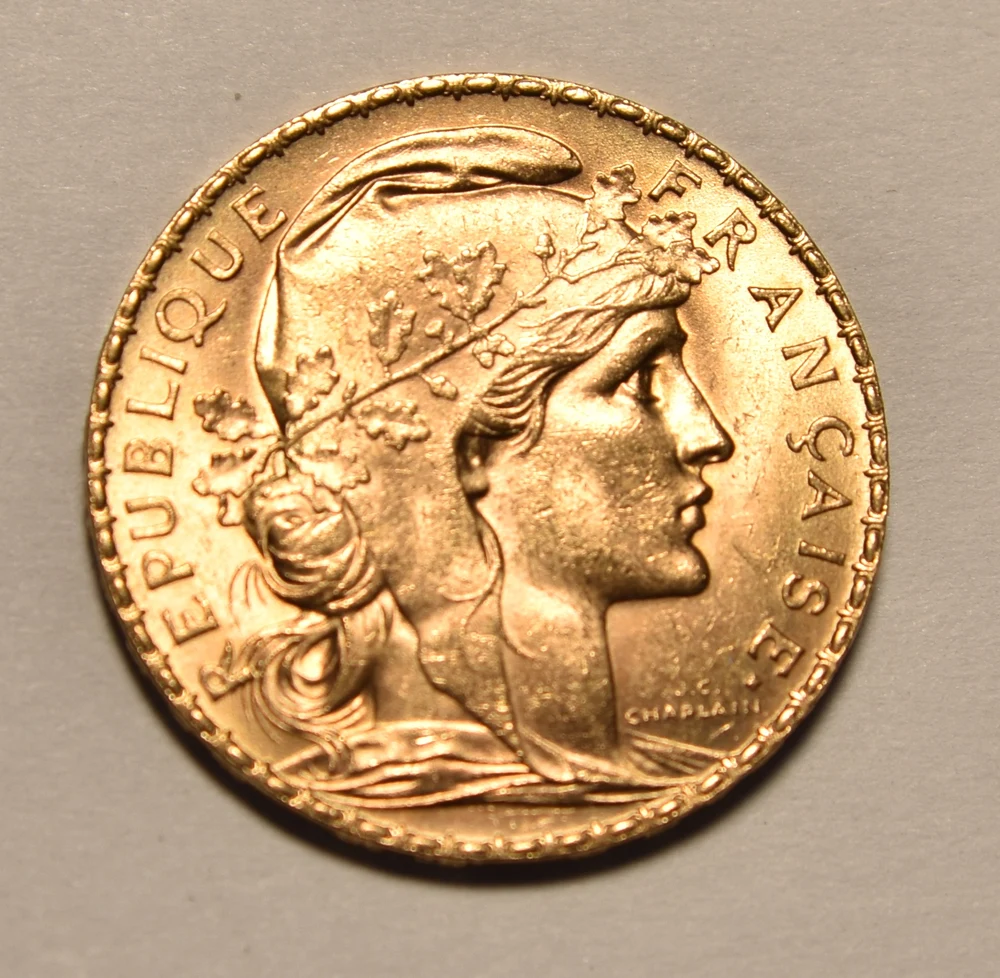
Photo credits and rights on the linked coin profile.
France • 90% gold; 10% alloy metal
Issue years: 1899–1914
Fine gold: 0.186682 troy oz
Photographs can help identify your coin. An appraisal may consider authenticity, condition and collector demand as well as metal content.
Request a photo appraisal View current silver coin buying information
