

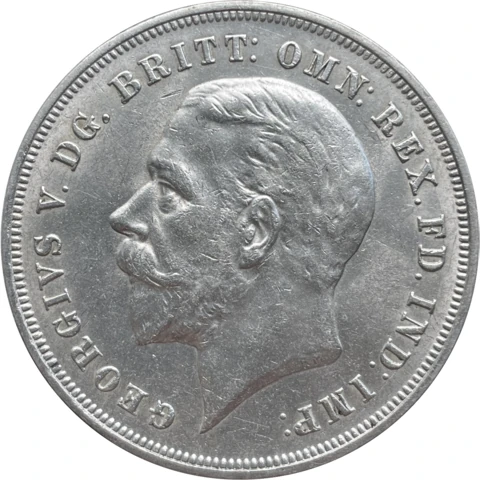
British Silver Crown — .500 Dated Types
Photo credits and rights on the linked coin profile.
United Kingdom • 50% silver; remaining alloy metals not independently verified
Issue years: 1927–1937
Fine silver: 0.454500 troy oz
United Kingdom • 1 crown (5 shillings)
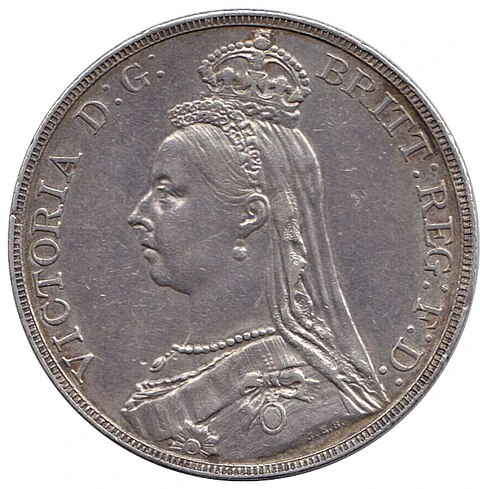
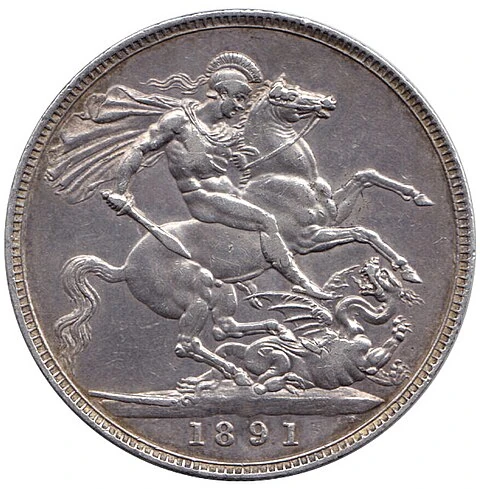
British sterling silver crowns in these ten inspected 1818–1902 types contain 0.8409 reference fine silver troy ounce, using the reference’s designated 28.2759 g / .925 standard. They have 27 specific issue years with substantial gaps, not continuous annual production. The genuine 1891 pair illustrates Victoria’s Jubilee portrait and St George reverse. Gothic, earlier royal and Edward VII crowns have different designs and finishes.
When a fresh spot bid is available, melt values use fine-metal content × spot bid. CashForCoins guide buying offers use the separately configured percentage for each metal. Selected rare/numismatic coins require an appraisal. Dollar amounts remain unavailable when a fresh quote or buying percentage is missing.
Twenty-seven specific annual years across ten ordinary/proof sterling types. Overdates and Roman edge years do not add issue years. Gothic only1847/1853, George IV1826 and William IV1831 proofs, young-head Victoria1839/1844/1845/1847, Jubilee1887–1892, mature draped1893–1900 and Edward VII1902 remain separate. Patterns, fantasy pieces and later .500 crowns excluded.
Formula: specified fine-metal troy ounces × quantity. Dollar melt value additionally requires an approved current metal price.
The genuine 1891 obverse, on the left in the source pair, shows Victoria facing left with a small crown, veil and jewellery. It matches the reference’s Jubilee KM765 description. George III faces right, George IV faces left, William IV faces right, and other Victorian types use young, Gothic or mature draped portraits. Edward VII faces right. Identify the portrait together with the complete opposite face; a royal head alone does not establish denomination, purity or date.
The photographed reverse shows St George on horseback slaying the dragon, with 1891 below. It represents KM765, not every included crown. Early George III crowns place this subject within their own legend; George IV also has a helmeted-arms proof design, William IV uses arms within a mantle, young-head Victoria uses crowned arms and Gothic crowns arrange separate crowned shields. Similar St George artwork also occurs on gold denominations and later crown alloys.
The included sequence crosses George III, George IV, William IV, Victoria and Edward VII. It includes isolated proof issues as well as multi-year types, so a broad 1818–1902 reference envelope does not establish a coin in every year. The 1847 young-head and Gothic designs overlap. The later Jubilee and veiled-head types form an annual 1887–1900 sequence. A separate 1902 Edward VII issue ends this inspected scope; later .500 crowns remain a different calculator.
Match both faces, the full issue date, portrait, reverse and edge with the correct dated type. Preserve overdates and Roman edge-year inscriptions rather than reducing them to an ordinary year. Source-supported diameters vary or are omitted, so this combined guide leaves the numeric diameter empty. Read each source before comparing a measured coin. An inscription, visual match or nominal mass does not authenticate a specimen or assay its alloy.
One matching sterling crown contributes 0.8409 reference fine silver troy ounce. Three contribute 2.5227 fine silver ounces and 84.8277 nominal gross grams. Nominal fine-metal mass follows gross mass × .925; the controlling the reference supplies rounded fine ounces. A .500 crown at similar gross mass has substantially less silver. Count only matching compositions; worn, plated, altered or unresolved specimens need separate assessment.
Specific source-supported family issue years: 1818–1822, 1826, 1831, 1839, 1844–1845, 1847, 1853, 1887–1900, 1902. The 27 annual dates preserve gaps and type-specific finishes.
Specific rows include 1818, 1819 and 1820, Roman regnal-edge variants, 1819/8 and 1820/19 overdates and a separately noted 1819 plain-edge entry. Overdates do not create additional issue years.
SECUNDO and TERTIO distinguish the recorded edge types. Both have proof entries; actual edge and finish attribution must accompany the issue date.
The inspected annual row is 1826 Proof with SEPTIMO on the edge. It has helmeted arms rather than the photographed St George reverse.
The specific annual row is 1831 Proof. Arms within a crowned mantle distinguish its reverse.
Specific dates are 1839, 1844, 1845 and 1847. The 1839 row is proof; 1844/1845 include separate proof entries. The broad span does not imply 1840–1843 or 1846 issues.
Only 1847 and 1853 occur. Proof/impaired-proof and plain/lettered edge entries remain separate. The source gives 38 mm, not the later 38.61 mm diameter.
All six annual dates are listed, with 1887 Proof separately labelled. The genuine 1891 photograph illustrates this small-crown-and-veil type only.
All eight issue years are listed. Roman regnal-year inscriptions produce multiple entries within a year; 1893 also has a proof. The recorded edge legend is DECVS ET TVTAMEN ANNO REGNI.
The 1902 annual rows include regular and matte-proof descriptions, including one duplicated proof label in the reference. The repeated label does not imply a new year or a separately authenticated finish.
Retain the date, portrait, reverse, edge and any proof attribution with each coin. The 1826 and 1831 inspected entries are proofs; Gothic entries include proof and impaired-proof descriptions, and 1902 includes matte proof. These labels cannot be established merely from a shiny photograph. Overdates, edge legends, condition and genuine finish may affect collector interest independently of metal content. Preserve surfaces and collection labels; do not clean a coin for comparison.
Provide complete photographs of both faces and the edge, including the full issue date and Roman inscriptions where present. Add actual measured mass and diameter when available. The licensed 1891 reference photograph illustrates a genuine design; it does not authenticate, grade, assay or establish the finish of a different specimen. Keep patterns, medals, fantasy pieces, replicas and unresolved alloys separate.
Sort these .925 crowns separately from the later .500 family, other denominations and uncertain pieces. Keep each coin’s date, edge, portrait and proof information with its photographs. The existing photo-appraisal link preserves the selected quantity for an enquiry; the reference silver amount is not a purchase offer. Live dollar pricing remains unavailable until an approved provider supplies it.
The reference’s designated melt table gives 28.2759 g / .925 / .8409 ASW. All ten inspected dated types give 28.2760 g / .9250 / .8409 ASW; the small gross-weight precision difference is disclosed without changing the reference ounces. Gothic KM744 gives 38 mm; Jubilee KM765, veiled-head KM783 and Edward VII KM803 give 38.61 mm; earlier tables omit diameter. No shared numeric diameter, uniform edge, thickness or balance-metal formula is inferred. Ten actual the reference annual tables and independent photographic permission were inspected on 2026-10-11. Only specific rows establish issue years; broad spans and X-number/pattern listings do not fill gaps. The source pair is split into whole-face WebP images without upscaling or invented artwork, retaining CC0 permission and visible attribution. Photographic metadata is not used to override the reference specifications. No prices, mintages or source articles are reproduced.
Content maintained by CashForCoins. Last substantive record update: 2026-10-11. Report a specification or attribution issue through our contact page.
Photo credits and rights on the linked coin profile.
United Kingdom • 50% silver; remaining alloy metals not independently verified
Issue years: 1927–1937
Fine silver: 0.454500 troy oz
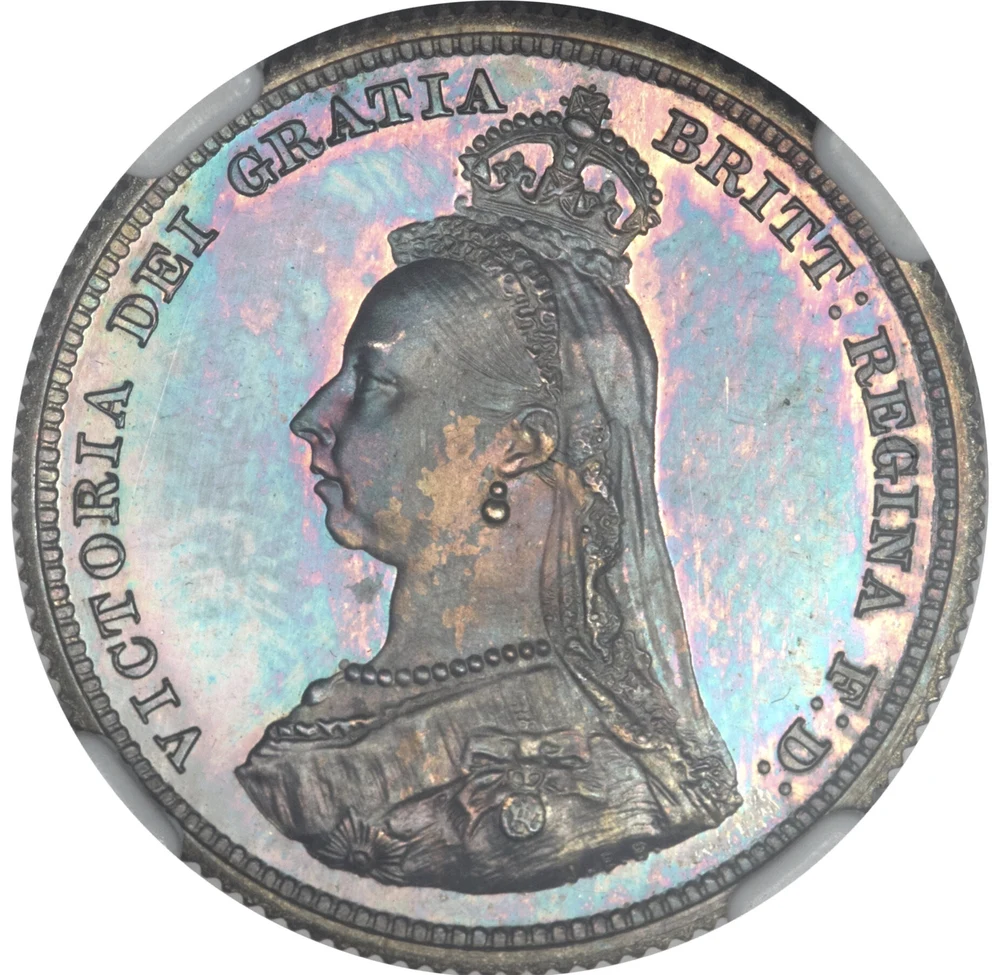
Photo credits and rights on the linked coin profile.
United Kingdom • 92.500% silver; balance copper
Issue years: 1816–1821, 1823–1827, 1829, 1831, 1834–1846, 1848–1919
Fine silver: 0.168200 troy oz
Photographs can help identify your coin. An appraisal may consider authenticity, condition and collector demand as well as metal content.
Request a photo appraisal View current silver coin buying information
