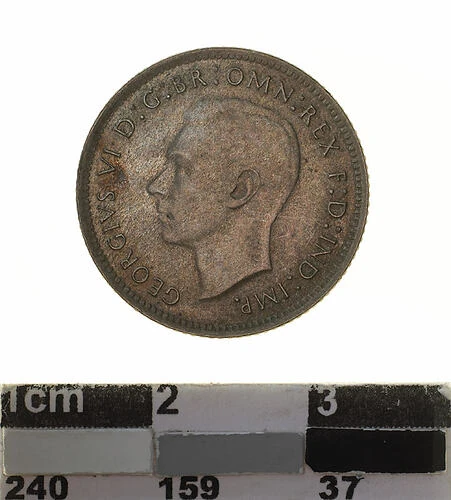
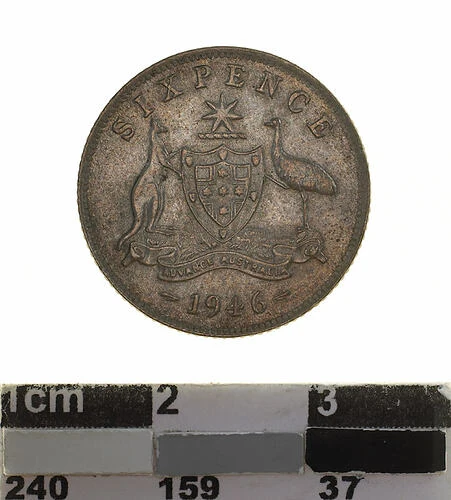
A matching Australian half-silver sixpence uses .0453 fine silver troy ounce and 2.82 gross grams in the designated reference melt reference. Included issue years are 1946, 1948 and 1950–1963. The paired photographs show a 1946 Melbourne example. Dated reference pages give 2.83 g/.0455 oz, while the 1947 statute specifies 2.82759 g. These differing presentations are explained below without treating them as separate physical coin standards.
Obverse — Genuine 1946 Melbourne half-silver sixpence; represents this dated specimen, not every included type. Photograph by Naomi Andrzejeski, Museums Victoria, CC BY 4.0. · Image source · CC BY 4.0Reverse — Genuine 1946 Melbourne half-silver sixpence; represents this dated specimen, not every included type. Photograph by Naomi Andrzejeski, Museums Victoria, CC BY 4.0. · Image source · CC BY 4.0
When a fresh spot bid is available, melt values use fine-metal content × spot bid. CashForCoins guide buying offers use the separately configured percentage for each metal. Selected rare/numismatic coins require an appraisal. Dollar amounts remain unavailable when a fresh quote or buying percentage is missing.
Verified coin specifications
Country
Australia
Face denomination
Sixpence
Composition
50% silver; remaining alloy metals not independently verified
Gross weight (grams)
2.82
Fineness
0.5
Fine-metal weight (troy oz)
0.0453
Edge
Reeded
Mint
Melbourne on the 1946 museum example; consult dated type
Mint mark
The reference (m); PL on listed 1951 issues
Restrikes
Patterns, replicas and later reproductions excluded
Actual source-reviewed issue years for this exact denomination, design and metal/weight scope. Overdates, mint combinations and proof availability remain type-specific; specimen photos and measurements do not certify other examples.
Source precision
Calculation deliberately retains the designated reference melt reference 2.82 g/.500/.0453 fine silver troy ounce. Dated KM 38a/45/52/58 report 2.83 g/.500/.0455 oz; the actual 1947 statute specifies 2.82759 g and millesimal fineness 500. These are disclosed reference/statutory presentations, not claims of separate physical weight standards. The statute commenced 8 July 1947 and does not independently establish the initial 1946 coin issue. No universal diameter or remaining alloy-metal ratio is assigned. All ASW values are reference amounts, not assays of individual worn coins.
Calculate this coin’s metal content
Formula: specified fine-metal troy ounces × quantity. Dollar melt value additionally requires an approved current metal price.
Obverse: identify the front
The photographed 1946 sixpence has George VI facing left, with IND:IMP in the surrounding legend. KM 38a and KM 45 belong to the George VI portion of the included series; the later type drops that wording. KM 52 and KM 58 show Elizabeth II facing right. The photograph represents one dated issue, so match the full legend and portrait of a later coin separately.
Reverse: identify the back
The photographed reverse shows the Australian arms, with the shield between a kangaroo and an emu, a Federation Star above and the ADVANCE AUSTRALIA ribbon below. SIXPENCE identifies the denomination and 1946 appears beneath the arms. Compare the complete reverse and rim; related arms designs on other Australian denominations do not establish the same metal content.
History and purpose
Museums Victoria identifies 1946 as the first year of 50% silver for the Australian sixpence. The Coinage Act 1947 separately formalizes a half-silver statutory schedule and records commencement on 8 July 1947. The date of that Act must not be substituted for the actual coin issue date. Earlier sterling sixpences require their own matching reference and remain separate from this half-silver guide.
How to identify this variant
Identify the sixpence denomination, actual date, portrait and full legend before using this reference. The reference dated entries show 19.5 mm for KM 38a/45/52 and 19.4 mm for KM 58; the 1946 museum specimen is measured at 19 mm. Those observations do not support one universal diameter. Wear affects measured mass, and a magnet or photograph cannot alone determine exact fineness or authenticity.
Understanding its metal content
The calculation uses the reference melt-table reference directly: 2.82 gross grams, .500 fineness and .0453 fine silver troy ounce per matching coin. Three matching coins contribute 8.46 reference gross grams and .1359 reference fine silver troy ounce. Gross alloy mass is not pure silver mass. The dated references instead list 2.83 g/.0455 oz; neither those values nor the statutory mass are silently substituted into this selected calculation.
Dates, varieties and composition changes
Actual included years are 1946, 1948, 1950, 1951, 1952, 1953, 1954, 1955, 1956, 1957, 1958, 1959, 1960, 1961, 1962, 1963. The inspected annual tables contain no 1947 or 1949 row. KM 38a includes a 1946 proof; KM 45 includes 1951 PL and its proof. KM 52 and KM 58 list dated proofs. Overlapping finishes are recorded in their exact dated types rather than counted as extra calendar years. Other patterns, replicas and undocumented special finishes need separate attribution.
Year, mint attribution, proof or circulation finish, condition and provenance can affect collector interest beyond the reference silver amount. A bright surface is not proof manufacture. Preserve any established certification and avoid polishing or cleaning; metal-value calculation does not establish grade, rarity or an offer.
Authenticity and condition
Supply complete photographs of both faces and the edge, with measured mass and diameter where available. The reference describes a matching type rather than certifying another specimen. Altered dates, plating, cast copies, uncertain finishes and unusual measurements require individual examination; source differences do not authenticate a coin.
Selling this coin
Keep earlier sterling sixpences and uncertain pieces separate from identified half-silver coins. Include the actual issue year, denomination, portrait, finish and complete photographs in a CashForCoins appraisal request. Quantity provides collection context; an offer depends on identification, condition and evaluation rather than reference metal alone.
Sources and calculation methodology
This guide gives priority to the designated reference World Silver melt reference for the calculation and shows the differing the reference dated presentation alongside it. The actual 1947 statutory schedule states 2.82759 g, half fine silver and half alloy, with a 1-in-125 weight allowance applying to tests of 1,000 pieces in bulk and a millesimal-fineness allowance of 5. This is not a per-coin assurance or a second manufacturing standard. The legal comparison comes from the original statutory schedule. Museums Victoria records this particular 1946 specimen at 2.815 g and 19 mm. Those measurements are separate from the reference inputs and statutory mass; they do not replace the calculation. The non-silver alloy components are not independently established.
Common questions
Which Australian half-silver sixpence years are included?The inspected dated references include 1946, 1948 and 1950–1963. The inspected tables contain no 1947 or 1949 row; finishes and mint attributions still require exact type identification.Why do the reference weights differ?The designated reference melt table gives 2.82 g/.0453 oz, its dated types give 2.83 g/.0455 oz and the 1947 statute specifies 2.82759 g. The calculation retains the designated reference and discloses the difference without claiming separate physical standards.Does melt value determine a buying offer?No. Reference metal content is one input. Actual identity, authenticity, finish, condition and collector demand require individual evaluation.
NGC: Australian sixpence KM 38a dated specifications and issue years — Actual annual years, design, proofs and differing 2.83 g/.500/.0455 oz/diameter presentation Identity and dates: the exact named dated type and its actual annual rows, with the separately disclosed weight/fineness/diameter presentation. (checked 2026-10-12)
NGC: Australian sixpence KM 45 dated specifications and issue years — Actual annual years, design, proofs and differing 2.83 g/.500/.0455 oz/diameter presentation Identity and dates: the exact named dated type and its actual annual rows, with the separately disclosed weight/fineness/diameter presentation. (checked 2026-10-12)
NGC: Australian sixpence KM 52 dated specifications and issue years — Actual annual years, design, proofs and differing 2.83 g/.500/.0455 oz/diameter presentation Identity and dates: the exact named dated type and its actual annual rows, with the separately disclosed weight/fineness/diameter presentation. (checked 2026-10-12)
NGC: Australian sixpence KM 58 dated specifications and issue years — Actual annual years, design, proofs and differing 2.83 g/.500/.0455 oz/diameter presentation Identity and dates: the exact named dated type and its actual annual rows, with the separately disclosed weight/fineness/diameter presentation. (checked 2026-10-12)
We use cookies to offer you a better browsing experience, analyze site traffic and personalize content. Read about how we use cookies and how you can control them in our Privacy Policy. If you continue to use this site, you consent to our use of cookies.