
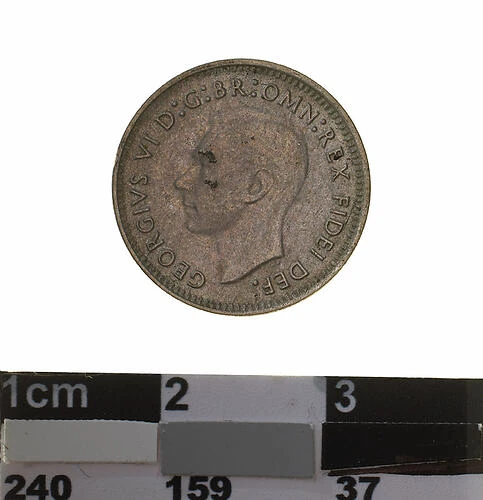
Australian Half-Silver Threepence — 1947–1964 Issues
Photo credits and rights on the linked coin profile.
Australia • 50% silver; 50% alloy remainder
Issue years: 1947–1964
Fine silver: 0.022700 troy oz
Australia • Shilling (12 pence)
Australian half-silver shillings have .500 fineness, 5.65 g nominal gross mass and .0908 reference fine silver troy ounce per matching coin. The confirmed issue years are 1946, 1948, 1950 and 1952–1963: fifteen dates across four portrait and legend types. A shilling is twelve predecimal pennies. Both genuine photographs show a 1952 Melbourne George VI working strike with the ram reverse. Earlier sterling shillings have a different silver calculation.
When a fresh spot bid is available, melt values use fine-metal content × spot bid. CashForCoins guide buying offers use the separately configured percentage for each metal. Selected rare/numismatic coins require an appraisal. Dollar amounts remain unavailable when a fresh quote or buying percentage is missing.
Fifteen confirmed dates across four .500 silver types; 1947, 1949 and 1951 are not annual issues in these tables. Melbourne and Perth are both listed in 1946. IND IMP is dropped on KM46; Elizabeth II begins in 1953 and adds F D in 1955. Later proof entries require actual finish attribution. Earlier sterling, patterns, tokens and replicas are excluded.
Formula: specified fine-metal troy ounces × quantity. Dollar melt value additionally requires an approved current metal price.
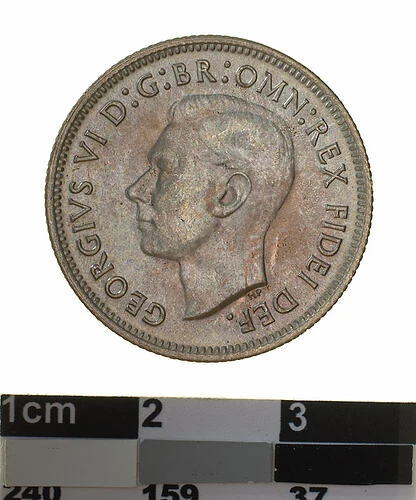
George VI’s bare head faces left in the illustrated 1952 coin, with HP beneath the neck and a surrounding legend ending FIDEI DEF. The legend has no IND IMP, matching the KM46 type. The reference credits T. H. Paget for this portrait. Elizabeth II types from 1953 have Mary Gillick’s laureate bust facing right; the KM59 legend adds F D from 1955. Inspect the actual legend and portrait rather than identifying alloy from a monarch alone.
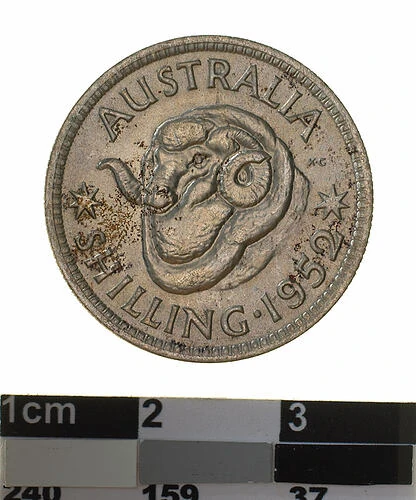
The photographed reverse has a ram’s head turned three-quarters left, with AUSTRALIA above and SHILLING 1952 around the lower rim between stars. KG appears in the field beside the head. The reference attributes the design to George Kruger Gray. Read the complete date and denomination, and compare the actual edge and portrait. A ram reverse also appears on earlier sterling issues, so the animal design by itself does not set silver purity.
The reference separates the .500 silver shilling standard beginning in 1946 from earlier sterling issues. Its classification article describes a four-metal alloy: 50% silver, 40% copper, 5% nickel and 5% zinc. The half-silver family spans George VI and Elizabeth II, including the later legend changes. Its final supported annual date is 1963. Museums Victoria records the pictured 1952 coin as Melbourne working strike NU 5965, with its individual dimensions listed separately from the nominal standard.
Confirm AUSTRALIA, SHILLING and an actual supported year, then match the portrait and legend. The sourced nominal standard is 5.65 g, 24 mm and a reeded edge. Record observed mass and diameter separately and photograph the edge. Distinguish earlier sterling ram shillings, British shillings and non-silver tokens. A date gap must not be filled from the broad family heading, and similar size or colour cannot establish the alloy or authenticity.
One matching half-silver shilling contributes .0908 reference fine silver troy ounce. Three matching coins total .2724 reference ounce and 16.95 nominal gross grams. Nominal silver mass is 5.65 g × .500 = 2.825 g per coin. Use the reference’s reported ASW consistently, rather than treating gross weight as pure silver. Split earlier sterling pieces and unresolved objects into separate groups before counting. The calculation is reference metal content, not a current dollar valuation or purchase offer.
Confirmed annual dates are 1946, 1948, 1950, 1952, 1953, 1954, 1955, 1956, 1957, 1958, 1959, 1960, 1961, 1962 and 1963. The four dated tables do not list 1947, 1949 or 1951 in these supported types. The reference’s parenthetical (m) and (p) codes attribute Melbourne and Perth; do not assume those exact strings appear on the coin. Both mints are listed in 1946. Later tables distinguish proof entries from regular issues, and a proof row does not turn an ordinary working strike into a proof.
Left-facing Paget portrait and ram reverse. The annual table lists Melbourne and Perth in 1946, and Melbourne in 1948; it does not list 1947.
IND IMP disappears from the legend. The table confirms these two Melbourne dates; the 1950–1952 heading does not establish a 1951 issue.
Mary Gillick’s laureate right-facing portrait with the continuing ram reverse. Both annual dates have regular and proof entries.
F D is added to the legend. All nine annual dates have regular and proof entries; finish still requires examination of the actual coin.
Document the actual date, mint attribution, portrait, legend and finish before considering collector value. The 1946 Melbourne and Perth issues need separate attribution, and later proof entries require support from the coin itself. Preserve packaging, certificates and provenance with the appropriate piece. Avoid cleaning surfaces. The museum photographs show a working strike and provide identification evidence; they do not establish a grade or a market price for another coin.
Supply clear photographs of both whole faces, the date, legends and actual edge. Keep measured mass and diameter separate from nominal figures. A convincing ram design and approximate size do not prove authenticity or silver content. Leave plated, altered, replica or unresolved pieces out of the counted lot pending examination. These licensed photographs illustrate a genuine museum object, not an assay result or an authentication certificate for a customer’s collection.
Sort half-silver Australian shillings away from earlier sterling shillings, florins, smaller denominations, foreign shillings and tokens. Count only pieces identified to this supported .500 family. Use the existing appraisal form with full faces, date, any mint attribution and real measurements when available. Live dollar pricing remains unavailable. Reference silver content and collectible value are different considerations; no offer or payment amount is implied by this guide.
The reference’s designated melt reference and four dated types agree on 5.65 g nominal gross mass, .500 fineness and .0908 reference fine silver troy ounce. The dated types give 24 mm diameter and reeded edge. Museums Victoria measures the illustrated NU 5965 working strike at 5.675 g and 23.5 mm, describing a milled edge; those individual measurements do not replace nominal specifications. The reference’s classification article describes the alloy as 50% silver, 40% copper, 5% nickel and 5% zinc. No thickness is verified. Rounded ASW is a reference, not an individual assay. Earlier sterling shillings, patterns and tokens are excluded. The fifteen dates were read from actual annual rows across all four the reference types, rather than inferred from their broad headings. The alloy ratios use the reference’s classification article. Both individual museum reuse panels permit CC BY 4.0 and credit Naomi Andrzejeski. Media 215581 shows the left-facing portrait and 215582 the ram with 1952. Original images, rights observations and file hashes are retained. WebP conversion preserves the original 416 × 500 pixels and photographic scale without upscaling or design alteration.
The reference’s supported .500 silver types report .0908 fine silver troy ounce and 5.65 g nominal gross mass per coin. Three matching shillings total .2724 reference silver ounce. Identify the actual coin before applying these values.
No. The four the reference dated types confirm 1946, 1948, 1950 and 1952–1963. They do not list 1947, 1949 or 1951 in this scope. The broad 1946–1963 family range is not continuous production.
No. The ram reverse also appears on earlier sterling Australian shillings. Check the date, portrait, legend and actual composition together. This calculator applies only to identified .500 issues in the supported date list.
Content maintained by CashForCoins. Last substantive record update: 2026-10-11. Report a specification or attribution issue through our contact page.
Photo credits and rights on the linked coin profile.
Australia • 50% silver; 50% alloy remainder
Issue years: 1947–1964
Fine silver: 0.022700 troy oz
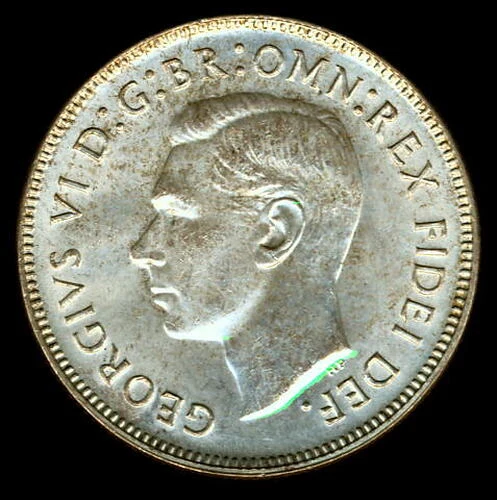
Photo credits and rights on the linked coin profile.
Australia • 50% silver; 50% alloy remainder
Issue years: 1946–1947, 1951–1954, 1956–1963
Fine silver: 0.181800 troy oz
Photographs can help identify your coin. An appraisal may consider authenticity, condition and collector demand as well as metal content.
Request a photo appraisal View current silver coin buying information
