Matching early Seated Liberty dimes use the reference of 2.67 gross grams, 90% silver and .0773 fine silver troy ounce. This guide covers observed dated types from 1837 through 1852 and the 1853 Philadelphia No Arrows issue. An 1853 Arrows dime belongs to the reduced-weight group.
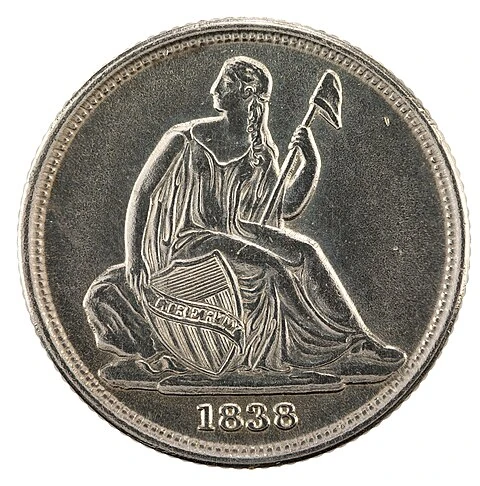
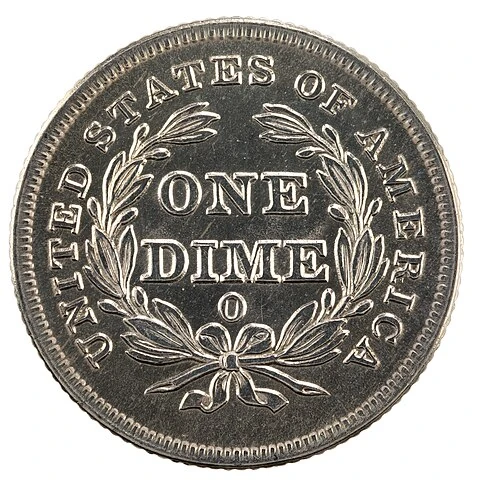
Obverse — Genuine1838 representative of the specifically matched dime design; other dates, mints and transition types require attribution. Photograph by Jaclyn Nash, National Numismatic Collection, National Museum of American History; PD-US-SI and VRT2013030510011547. · Image source · PD-US-SI; file-specific VRT photographic permissionReverse — Genuine1838 representative of the specifically matched dime design; other dates, mints and transition types require attribution. Photograph by Jaclyn Nash, National Numismatic Collection, National Museum of American History; PD-US-SI and VRT2013030510011547. · Image source · PD-US-SI; file-specific VRT photographic permission
When a fresh spot bid is available, melt values use fine-metal content × spot bid. CashForCoins guide buying offers use the separately configured percentage for each metal. Selected rare/numismatic coins require an appraisal. Dollar amounts remain unavailable when a fresh quote or buying percentage is missing.
Verified coin specifications
Country
United States
Face denomination
10 U.S. cents
Composition
90% silver, 10% copper
Gross weight (grams)
2.67
Fineness
0.9
Fine-metal weight (troy oz)
0.0773
Diameter (mm)
17.9
Edge
Reeded
Mint
United States Mint; exact branch depends on dated type
Mint mark
No mark or O; match dated type
Restrikes
Patterns, replicas and unverified specialist exceptions excluded
Issue years
1837–1852; 1853 Philadelphia No Arrows
Actual source-reviewed issue years for this exact denomination, design and metal/weight scope. Overdates, mint combinations and proof availability remain type-specific; specimen photos and measurements do not certify other examples. 1837–1852 and1853 PhiladelphiaNoArrows only;1853 Arrows belongs to the reduced standard.
Source precision
This calculation retains the reference’s reported .0773 fine silver troy ounce directly. Its 2.67 g presentation is not the full-precision statutory nominal mass; multiplying rounded fields cannot restore omitted precision. The legal comparison explains reference rounding without claiming another alloy or manufacturing standard. Annual coverage is limited to observed KM 61, 63.1 and 63.2 types; patterns, replicas and unverified specialist exceptions are excluded.
Calculate this coin’s metal content
Formula: specified fine-metal troy ounces × quantity. Dollar melt value additionally requires an approved current metal price.
Obverse: identify the front
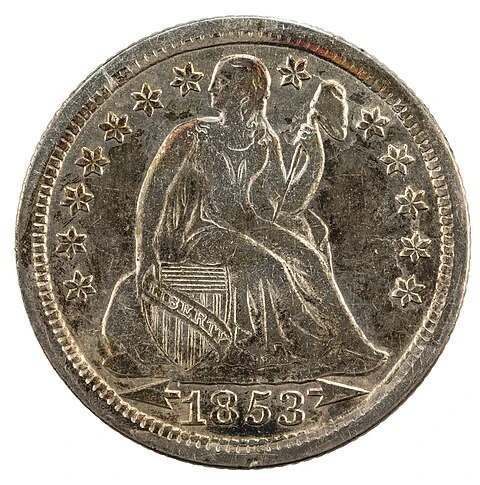
Liberty is seated beside a shield with a pole and cap. The earliest No Stars form is distinct from the later Stars designs. Added drapery at Liberty's elbow is another design distinction within this heavier period. Match the date, stars and drapery to the exact dated type.
Reverse: identify the back
ONE DIME appears inside a wreath, with UNITED STATES OF AMERICA around the reverse. No Stars and Stars obverses can share this denomination layout. The mint mark and the complete wreath matter for identification; a related half dime is a different denomination.
History and purpose
The January 18, 1837 Mint Act specifies a 41.25-grain dime and a .900 silver alloy. This corresponds to 2.6729550375 nominal grams and .07734375 fine silver troy ounce. The reference presents the dated reference with rounded gross mass and ASW. The reduced-weight legislation of 1853 marks a later change rather than a change in the denomination.
How to identify this variant
Read the denomination and actual date first. A No Stars 1837 or 1838-O differs from a Stars coin of the same broad period. In 1853, inspect for arrows beside the date before choosing the weight reference. The listed 1853 scope is Philadelphia No Arrows; other alleged transition pieces need exact attribution.
Understanding its metal content
The selected reference is 2.67 gross grams, .900 fineness and 0.0773 fine silver troy ounce per matching dime. Three matching coins contribute 8.01 reference gross grams and 0.2319 reference fine silver troy ounce. Gross alloy weight includes copper; use fine silver weight for a silver spot-price calculation. A spot quote is per troy ounce, and a reference melt estimate is not a collector valuation or buying offer.
Dates, varieties and composition changes
Included calendar years are 1837, 1838, 1839, 1840, 1841, 1842, 1843, 1844, 1845, 1846, 1847, 1848, 1849, 1850, 1851, 1852 and 1853. The 1853 inclusion is conditional on Philadelphia No Arrows. KM 63.1 has an 1838–1840 URL span, but the inspected annual rows show 1838–1839; the 1840 addition is separately supported by KM 63.2. Date styles, star sizes, added drapery and listed overdates are design or die distinctions, not additional calendar years.
Dated type
Observed years
Identification scope
The reference
KM 61
1837, 1838
1837 Philadelphia No Stars; 1838-O No Stars
2.6700 g / .900 / 0.0773 fine silver troy oz
KM 63.1
1838, 1839
Observed 1838–1839 Stars entries; 1840 scope is not inferred from the URL span
Observed added-drapery rows; 1853 is Philadelphia No Arrows only
2.6700 g / .900 / 0.0773 fine silver troy oz
Melt value versus collector value
A metal estimate is a reference for silver content, not a collector valuation. Date, mint, condition, original surfaces, finish and attribution can matter more than the silver amount. Keep certification labels and provenance with the coin and avoid cleaning or polishing before an appraisal.
Authenticity and condition
Compare complete photographs of both faces and the edge, the readable date and mint mark, and measured mass and diameter. Wear and damage change a specimen's measured weight. A matching photograph or a single scale reading cannot certify authenticity; uncertain dates, altered markings and unusual surfaces need individual examination.
Selling this coin
Separate identified weight families before counting a group of Seated Liberty dimes. Keep uncertain pieces aside and describe their dates, mint marks, arrows and finish in a CashForCoins appraisal request. Supply both faces rather than a photograph of a pile. The reference calculation does not establish a buying offer.
Sources and calculation methodology
This calculation retains the reference’s reported .0773 fine silver troy ounce directly. Its 2.67 g presentation is not the full-precision statutory nominal mass; multiplying rounded fields cannot restore omitted precision. The legal comparison explains reference rounding without claiming another alloy or manufacturing standard. Annual coverage is limited to observed KM 61, 63.1 and 63.2 types; patterns, replicas and unverified specialist exceptions are excluded.
Common questions
Does every 1853 Seated Liberty dime use the heavy reference?No. This reference includes only the observed Philadelphia No Arrows type for 1853. Arrows dimes use the reduced reference; identify the exact dated type before calculation.Does a silver-content estimate establish a buying offer?No. It gives a metal reference for an identified type. Authentication, condition, finish and collector demand require individual evaluation.Should a worn dime weigh exactly the reference amount?No. The nominal reference is separate from an actual worn specimen. Record measured mass, readable date and complete photographs; do not authenticate or select a weight family from a scale reading alone.
References
NGC: KM 61 Seated Liberty dime dated table — Observed annual rows, design and gross/fineness/ASW reference; no prices reproduced Identity and dates: KM 61 actual observed rows; weight 2.6700 g and fineness 0.9000. Diameter 17.9 mm is explicitly reported. (checked 2026-10-12)
NGC: KM 63.1 Seated Liberty dime dated table — Observed annual rows, design and gross/fineness/ASW reference; no prices reproduced Identity and dates: KM 63.1 actual observed rows; weight 2.6700 g and fineness 0.9000. Diameter 17.9 mm is explicitly reported. (checked 2026-10-12)
NGC: KM 63.2 Seated Liberty dime dated table — Observed annual rows, design and gross/fineness/ASW reference; no prices reproduced Identity and dates: KM 63.2 actual observed rows; weight 2.6700 g and fineness 0.9000. Diameter 17.9 mm is explicitly reported. (checked 2026-10-12)
We use cookies to offer you a better browsing experience, analyze site traffic and personalize content. Read about how we use cookies and how you can control them in our Privacy Policy. If you continue to use this site, you consent to our use of cookies.



.jpg)