Draped Bust Small Eagle dimes are the regular United States ten-cent coins dated 1796 and 1797. The reference’s nominal reference is 2.7 g gross, .892 silver fineness and .0774 fine troy ounce. The small eagle reverse distinguishes this two-year design from the later Heraldic Eagle dime. Identify the denomination and design before using a silver total; collector value can be much greater than a metal estimate.
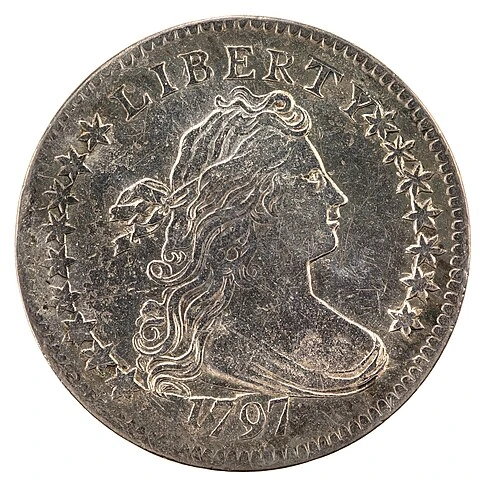
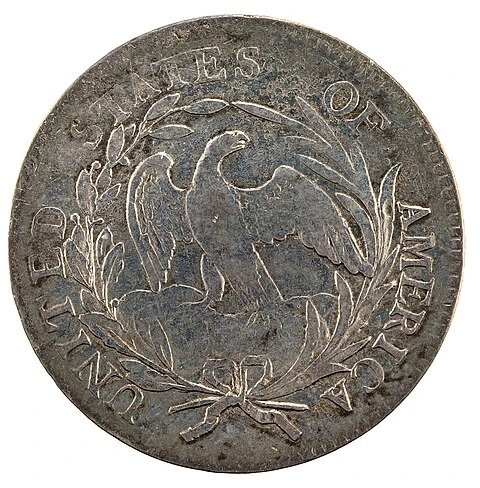
Obverse — Genuine1797 representative of the specifically matched dime design; other dates, mints and transition types require attribution. Photograph by Jaclyn Nash, National Numismatic Collection, National Museum of American History; PD-US-SI and VRT2013030510011547. · Image source · PD-US-SI; file-specific VRT photographic permissionReverse — Genuine1797 representative of the specifically matched dime design; other dates, mints and transition types require attribution. Photograph by Jaclyn Nash, National Numismatic Collection, National Museum of American History; PD-US-SI and VRT2013030510011547. · Image source · PD-US-SI; file-specific VRT photographic permission
When a fresh spot bid is available, melt values use fine-metal content × spot bid. CashForCoins guide buying offers use the separately configured percentage for each metal. Selected rare/numismatic coins require an appraisal. Dollar amounts remain unavailable when a fresh quote or buying percentage is missing.
Verified coin specifications
Country
United States
Face denomination
10 U.S. cents
Composition
.892 silver fineness as displayed by the reference; original statutory copper-alloy ratio is recorded separately
Actual source-reviewed issue years for this exact denomination, design and metal/weight scope. Overdates, mint combinations and proof availability remain type-specific; specimen photos and measurements do not certify other examples.
Source precision
The designated reference U.S. silver melt table has no row for this early dime type. The supplementary dated reference 1796 Small Eagle reference supplies 2.7 g gross, .892 fineness and .0774 oz ASW at its printed precision, plus 19 mm diameter. Preserve that reference convention separately from exact statutory provenance: 41.6 grains gross, 37.125 grains fine and 1485/1664 silver. None of these quantities is an assay or a measured mass of the photographed specimen.
Calculate this coin’s metal content
Formula: specified fine-metal troy ounces × quantity. Dollar melt value additionally requires an approved current metal price.
Obverse: identify the front
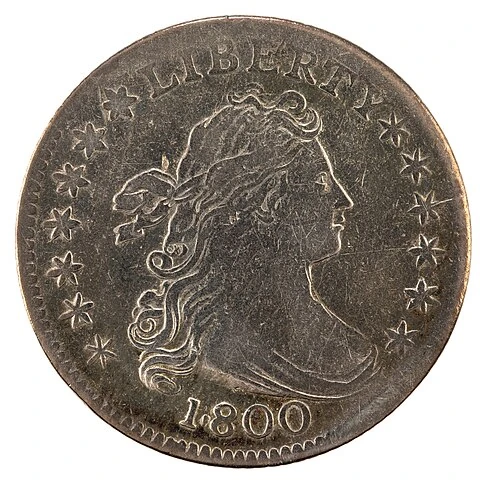
Liberty faces right, with flowing hair, drapery at the neckline and the date below. The word LIBERTY is above the portrait, with stars around it. The number and placement of stars matter for variety attribution, but star count alone does not establish the denomination. Compare the full portrait, lettering, date and rim with a reference of the same dime type.
Reverse: identify the back
A small eagle stands within a wreath beneath UNITED STATES OF AMERICA. This compact eagle-and-wreath arrangement is the defining reverse of the Small Eagle dime. Do not substitute the larger shielded eagle from the 1798–1807 type. Early dime designs do not present the modern ONE DIME label, so check scale and catalog identity rather than assuming every similar Liberty-and-eagle coin is ten cents.
History and purpose
The U.S. Mint dates the first regular dime coinage to 1796. The denomination had been authorized earlier by the 1792 coinage law, but authorization and the dates on circulating coins are different facts. Small Eagle dimes occupy the opening position in the regular dime sequence, followed by Heraldic Eagle Draped Bust, Capped Bust, Seated Liberty, Barber, Mercury and Roosevelt designs. The 1792 disme patterns are separate historical pieces.
How to identify this variant
Confirm a date of 1796 or 1797, a right-facing Draped Bust portrait and the small eagle within a wreath. The historical issuer is the United States Mint at Philadelphia, with no mint letter on these regular dime issues. The reference’s dated 1796 reference supplies approximately 19 mm diameter and a reeded edge. Compare actual dimensions and both faces together; an unscaled photograph can confuse the dime with a smaller half dime or a larger denomination.
Understanding its metal content
The reference gives .0774 fine troy ounce as the nominal silver reference. For three correctly identified coins using that same reference, multiplication gives .2322 reference fine troy ounce and 8.1 nominal gross grams. The displayed inputs 2.7 × .892 also give 2.4084 nominal fine grams; the reference ounce figure is retained at its own published precision. These are reference calculations, not the measured silver remaining in worn, damaged or altered specimens.
Dates, varieties and composition changes
The actual engraved issue years are 1796 and 1797. The reference separately catalogs 1797 with 16 stars as JR-1 and 13 stars as JR-2. These are varieties within one dated year, not extra annual issues or separate silver standards. A reference photograph dated 1797 illustrates one specimen, not every star layout. Record a certified die attribution separately from the general Small Eagle identification.
Melt value versus collector value
Treat an early dime as a collectible object before considering its silver alone. Date, die attribution, remaining detail, surface preservation and damage can affect an appraisal. A photographed coin's color or sharpness does not assign a grade to another specimen. Keep certification records, holders and provenance with the coin. Do not polish, file, dip or attempt to brighten its surfaces.
Authenticity and condition
Check the complete date, portrait, small eagle, lettering, rim, edge and actual dimensions as one identification exercise. A close match in weight cannot establish authenticity, and a low weight does not by itself prove that a worn coin is counterfeit. For a consequential sale or purchase, obtain an examination by a qualified numismatist or established grading service. Handle the coin by its edge and avoid destructive tests.
Selling this coin
Keep Small Eagle dimes separate from later dimes and from half dimes when describing a collection. Record the engraved year, any certified JR attribution and visible damage. Provide clear photographs of both complete faces, together with available certification and ownership records, through the CashForCoins appraisal process. Explain what you actually have rather than assigning a collector premium from a nominal silver figure.
Sources and calculation methodology
The numerical reference follows the reference’s 1796 dime entry at its published 2.7 g, .892 and .0774 oz precision. The annual issue scope comes from the reference’s dated early-dime entries. The original 1792 law specifies 41.6 grains gross, 37.125 grains fine silver and the ratio 1485/1664 silver with copper alloy. Those statutory quantities are historical provenance; they do not silently replace the rounded reference. The present the reference U.S. silver melt table has no Small Eagle dime row. Prices and population counts are not used to calculate a collector value.
Common questions
Which years belong to the Small Eagle dime?The regular Draped Bust Small Eagle dime is dated 1796 or 1797. The later Heraldic Eagle reverse is a separate design.How much silver does the reference assign to a Small Eagle dime?The reference’s dated 1796 reference lists .0774 fine troy ounce, with 2.7 g gross weight and .892 silver fineness. This is a nominal reference rather than an individual assay.Why can a 1797 dime have different star counts?The reference catalogs 1797 16 Stars as JR-1 and 13 Stars as JR-2. They are separate varieties dated the same year and do not create different annual dates.Should I clean a Small Eagle dime before an appraisal?Preserve its surfaces. Supply clear photographs and existing certification instead of polishing, filing or chemically cleaning it.
U.S. Mint: Coinage Act of April 2, 1792 — identity dime denomination; historical weight 41.6 grains standard and 37.125 grains fine silver; fineness legal ratio 1485/1664; alloy copper; not a replacement for rounded NGC reference inputs (checked 2026-10-12)
U.S. Mint: dime denomination history — identity first regular dimes in 1796; design Liberty/eagle before 1837 wreath transition; no transfer of current clad specifications to historic silver (checked 2026-10-12)
We use cookies to offer you a better browsing experience, analyze site traffic and personalize content. Read about how we use cookies and how you can control them in our Privacy Policy. If you continue to use this site, you consent to our use of cookies.



.jpg)