Draped Bust Heraldic Eagle dimes are regular United States ten-cent coins dated 1798, 1800–1805 and 1807. They share the early nominal silver reference that the reference reports as 2.7 g gross, .892 fineness and .0774 fine troy ounce. The larger eagle with shield identifies this reverse family. A broad 1798–1807 label does not mean a coin exists for every intervening year.
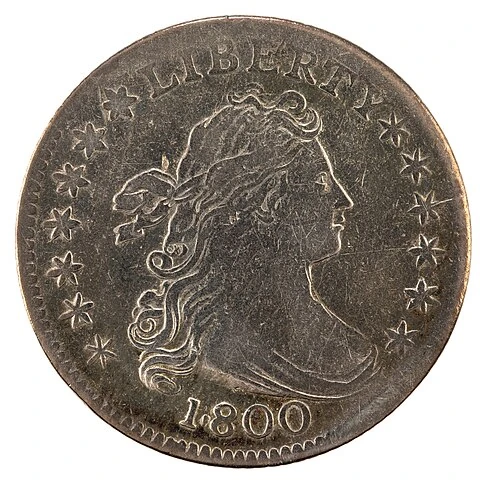
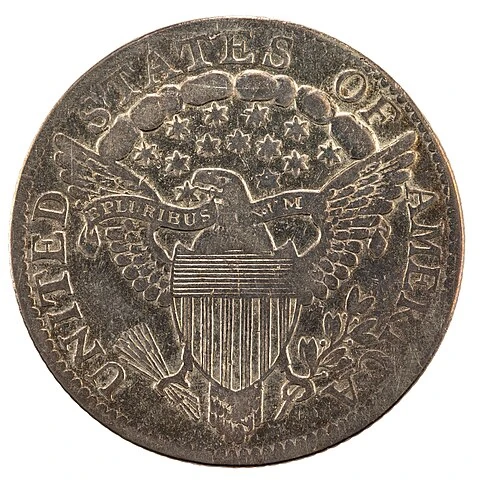
Obverse — Genuine1800 representative of the specifically matched dime design; other dates, mints and transition types require attribution. Photograph by Jaclyn Nash, National Numismatic Collection, National Museum of American History; PD-US-SI and VRT2013030510011547. · Image source · PD-US-SI; file-specific VRT photographic permissionReverse — Genuine1800 representative of the specifically matched dime design; other dates, mints and transition types require attribution. Photograph by Jaclyn Nash, National Numismatic Collection, National Museum of American History; PD-US-SI and VRT2013030510011547. · Image source · PD-US-SI; file-specific VRT photographic permission
When a fresh spot bid is available, melt values use fine-metal content × spot bid. CashForCoins guide buying offers use the separately configured percentage for each metal. Selected rare/numismatic coins require an appraisal. Dollar amounts remain unavailable when a fresh quote or buying percentage is missing.
Verified coin specifications
Country
United States
Face denomination
10 U.S. cents
Composition
.892 silver fineness as displayed by the reference; original statutory copper-alloy ratio is recorded separately
Actual source-reviewed issue years for this exact denomination, design and metal/weight scope. Overdates, mint combinations and proof availability remain type-specific; specimen photos and measurements do not certify other examples.
Source precision
The designated reference U.S. silver melt table has no row for this early dime type. The supplementary dated reference 1800 Heraldic Eagle reference supplies 2.7 g gross, .892 fineness and .0774 oz ASW at its printed precision, plus 19 mm diameter. Preserve that reference convention separately from exact statutory provenance: 41.6 grains gross, 37.125 grains fine and 1485/1664 silver. None of these quantities is an assay or a measured mass of the photographed specimen.
Calculate this coin’s metal content
Formula: specified fine-metal troy ounces × quantity. Dollar melt value additionally requires an approved current metal price.
Obverse: identify the front
A right-facing Liberty portrait carries the Draped Bust design, with the date below. Read the complete date before identifying an overdate or selecting a dated comparison. The portrait resembles the earlier Small Eagle dime and other early U.S. silver denominations, so the obverse by itself is insufficient. Use the reverse, scale, edge and full coin outline together.
Reverse: identify the back
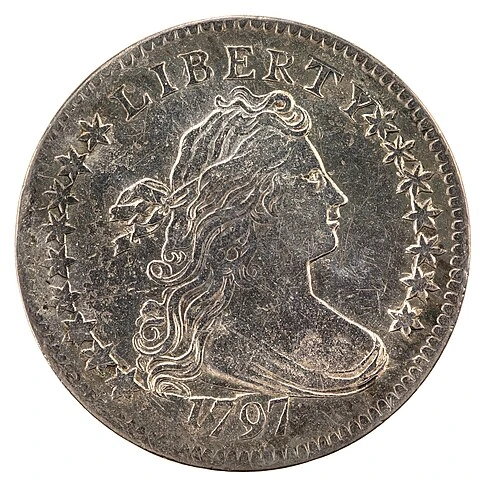
The reverse presents a heraldic eagle with a shield, a scroll and stars above. Its layout differs from the small eagle enclosed in a wreath on 1796–1797 dimes. The same broad heraldic motif appears on other denominations, which require different specifications. Compare the actual coin with a reference explicitly identified as a dime rather than inferring its value from the eagle.
History and purpose
The Heraldic Eagle design follows the two-year Small Eagle dime and precedes the Capped Bust dime first dated 1809. This is a design transition within the ten-cent denomination, separate from later changes to the dime's legal silver ratio and weight. Face dates and manufacturing dates can differ: the reference discusses 1800-dated dimes as likely delivered during 1801. The annual list here describes engraved issue dates.
How to identify this variant
Match a regular date in the stated scope, right-facing Draped Bust Liberty and the shielded heraldic eagle. These issues belong to Philadelphia and do not carry a branch mint letter. The reference’s exact 1800 entry supplies the approximately 19 mm diameter and reeded edge reference. Confirm that the item is a dime before assigning its silver quantity; replicas and other denominations do not inherit this reference.
Understanding its metal content
The preserved the reference 1800 reference is .0774 fine troy ounce per matching dime. Three coins at that reference total .2322 fine troy ounce and 8.1 nominal gross grams. Multiplying the separate displayed inputs 2.7 g and .892 gives 2.4084 nominal fine grams; this does not justify changing the published ounce precision. A nominal calculation describes a reference standard rather than the measured metal of a worn specimen or the price a collector will pay.
Dates, varieties and composition changes
Actual issue years are 1798, 1800, 1801, 1802, 1803, 1804, 1805 and 1807. The annual sequence contains no regular dime dated 1799 or 1806, and no 1808 dime bridges the change to Capped Bust. The reference recognizes 1798/7 overdates with different reverse star counts, 1804 reverse-star varieties, and four- or five-berry distinctions for 1805. An overdate contributes its upper engraved year once; it does not create a separate year in the annual list. Specialist die attribution remains distinct from family identification.
Melt value versus collector value
Consider date, die attribution, surfaces and condition before treating an early dime as bullion. A specialist may distinguish a die variety from damage or ordinary wear. Preserve certificates and holder information, and photograph visible scratches, bends, corrosion or mounting traces honestly. No rarity label, market price or numeric condition grade can be established from a generic illustration.
Authenticity and condition
Inspect the date, portrait, reverse arrangement, lettering, star layout, rim and edge with measurements of the real specimen. Similar silver color and a plausible scale weight are screening observations, not proof of authenticity. A valuable or uncertain coin should be examined directly by an experienced numismatist or grading service. Avoid acid testing, scratching or altering the surface to investigate the metal.
Selling this coin
Separate Heraldic Eagle dimes from Small Eagle and Capped Bust dimes when preparing a collection description. List each engraved date and any reliable certified die attribution. Keep both faces visible in photographs and include certification or provenance through the CashForCoins appraisal process. A nominal silver figure can describe the reference metal quantity; an actual offer also requires identification and assessment of the real coins.
Sources and calculation methodology
The reference’s exact 1800 dime record provides the 2.7 g gross, .892 fineness, .0774 oz ASW, diameter, mint and edge reference. The reference’s annual early-dime entries establish the dated scope and major cataloged varieties. The 1792 coinage law supplies the original gross and fine grain quantities and silver/copper ratio, which are recorded as historical context without replacing the reference’s published precision. The current designated U.S. melt table has no Heraldic Eagle dime row. Date lists refer to faces, and copied valuation tables are not used.
Common questions
Were Heraldic Eagle dimes issued every year from 1798 to 1807?No. The actual regular face dates are 1798, 1800–1805 and 1807. The annual series has no 1799 or 1806 dime.How does the Heraldic Eagle dime differ from the Small Eagle dime?The Heraldic Eagle reverse has a larger eagle with a shield and stars above. The earlier 1796–1797 reverse has a small eagle within a wreath.Does the date 1800 prove that the coin was manufactured in 1800?No. The list records engraved dates. The reference notes that most or all 1800-dated dimes are believed to have been delivered in 1801.Does an overdate use a separate silver calculation?A recognized die variety does not automatically imply a different material standard. Confirm its denomination and exact identity before applying the nominal reference.
U.S. Mint: Coinage Act of April 2, 1792 — identity dime denomination; historical weight 41.6 grains standard and 37.125 grains fine silver; fineness legal ratio 1485/1664; alloy copper; not a replacement for rounded NGC reference inputs (checked 2026-10-12)
U.S. Mint: dime denomination history — identity first regular dimes in 1796; design Liberty/eagle before 1837 wreath transition; no transfer of current clad specifications to historic silver (checked 2026-10-12)
NGC Coin Explorer: 1800 Draped Bust dime — identity 1800 heraldic-eagle dime; mint Philadelphia; weight 2.7 g; fineness .892; ASW .0774 oz; diameter 19 mm; design Robert Scot; reeded edge; engraved date does not guarantee same production calendar year (checked 2026-10-12)
We use cookies to offer you a better browsing experience, analyze site traffic and personalize content. Read about how we use cookies and how you can control them in our Privacy Policy. If you continue to use this site, you consent to our use of cookies.



.jpg)