
.JPG)
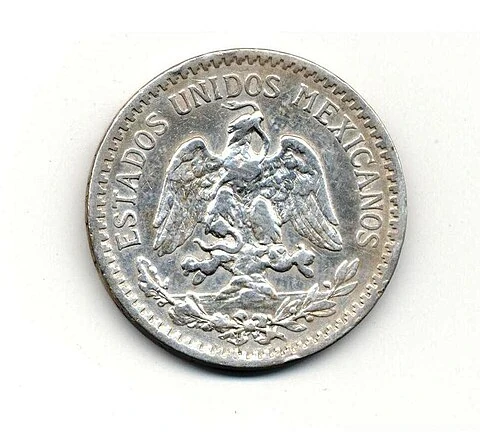
Mexican Reduced-Size .800 Silver Fifty Centavos
Photo credits and rights on the linked coin profile.
Mexico • 80% silver reference; remaining alloy metals not independently established
Issue years: 1918–1919
Fine silver: 0.233100 troy oz
Mexico • 50 centavos
A matching large Mexican .800 silver fifty centavos contains 0.3215 reference fine silver troy ounce. Actual issue years are 1905–1908, 1912–1914 and 1916–1918. Its nominal gross mass is 12.5 g and diameter 30 mm. Confirm the exact date, fifty-centavo denomination, design and nominal size before selecting this larger standard.
When a fresh spot bid is available, melt values use fine-metal content × spot bid. CashForCoins guide buying offers use the separately configured percentage for each metal. Selected rare/numismatic coins require an appraisal. Dollar amounts remain unavailable when a fresh quote or buying percentage is missing.
Exact reviewed annual face/issue years for the assigned standard, retaining mint and design gaps. Overdate undernumerals and commemorative life dates do not add annual issues. Separate alloys, weights, designs and finish availability are explained in the guide. Larger12.5-g/.800 fifty centavos overlaps the reduced9.0625-g standard in1918; identify exact type.
Formula: specified fine-metal troy ounces × quantity. Dollar melt value additionally requires an approved current metal price.
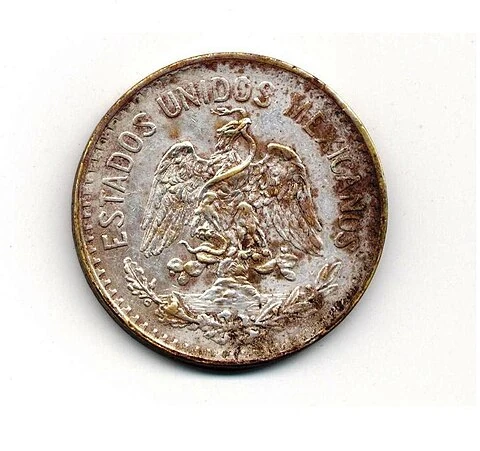
The matching KM 445 obverse shows Mexican national arms. Compare the eagle with the complete reverse, date and nominal size. The same emblem appears on other denominations and fifty-centavo standards; it does not alone select the right silver calculation.
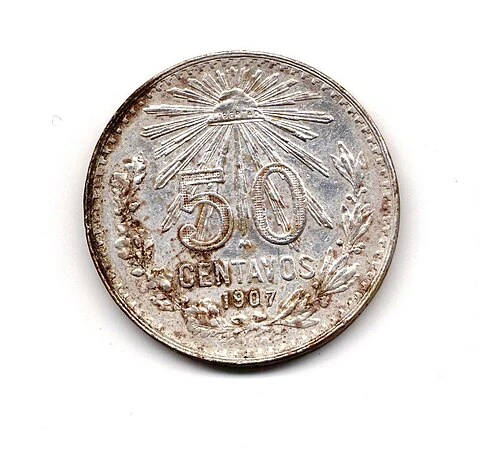
The reverse has the fifty-centavo value and date within a three-quarter wreath, with a radiant Liberty cap above. Preserve full denomination, date, mint details and rims when photographing the coin. The 1907 numeral can have a curved or straight 7; identify that variety from the actual numeral shape.
This larger .800 family precedes the reduced-size .800 KM 446 issue of 1918–1919. The two overlap in 1918 but have different nominal masses and fine silver amounts. The .720 fifty-centavo standard beginning in 1919 uses 8.3333 g and .1929 fine silver troy ounce. Later .420 and .300 issues also carry the same denomination with different silver content. Sort by physical standard and exact type.
U.S. Mint records identify larger .800 fifty centavos manufactured for Mexico at San Francisco in 1906, and San Francisco and Denver in 1907. Their recorded alloy is 800 parts silver and 200 parts copper per thousand, with 12.5 g gross mass. This evidence is specific to the documented production; the year alone does not attribute an individual coin to a factory.
For this standard match fifty centavos, one of the actual included annual years, the KM 445 design and nominal 12.5 g/30 mm specifications. A date inside the broad 1905–1918 span does not establish an annual issue;1909–1911 and 1915 are not included by the inspected rows. Keep reduced-size .800, .720, .420, .300, base-metal, regional and uncertain pieces separate. Wear, clipping or mounting can alter measured mass.
Three matching larger coins contribute 37.5 nominal gross grams and .9645 reference fine silver troy ounce. Three reduced-size .800 coins instead use .6993 reference fine silver troy ounce, despite sharing fineness. Gross alloy weight is not fine silver mass; troy ounces differ from ordinary avoirdupois ounces. Dollar melt pricing requires an approved current market quote; missing pricing is not represented as zero or as a buying offer.
Actual annual years are 1905, 1906, 1907, 1908, 1912, 1913, 1914, 1916, 1917 and 1918. The reference records closed/open 9 variants in 1906, curved/straight 7 variants in 1907, 1913/07 and 1913/2 overdates, and narrow/wide dates in 1916. An overdate undernumeral does not add a separate annual issue. Preserve die details and assayer/mint attribution for individual review.
Date, numeral shape, overdate, die pairing, condition and provenance can affect collector interest independently of silver. Keep possible die varieties available for review instead of automatically combining every piece as scrap. The guide does not infer grade, rarity or collector value from the reference metal amount. Avoid cleaning or polishing and retain certification and established descriptions.
Complete obverse, reverse and edge photographs, measured mass and diameter help identify an uncertain coin. Compare the large 12.5 g/30 mm standard with the smaller 9.0625 g/27 mm .800 issue, especially for the overlapping 1918 date. Cast regional pieces, plated copies, altered dates and patterns need separate investigation. A source caption, shine or photograph cannot establish authenticity or a proof finish.
Sort 50 centavos coins by complete date, design and nominal metal standard before entering quantities. Send clear photographs of both sides, plus edge photographs and measured weight where available, when requesting a CashForCoins appraisal. Preserve possible overdates and unusual die details for individual review. An offer can depend on authenticity, condition and collector demand alongside metal content. The reference melt calculation is an educational estimate.
The inspected reference dated KM 445 table gives 12.5000 g gross mass, .8000 silver, .3215 reference fine silver troy ounce and 30 mm diameter. Actual observed annual years are 1905–1908, 1912–1914 and 1916–1918. These values define a larger physical standard distinct from the reduced-size 9.0625 g/.800/.2331/27 mm KM 446 standard that overlaps in 1918. Thickness and remaining-alloy proportions are not invented. Actual annual years come from dated catalog rows rather than filling every year in a broad series heading. Overdates are counted under the visible issue year. The fine-silver reference applies to a correctly attributed coin; it does not establish authenticity, grade or collector value.
The independently licensed genuine faces retain their complete rims. A joined source photograph is split into its actual obverse and reverse with WebP conversion only; no enlargement, retouching or synthetic reconstruction is used. It does not assay another specimen.
Content maintained by CashForCoins. Last substantive record update: 2026-10-12. Report a specification or attribution issue through our contact page.
Photo credits and rights on the linked coin profile.
Mexico • 80% silver reference; remaining alloy metals not independently established
Issue years: 1918–1919
Fine silver: 0.233100 troy oz
Photographs can help identify your coin. An appraisal may consider authenticity, condition and collector demand as well as metal content.
Request a photo appraisal View current silver coin buying information
