
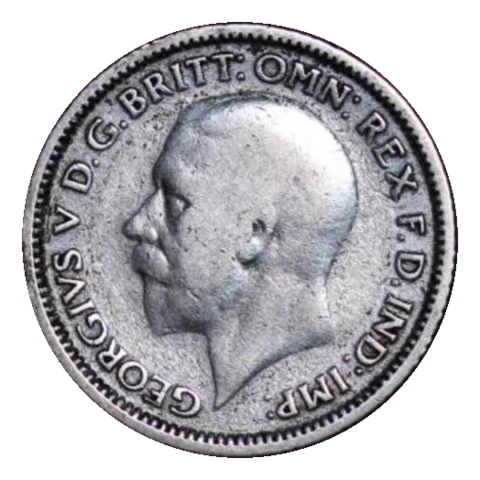
British Silver Sixpence — .500 Dated Types
Photo credits and rights on the linked coin profile.
United Kingdom • 50% silver; remaining alloy metals not independently verified
Issue years: 1920–1946
Fine silver: 0.045500 troy oz
United Kingdom • Sixpence
Matching British sterling sixpences in this guide use 2.8276 gross grams, .925 fineness and .0841 fine silver troy ounce in five inspected reference dated types. The 29 included issue years are listed individually below; the guide does not treat every 1816–1919 coin as interchangeable. Edward VII references, other unreviewed types and the conflicting 1920 sterling row remain outside this calculation.
When a fresh spot bid is available, melt values use fine-metal content × spot bid. CashForCoins guide buying offers use the separately configured percentage for each metal. Selected rare/numismatic coins require an appraisal. Dollar amounts remain unavailable when a fresh quote or buying percentage is missing.
Actual source-reviewed issue years for this exact denomination, design and metal/weight scope. Overdates, mint combinations and proof availability remain type-specific; specimen photos and measurements do not certify other examples. Only29 listed years of five matching dated types; other portraits and1920 sterling conflict excluded. Retained route does not establish broader coverage.
Formula: specified fine-metal troy ounces × quantity. Dollar melt value additionally requires an approved current metal price.
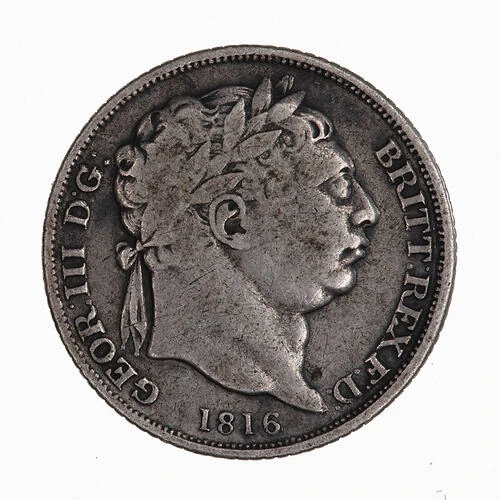
The photographed 1816 KM 665 example shows the laureate head of George III facing right, with the date below. The other included portraits differ: George IV faces left on KM 678, William IV faces right on KM 712, KM 779 shows the mature Victoria portrait and KM 815 George V facing left. The actual 1816 photograph represents one included type rather than every later monarch.
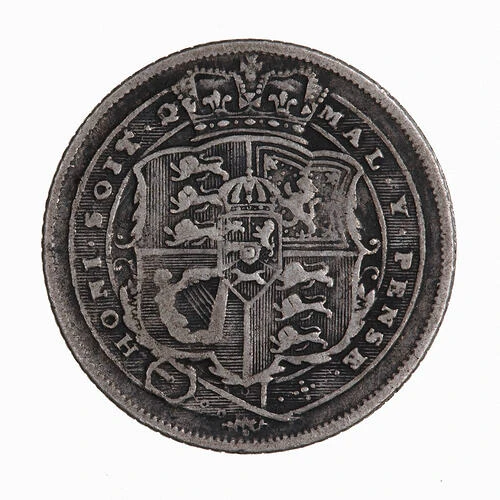
The photographed 1816 reverse has a crowned and garnished royal shield inside the Garter and its surrounding motto. KM 678 has crowned arms; KM 712 and KM 779 use crowned denomination-and-wreath arrangements, and KM 815 shows a lion atop a crown dividing the date. Keep the exact date, portrait and reverse together when matching a coin to its reference.
The reviewed types span several reigns following the 1816 coinage. Only types with the explicitly matched the reference inputs are included. The sparse William IV list and the separately reviewed mature Victoria/George V types leave substantial intervening coverage uncompleted. Exclusion from this guide is not evidence that a coin was never issued; it means its exact type or reference input is not covered by this guide.
Check sixpence denomination, actual face year, royal portrait, complete legend, reverse and finish. The 1920 boundary cannot be selected by date alone: the reference includes a 1920 sterling row in KM 815 but its KM 815a.1 and Royal Mint’s George V reference describe half-silver coinage from 1920. This guide excludes that unresolved sterling row. Plain-edge proofs and circulation pieces must retain their exact finish attribution.
The matched the reference uses .0841 fine silver troy ounce and 2.8276 gross grams per included coin. Three matching pieces contribute .2523 reference fine silver troy ounce and 8.4828 nominal gross grams. The reference supplies ASW to four decimals; small last-digit differences from multiplying rounded gross mass and fineness are not silently normalized. Gross alloy mass, fine silver content and current market value are separate measures.
Actual included years are 1816, 1817, 1818, 1819, 1820, 1821, 1831, 1834, 1835, 1836, 1837, 1893, 1894, 1895, 1896, 1897, 1898, 1899, 1900, 1901, 1911, 1912, 1913, 1914, 1915, 1916, 1917, 1918, 1919. KM 665 includes 1817 plain/milled-edge proof distinctions, 1819/8 and its proof, and an 1820 inverted-I row. KM 678 includes the 1821 BBITANIAR legend error and proof. KM 712 includes 1831 plain/milled-edge proofs, 1834/1835 round-topped-3 proofs and 1836/1837 proofs; 1832 and 1833 are absent from that inspected table. KM 779 includes 1893 proof and KM 815 includes the 1911 proof. Finish variants do not add a second calendar year.
| Included dated type | Actual calculation years | Reference inputs |
|---|---|---|
| KM 665 | 1816, 1817, 1818, 1819, 1820 | 2.8276 g / .925 / .0841 fine silver oz |
| KM 678 | 1821 | 2.8276 g / .925 / .0841 fine silver oz |
| KM 712 | 1831, 1834, 1835, 1836, 1837 | 2.8276 g / .925 / .0841 fine silver oz |
| KM 779 | 1893, 1894, 1895, 1896, 1897, 1898, 1899, 1900, 1901 | 2.8276 g / .925 / .0841 fine silver oz |
| KM 815 | 1911, 1912, 1913, 1914, 1915, 1916, 1917, 1918, 1919 | 2.8276 g / .925 / .0841 fine silver oz |
The reference KM 760 Jubilee Victoria 1887–1893 gives 2.83 g/.0842 oz; KM 799 Edward VII 1902–1910 gives 3.01 g/.0895 oz although Royal Mint gives 2.83 g/.925 for that family. Neither presentation is silently merged into this selected reference. The 1920 sterling row remains excluded alongside the separately supported half-silver boundary. Unreviewed George IV and earlier Victoria types are also outside the stated calculation scope.
Exact year, portrait, legend error, overdate, proof finish, condition and provenance can affect collector interest independently of reference silver. Preserve edge evidence and established attribution. Avoid cleaning or polishing; neither a bright surface nor the reference metal amount establishes grade or a buying offer.
Use complete obverse, reverse and edge photographs with measured mass and diameter where possible. Matching a dated reference entry is not an authentication certificate. Wear, plating, altered dates, replicas and uncertain proofs require individual examination. No missing universal diameter or complete-series mint attribution is supplied merely to fill a field.
Separate these matching sterling types from half-silver sixpences, conflicting Edward VII entries and uncertain coins. State each actual date, portrait and finish when sending complete photographs to CashForCoins for appraisal. Reference weight and quantity describe a holding; individual identity, condition and authenticity inform evaluation.
The calculation is limited to inspected reference KM 665, KM 678, KM 712, KM 779 and KM 815 rows dated before 1920 that each give 2.8276 g/.925/.0841 oz. The broader the reference melt group’s 3.01 g/.0895 oz is retained as comparison evidence, and conflicting or differently rounded presentations remain explicitly outside scope. Royal Mint’s Edward VII and George V specifications are primary cross-checks, not replacement inputs for this calculation. Actual years are drawn from dated rows rather than inferred from a broad reign or route interval.
Museums Victoria records the photographed 1816 specimen at 2.644 g and 20 mm. Those individual measurements do not replace the matching reference nominal reference or establish a universal diameter for the other included types.
Content maintained by CashForCoins. Last substantive record update: 2026-10-12. Report a specification or attribution issue through our contact page.
Photo credits and rights on the linked coin profile.
United Kingdom • 50% silver; remaining alloy metals not independently verified
Issue years: 1920–1946
Fine silver: 0.045500 troy oz
Photographs can help identify your coin. An appraisal may consider authenticity, condition and collector demand as well as metal content.
Request a photo appraisal View current silver coin buying information
