


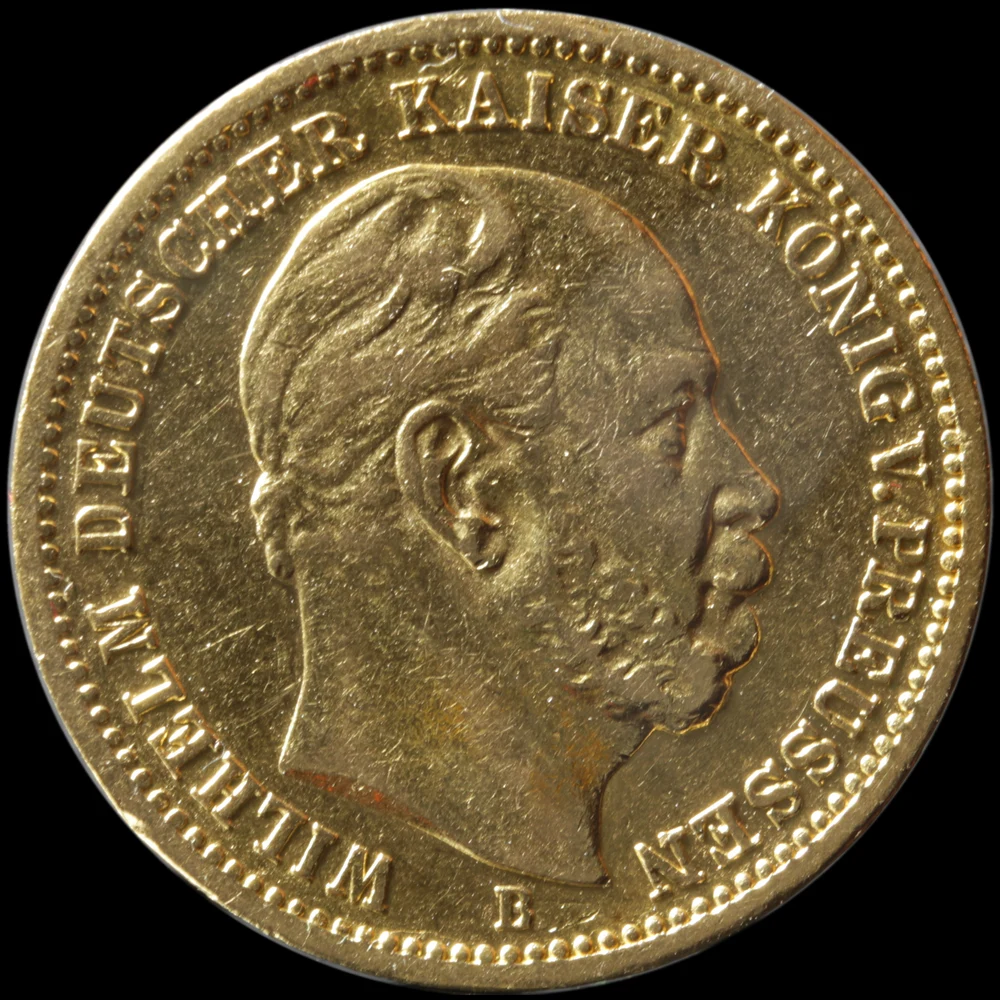
Prussian Gold 20 Mark
Photo credits and rights on the linked coin profile.
Germany • 90.0% gold; balance alloy metal
Issue years: 1871–1879, 1881–1915
Fine gold: 0.230500 troy oz
Germany • 10 marks
An ordinary Prussian gold ten-mark coin matching the retained standard contains .1152 reference fine gold troy ounce at 3.9820 g gross and .900 gold fineness. The actual reviewed annual dates are 1872–1880, 1882–1883, 1886, 1888–1890, 1892–1907, 1909–1912. The illustrated 1888-A Friedrich III coin represents one portrait within this family, rather than every emperor or year. Confirm 10 MARK and the ruler legend before counting coins; similarly named later German silver commemoratives do not share this gold standard.
When a fresh spot bid is available, melt values use fine-metal content × spot bid. CashForCoins guide buying offers use the separately configured percentage for each metal. Selected rare/numismatic coins require an appraisal. Dollar amounts remain unavailable when a fresh quote or buying percentage is missing.
Thirty-five actual annual dates across five normal Prussian ten-mark types. No1881,1884–1885,1887,1891 or1908 annual rows inserted. Ruler, mint and finish combinations remain distinct; heavier/lighter patterns and fantasies excluded.
Formula: specified fine-metal troy ounces × quantity. Dollar melt value additionally requires an approved current metal price.
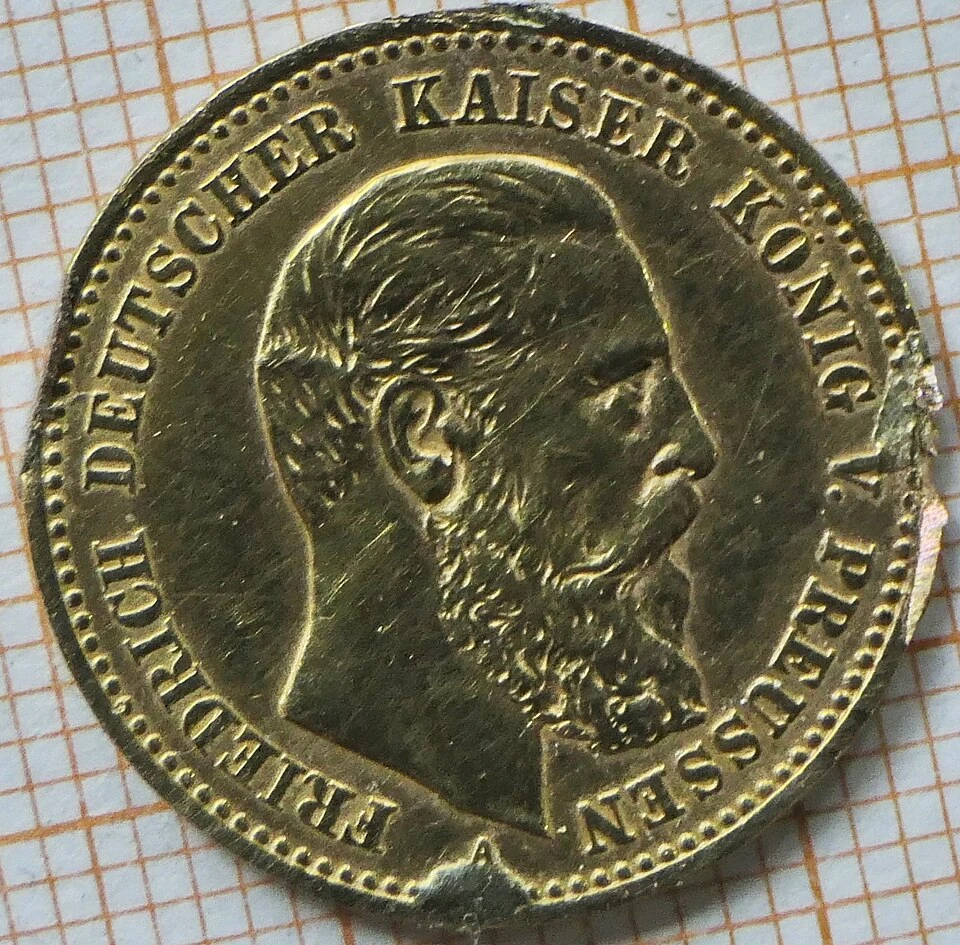
The representative photograph shows Friedrich III facing right, with the name FRIEDRICH and the German emperor and Prussian king titles around the portrait. A below the bust identifies the Berlin issue. Wilhelm I and Wilhelm II ordinary coins use their own portrait legends. Those ruler changes belong to distinct dated types even when the nominal ten-mark gold amount remains the same. Do not identify the ruler from the reverse eagle or from the year 1888 alone.
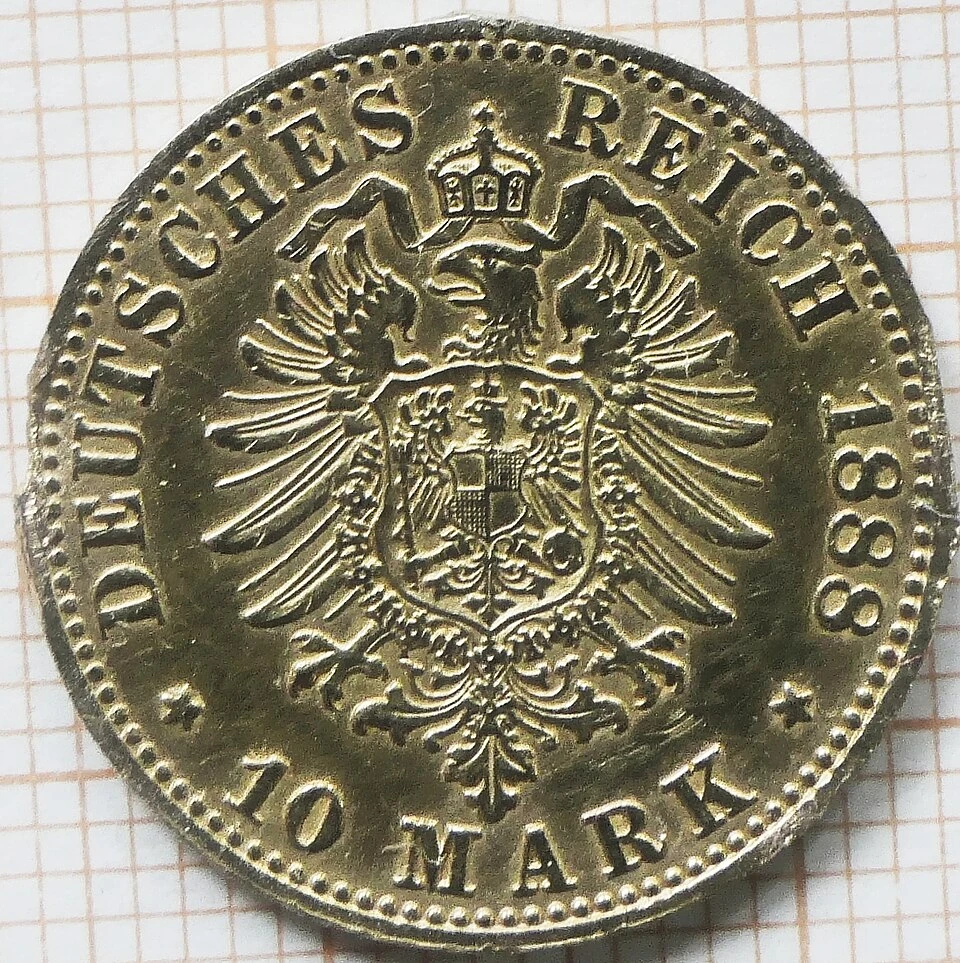
The representative reverse carries a crowned imperial eagle, DEUTSCHES REICH, the date 1888 and 10 MARK below. Keep the entire denomination readable. Earlier Wilhelm I reverses and the later Wilhelm II type III eagle differ in design. An eagle also occurs on larger gold denominations and silver coins; the motif alone cannot determine mass, metal or value. Surface marks on the photographed former-mounted specimen are condition evidence, not part of the engraved design.
The reference classifies the normal Prussian gold ten marks into five retained types. KM 502 has Wilhelm I and the early 1872–1873 reverse, followed by KM 504 with a changed reverse. Friedrich III appears on KM 514 dated 1888. Wilhelm II uses the 1889 KM 517 reverse and the later KM 520 eagle. The Jewish Museum Berlin records an 1888-A Friedrich ten marks from the collection of Ernst Schwerin, corroborating the Berlin mark and ruler attribution without determining the provenance of a visitor’s coin.
Read 10 MARK, the complete Prussian ruler title, year and mint letter together. A matching specimen should be compared with the 3.9820-g nominal reference and approximately 19.5-mm diameter. Earlier mint letters include B and C; A identifies the photographed Berlin issue. Coins with 20 MARK contain a different nominal gold quantity and require their own guide. The small denomination can be confused in an unscaled photograph, so measure the actual coin and retain clear full-rim images.
The reference reports .1152 fine gold troy ounce per matching ordinary coin. Three matching coins therefore total .3456 reference fine troy ounce and 11.9460 nominal gross grams. Multiplying the displayed 3.9820-g mass by .900 gives 3.58380 nominal fine grams, approximately 0.115222 troy ounce. This displayed-input calculation is separate from the retained four-decimal the reference AGW. It does not establish an individual assay, a collectible premium or a buying offer.
Specific reviewed issue years: 1872–1880, 1882–1883, 1886, 1888–1890, 1892–1907, 1909–1912. Within this scope KM 502 lists 1872–1873; KM 504 lists 1874–1880, 1882–1883, 1886 and 1888; KM 514 lists 1888; KM 517 lists 1889; and KM 520 lists 1890, 1892–1907 and 1909–1912. No 1881, 1884–1885, 1887, 1891 or 1908 normal annual row is inserted. Keep mint combinations and ordinary versus proof finishes separate. The search also lists nonstandard gold, silver and copper patterns or fantasies; these are excluded from the normal calculation.
Portrait type, mint, date, finish, condition and genuine errors can affect collector interest beyond the shared reference gold content. The CC 0 reference photographs describe a formerly mounted coin. Mount marks do not authenticate another specimen and should not be removed by polishing or filing. Preserve packaging, certification and any ownership information for appraisal. No market premium, scarcity rating or numeric condition grade is assigned by comparison with these illustrations.
Examine the complete portrait, denomination, eagle, mint mark, date, edge and measurements together. Matching mass and diameter are useful checks but cannot authenticate a coin by themselves. Nonstandard pieces found under the same ten-mark search heading include a heavier 1887 X 21 and a lighter 1913 X 5; their shared wording cannot transfer this ordinary gold quantity. Leave uncertain pieces out of a total until properly identified. Avoid cleaning, scratching, acid testing and damaging a mount-removal area.
Separate ten marks from twenty marks, later German silver denominations and uncertain patterns before counting a lot. Record each ruler, year, mint letter, finish and any mount damage. Clear photographs of both faces plus the actual edge help the existing CashForCoins appraisal workflow assess the real specimens. The library total is an educational nominal metal quantity. An actual offer also depends on identity, condition and the buyer’s assessment; an unconfigured market price is not displayed as zero.
The designated reference World Gold melt table and five matching ordinary dated types report 3.9820 g gross, .9000 fineness and .1152 fine troy ounce. Actual annual rows have gaps. The 19.5 mm diameter is corroborated by the Jewish Museum Berlin description of a matching 1888-A Friedrich ten marks. Museum specimen measurements are not substituted for the reference mass. No alloy remainder, thickness, grade or genuine manufacturing year is invented. All four visible pages of the reference Prussian ten-mark search were reviewed and the five matching normal types were read directly. Only factual annual rows, composition and design are used; no reference valuation or mintage table is copied. The photographs are independently CC 0 released own-work images by 5snake 5. Their former-mounted condition is disclosed separately from the nominal metal reference. Both actual CC 0 face photographs were visually reviewed before private import; actual staging calculator and rendering acceptance is recorded separately.
The complete source faces are converted to WebP without cropping, enlargement, retouching or synthetic reconstruction. Coin engravers are not identified as the photographer.
Content maintained by CashForCoins. Last substantive record update: 2026-10-12. Report a specification or attribution issue through our contact page.
Photo credits and rights on the linked coin profile.
Germany • 90.0% gold; balance alloy metal
Issue years: 1871–1879, 1881–1915
Fine gold: 0.230500 troy oz
Photographs can help identify your coin. An appraisal may consider authenticity, condition and collector demand as well as metal content.
Request a photo appraisal View current gold coin buying information
