
Canada • 1 Canadian dollar
Canadian Twentieth-Ounce Gold Maple Leaf — Actual 1993–2026 Years
The Canadian twentieth-ounce Gold Maple Leaf is a one-dollar bullion coin marked 1/20 OZ and .9999 gold. Its documented annual family extends from 1993 through 2026. It is larger and contains more gold than the separate one-gram 50-cent Maple Leaf. A calculator must match the actual coin denomination and weight inscription before combining either size with a collection.
Images supplied by CashForCoins; used with permission. · Image source · CashForCoins website use authorized by site owner
Images supplied by CashForCoins; used with permission. · Image source · CashForCoins website use authorized by site owner
When a fresh spot bid is available, melt values use fine-metal content × spot bid. CashForCoins guide buying offers use the separately configured percentage for each metal. Selected rare/numismatic coins require an appraisal. Dollar amounts remain unavailable when a fresh quote or buying percentage is missing.
Verified coin specifications
- Country
- Canada
- Face denomination
- 1 Canadian dollar
- Composition
- 99.99% gold
- Fineness
- 0.9999
- Fine-metal weight (troy oz)
- 0.05
- Diameter (mm)
- 14.1
- Edge
- Reeded / serrated; match actual dated issue
- Mint
- Royal Canadian Mint
- Mint mark
- See dated mint attribution
- Restrikes
- See dated issue attribution and exclusions in this guide
- Issue years
- 1993–2026
Normal issue dates within this profile. Read the guide for changing designs, mint/finish differences and excluded material standards.
- Source precision
- No matching twentieth-ounce row appears in the designated reference melt table. Exact the reference KM238 prints 1.5551 g, .9999 fineness and .05 AGW. Exact .05 fine troy ounce weighs 1.55517384 g, greater than that printed gross mass. Preserve the source values but keep specs_verified=0 and editorial_approved=0; do not invent a replacement gross weight or weaken the mass guard. Current Mint 1.55-g display is even more rounded. The reference annual rows directly verify 1993–2001; original Numista dated catalogue tables establish 2002–2022 and 2024–2025, and original Mint 2023 and 2026 bullion programs list this size. Those annual sources support every 1993–2026 year, not an inferred start/end fill. The calculator uses the independently stated fine-metal amount directly. Gross mass is unavailable here; a rounded fine-weight display or inconsistent gross reference is not presented as a verified gross measurement. Restrike status: Normal one-dollar twentieth-ounce gold bullion only; collector denominations and metals require their own identities. Mint mark: Retain any genuine dated privy and finish; do not invent a mint mark.
Calculate this coin’s metal content
Formula: specified fine-metal troy ounces × quantity. Dollar melt value additionally requires an approved current metal price.
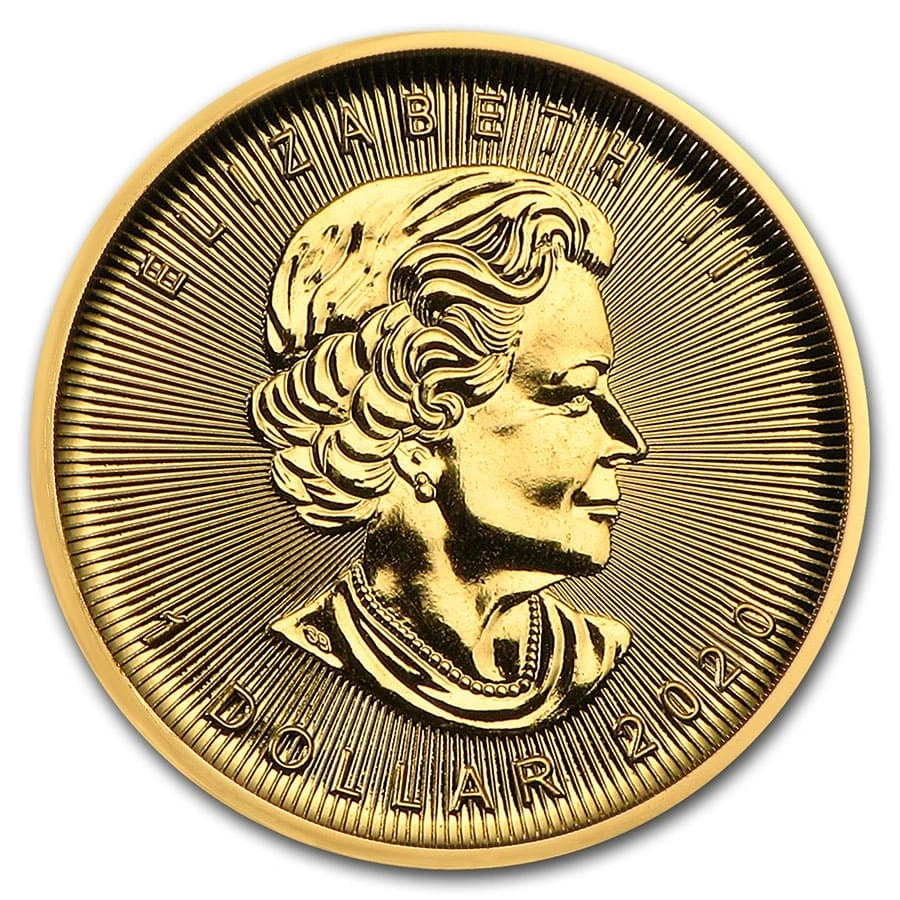
Obverse: identify the front
The monarch, actual year and one-dollar denomination establish the national side. Early issues use Dora de Pédery-Hunt’s crowned Elizabeth II effigy; later Elizabeth II pieces use the bareheaded portrait associated with Susanna Blunt. Charles III bullion is documented for 2024 onward. Preserve the complete portrait face and date rather than using a shared royal head as a substitute for this particular fraction.
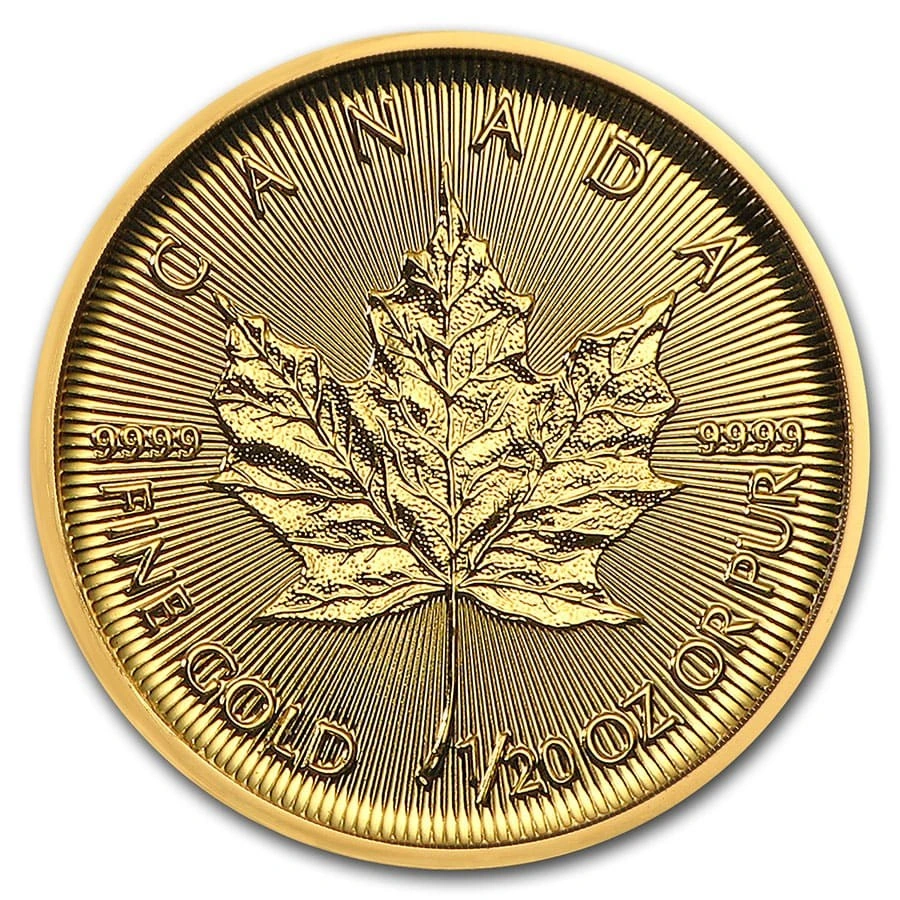
Reverse: identify the back
The normal maple-leaf reverse carries CANADA, .9999 purity and the twentieth-ounce gold marking. Later issues show a radial-line background. Keep the whole reverse and rim readable so the gold weight is not confused with a different fraction, metal or collector denomination. A proof maple design with several leaves or a different monetary value is not automatically this one-dollar bullion identity.
History and purpose
The twentieth-ounce size joined the Gold Maple Leaf program in 1993, later than the quarter- and tenth-ounce gold denominations. Its one-dollar face value is a denomination rather than an appraisal of its metal. The series continued through changes in monarch portrait and surface security treatment while retaining the characteristic normal fractional gold marking. Those design changes should remain attributed to their actual dates.
How to identify this variant
Read 1 DOLLAR, the actual year, the .9999 marking and FINE GOLD 1/20 OZ together. The current issuer diameter is 14.1 mm, distinct from the 8-mm one-gram Maplegram. Size and color alone cannot identify genuine gold. Use this nominal reference only after confirming the specific bullion type; do not silently absorb silver fractional Maple Leafs, gold-plated coins or differently denominated collector pieces.
Understanding its metal content
The calculator retains .05 fine troy ounce per matching coin. Multiply that fine-metal amount by the correctly identified quantity. Gross mass is unavailable; the declared fine-metal content is used directly without inventing a gross measurement. Fineness describes the alloy and must not be deducted a second time from an issuer’s already fine-metal declaration. Reference quantities do not determine authenticity, condition or collector premiums.
Dates, varieties and composition changes
Documented normal annual dates are 1993–2026 inclusive. The source groups are 1993–2001 in the reference KM238; 2002–2003 in the continuing third-portrait dated catalogue; 2004–2012 in the next portrait table; 2013–2014 and 2015–2022 in separate later dated tables; and 2023–2026 in original recent issuer/catalogue records. The reference separately records a 1999 “20 YEARS ANS” privy and a 2000 oval date privy. The catalogue also records a 2001 Viking-privy set. Retain those attributions without treating a holder label as a new alloy. Different collector reverse designs or denominations require separate verification.
Melt value versus collector value
Keep the actual date, portrait, finish and any genuine privy with original packaging or certification. The face value does not establish a resale value, and this guide assigns no rarity, grade or guaranteed premium. A small gold coin is easily scratched during handling. Clear identification photographs and preservation of original surfaces are more useful for appraisal than polishing or opening sealed collectible packaging.
Authenticity and condition
Compare the complete two-side inscriptions, rim, edge and physical dimensions with the matching dated bullion type. Correct markings and a plausible diameter do not independently authenticate a coin. Keep uncertain purity, plated pieces and unrelated collector designs outside a confirmed normal-bullion count. Avoid destructive acid testing or scraping a collector specimen solely to resolve a reference-table rounding issue.
Selling this coin
Sort twentieth-ounce one-dollar pieces separately from tenth-ounce five-dollar coins and one-gram 50-cent coins. Record actual annual dates, finishes and privies before requesting appraisal through the existing CashForCoins process. Preserve packaging and full-rim photographs. Nominal gold content is one input to an evaluation, and a missing live market quote should remain unavailable rather than display a zero-dollar purchase value.
Sources and calculation methodology
The calculator retains .05 fine troy ounce per matching coin. The retained fineness is .9999, and the nominal diameter is 14.1 mm. Gross mass is unavailable; the declared fine-metal content is used directly without inventing a gross measurement. The references below distinguish the exact denomination and material standard from similar-looking coins. Reported fine content and rounded gross-mass arithmetic are separate conventions. The dated photographs supplied for CashForCoins use illustrate the identified type; they do not authenticate or grade an individual holding. A live market bid is obtained separately from specification references.
Common questions
Is a twentieth ounce the same as one gram?
No. The twentieth-ounce one-dollar Gold Maple Leaf and one-gram 50-cent Maplegram have different weights and dimensions.Did this fraction exist before 1993?
The documented normal one-dollar twentieth-ounce program begins in 1993; earlier Maple Leaf denominations do not establish an earlier date for this size.Why is the calculator reference held?
The reference’s printed gross mass is slightly below its exact stated fine-metal amount. That contradiction needs a documented resolution before this draft can approve a calculator record.References
- NGC exact KM238 normal annual rows — 1993–2001 actual years; 1.5551g; .9999; .05 AGW; 1999/2000 privies; identity KM238 twentieth-ounce Gold Maple Leaf; dates 1993–2001; fineness .9999; diameter 14.1 mm (checked 2026-10-16)
- Manufacturer-supported Gold Maple Leaf technical history — first twentieth-ounce issue 1993; historical dimensions; no gross convention substituted (checked 2026-10-16)
- Original Numista actual dated bullion type — actual 2002 and 2003 continuing KM238 rows; 2001 Viking privy (checked 2026-10-16)
- Original Numista actual dated bullion type — actual every 2004–2012 year; 2004 anniversary attribution (checked 2026-10-16)
- Original Numista actual dated bullion type — actual 2013 and 2014 annual rows (checked 2026-10-16)
- Original Numista actual dated bullion type — actual every 2015–2022 year; radial-line reverse (checked 2026-10-16)
- Original Numista actual dated bullion type — actual Charles III one-dollar 2024 and 2025 rows (checked 2026-10-16)
- Original Royal Canadian Mint 2023 bullion program — 2023 program lists one-dollar twentieth-ounce .9999 fraction, 14.1mm, serrated; display weight rounded1.55g (checked 2026-10-16)
- Original Royal Canadian Mint 2026 bullion program — 2026 normal twentieth-ounce fraction; current physical specification separately attributed (checked 2026-10-16)
Issue-year references
Content maintained by CashForCoins. Last substantive record update: 2026-10-16. Report a specification or attribution issue through our contact page.
Have this coin or a collection?
Photographs can help identify your coin. An appraisal may consider authenticity, condition and collector demand as well as metal content.
Request a photo appraisal View current gold coin buying information