
Canada • 20 Canadian dollars
Canadian Gold Maple Leaf — Half Ounce
The normal Canadian half-ounce Gold Maple Leaf has a 20-dollar face denomination and 25 mm issuer diameter. The reference’s designated reference uses 15.5515 g gross, .9999 fineness and 0.4999 fine gold troy ounce. Actual reviewed annual dates are 1986–2026. The commercial 1/2-ounce label and the reference’s rounded reference figure are displayed distinctly so a collection calculation can retain its selected source.
Images supplied by CashForCoins; used with permission. · Image source · CashForCoins website use authorized by site owner
Images supplied by CashForCoins; used with permission. · Image source · CashForCoins website use authorized by site owner
When a fresh spot bid is available, melt values use fine-metal content × spot bid. CashForCoins guide buying offers use the separately configured percentage for each metal. Selected rare/numismatic coins require an appraisal. Dollar amounts remain unavailable when a fresh quote or buying percentage is missing.
Verified coin specifications
- Country
- Canada
- Face denomination
- 20 Canadian dollars
- Composition
- 99.99% gold; balance unspecified trace material
- Gross weight (grams)
- 15.5515
- Fineness
- 0.9999
- Fine-metal weight (troy oz)
- 0.4999
- Diameter (mm)
- 25
- Edge
- Serrated/reeded
- Mint
- Royal Canadian Mint
- Mint mark
- See dated mint attribution
- Restrikes
- See dated issue attribution and exclusions in this guide
- Issue years
- 1986–2026
Normal issue dates within this profile. Read the guide for changing designs, mint/finish differences and excluded material standards.
- Source precision
- The reference designated World Gold melt table supplies 15.5515 g gross, .9999 fineness and 0.4999 reference AGW. The issuer markets this size as 1/2 oz and shows rounded 2026 gross grams; the retained calculator follows the user-designated reference instead of silently substituting the round ounce label. Issuer diameter 25 mm. Reviewed annual date entries establish every year 1986–2026. No image license or actual render approval is implied. Restrike status: Normal fractional Gold Maple Leaf standard; changed-material commemoratives, trials and replicas excluded. Mint mark: Issue-dependent security or privy marks; inspect the actual issue.
Calculate this coin’s metal content
Formula: specified fine-metal troy ounces × quantity. Dollar melt value additionally requires an approved current metal price.
Obverse: identify the front
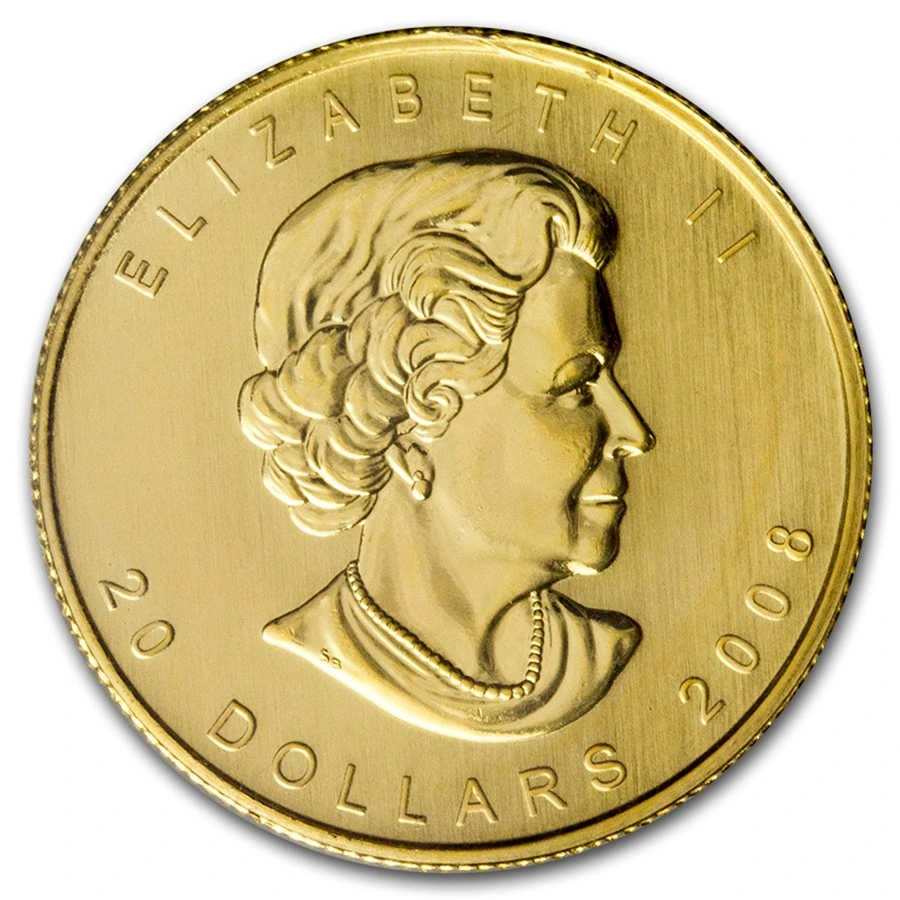
The Canadian sovereign’s portrait appears above the 20-dollar denomination and actual coin year. Elizabeth II portraits appear on earlier issues; the 2026 issuer reference shows Charles III by Steven Rosati. The queen faces right and the king faces left. A portrait transition is a design distinction rather than permission to change the documented normal gold standard. Read the complete amount and year rather than identifying a fractional size from a cropped royal head.
Reverse: identify the back
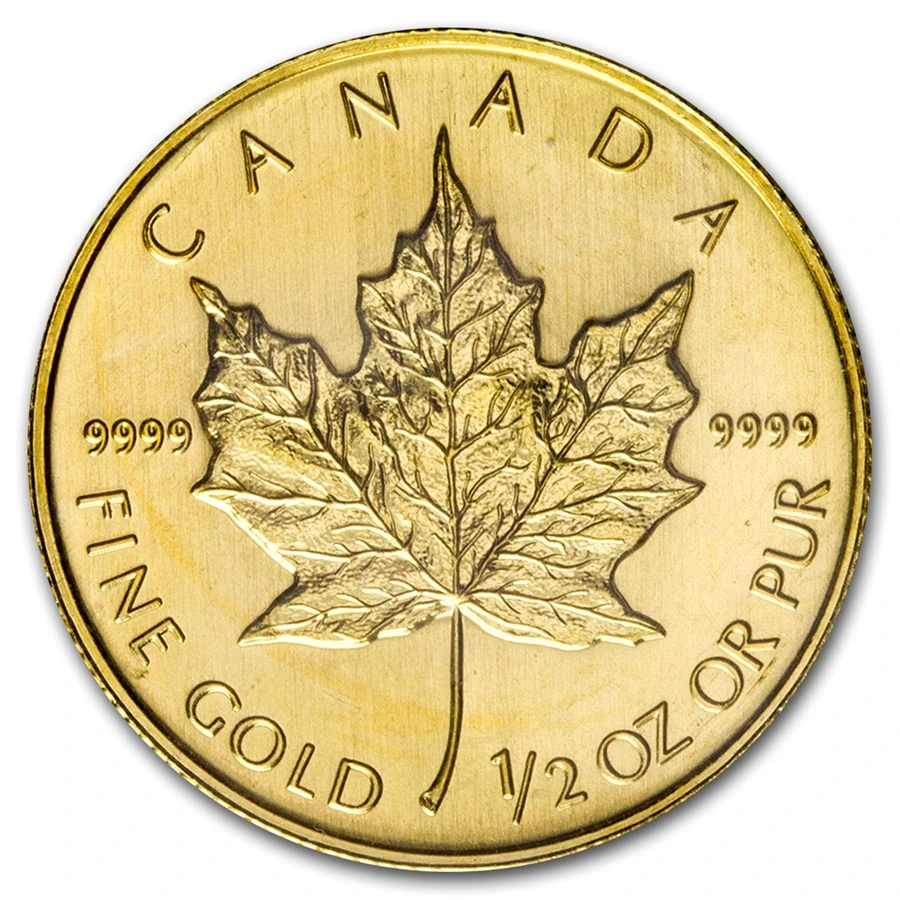
The reverse shows a maple leaf with Canada’s name and a fine-gold inscription in English and French. Match the 1/2-ounce size inscription, .9999 purity and the complete denomination on the other face. A similar maple leaf on silver, platinum or a different gold size is not sufficient for this record. Later normal issues use radial field lines; special privy marks or commemorative modifications need their own dated design notes.
History and purpose
The Gold Maple Leaf began as a one-ounce Canadian program in 1979. The quarter and tenth sizes followed in 1982; the half was added in 1986. These introduction dates differ, so the full 1979 program history cannot be assigned to every fractional denomination. Canada’s early one-ounce .999 coins and later .9999 standard require distinct purity attribution; the normal fraction described here uses the documented .9999 reference.
How to identify this variant
A full-ounce Canadian fifty dollars is 30 mm, while this twenty-dollar half is 25 mm. The early the reference KM153 type page displays a conflicting 32 mm diameter; the directly matched Royal Canadian Mint product table supplies the retained 25 mm reference. That diameter conflict does not replace the reference’s selected metal inputs. Compare both faces, actual engraved date, complete gold inscription, mass and dimensions. Set certificates and original packaging can assist attribution but do not prove a loose coin’s authenticity. A medal, plated copy or altered collector issue stays outside the nominal total until separately identified.
Understanding its metal content
The retained reference amount is 0.4999 fine gold troy ounce per matching coin, using the reference’s published value. Ten matching coins total 4.9990 reference fine troy ounces. Multiplying 15.5515 nominal gross grams by .9999 gives 15.54994485 nominal fine grams for orientation. The round 1/2-ounce product name does not silently override the selected reference data. Trace alloy material is not additional gold, and a worn or mounted specimen requires individual assessment.
Dates, varieties and composition changes
The reviewed normal annual records contain every year from 1986 through 2026. The 2026 issuer table independently confirms this exact fractional denomination. The annual list does not imply that every finish, privy mark or presentation set was made each year. Record special anniversary imagery and any altered reverse as additional attribution. Five-nines .99999 collector editions and other different-material coins are not automatically included in this .9999 record.
Melt value versus collector value
Keep original assay packaging, proof certificates and any documented special edition together with their actual coins. Finish, condition and specific anniversary designs can matter beyond the shared nominal metal quantity. A reflective face in a photograph does not by itself establish proof status or a market premium. This guide supplies identification and metal references without assigning an unexamined coin a grade, rarity claim or current collector price.
Authenticity and condition
Compare the complete maple, royal portrait, date, gold wording, edge and measurements. The issuer describes security features for current bullion, but feature details must match the actual denomination and year rather than being imposed on every older coin. A correct scale reading alone does not prove genuineness. Avoid scratching, acid testing or polishing a coin in an attempt to identify the purity inscription. Uncertain or altered pieces should be assessed separately.
Selling this coin
Separate 20-dollar half-ounce Gold Maple Leafs from other fractional sizes and metals. Record actual face years, complete purity inscriptions, dimensions and any special packaging. Clear front, back and edge photographs help the existing CashForCoins appraisal process evaluate the real lot. A nominal reference gold total organizes the collection but is not a guaranteed buying amount. Live dollar melt values stay unavailable until an approved price feed exists.
Sources and calculation methodology
The calculator retains 0.4999 fine troy ounce per matching coin. The retained fineness is 0.9999, and the nominal diameter is 25 mm. Nominal gross mass is 15.5515 grams. The references below distinguish the exact denomination and material standard from similar-looking coins. Reported fine content and rounded gross-mass arithmetic are separate conventions. The dated photographs supplied for CashForCoins use illustrate the identified type; they do not authenticate or grade an individual holding. A live market bid is obtained separately from specification references.
Common questions
Did the half-ounce Gold Maple Leaf start in 1979?
No. The normal 20-dollar half started in 1986. The one-ounce program began earlier in 1979.
Why does the calculator differ slightly from the round ounce name?
It retains the selected reference AGW of 0.4999 oz. The issuer’s 1/2-ounce marketing size is explained separately; the input is not silently changed.
Can a different metal with the same maple design use this record?
No. Match the gold inscription, purity, denomination and size together. Silver and platinum Maple Leafs require their own metal calculation.
References
- NGC designated world-gold melt table — weight 15.5515 g; fineness .9999; reference AGW 0.4999 oz (checked 2026-10-16)
- Royal Canadian Mint exact 2026 fractional-size table — identity; dates 2026; denomination CAD20; diameter 25 mm; .9999 alloy; size 1/2 oz; serrated edge (checked 2026-10-16)
- Original catalog annual dated entries — identity; dates actual annual 1986–2025; 2026 issuer confirmation; no prices copied (checked 2026-10-16)
Issue-year references
Content maintained by CashForCoins. Last substantive record update: 2026-10-16. Report a specification or attribution issue through our contact page.
Have this coin or a collection?
Photographs can help identify your coin. An appraisal may consider authenticity, condition and collector demand as well as metal content.
Request a photo appraisal View current gold coin buying information