
Austria • 20 corona (20 kronen)
Austrian 20 Corona Gold Coin
A matching Austrian 20-corona gold coin uses 6.7751 nominal gross grams, .900 fineness and 0.1960 reference fine gold troy ounce. This guide covers the inspected Franz Joseph types dated 1892–1905 and 1908–1916, including 1915-dated restrikes. The covered 1916 issue is KM 2818; the separate pointed-shield KM 2827 and unissued 1918 Charles I type are outside this guide. Gaps between the listed dates are retained.
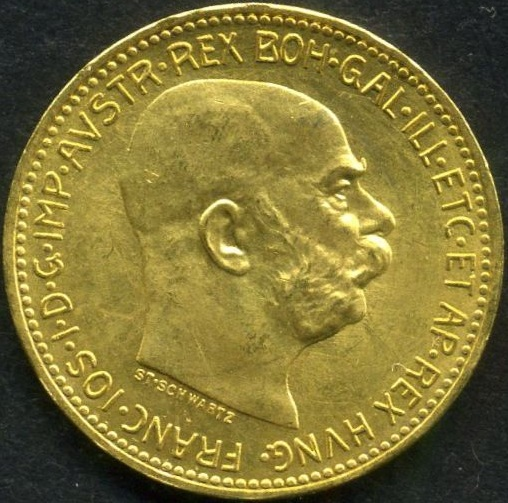
DJGrandfather / Wikimedia Commons / CC BY-SA 4.0 Changes: Complete acquired photograph retained; no crop. Native508×503 pixel dimensions retained; no enlargement. Converted to lossless WebP. No retouching, synthetic reconstruction or rim trimming. · Image source · CC BY-SA 4.0
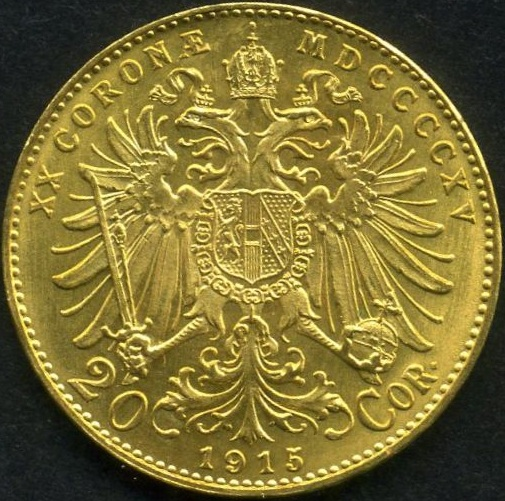
DJGrandfather / Wikimedia Commons / CC BY-SA 4.0 Changes: Complete acquired photograph retained; no crop. Native505×501 pixel dimensions retained; no enlargement. Converted to lossless WebP. No retouching, synthetic reconstruction or rim trimming. · Image source · CC BY-SA 4.0
When a fresh spot bid is available, melt values use fine-metal content × spot bid. CashForCoins guide buying offers use the separately configured percentage for each metal. Selected rare/numismatic coins require an appraisal. Dollar amounts remain unavailable when a fresh quote or buying percentage is missing.
Verified coin specifications
- Country
- Austria
- Face denomination
- 20 corona (20 kronen)
- Composition
- 90% gold; remaining alloy metals not independently established
- Gross weight (grams)
- 6.7751
- Fineness
- 0.9
- Fine-metal weight (troy oz)
- 0.196
- Diameter (mm)
- 21
- Mint
- Vienna; Austrian Mint restrikes
- Mint mark
- None asserted
- Restrikes
- 1915-dated official restrikes; date is not actual manufacture year
- Issue years
- 1892–1905; 1908–1916 (1915-dated restrikes; 1916 KM 2818 only, excluding pointed-shield KM 2827)
Actual source-observed issue-date labels for the bounded denomination, design and nominal standard. Catalogue endpoints do not imply annual mint production; overdates and proof/mint combinations remain type-specific. Specimen measurements and images do not certify another coin. Excluded dated types are retained separately in this research record.1915 is a restrike face date, not a verified manufacture year.
- Source precision
- The retained matching reference uses 6.7751 nominal gross grams, 0.900 fineness and 0.1960 fine gold troy ounce. Source-specific precision and any disagreement are documented in References. Actual specimen measurements do not replace the nominal reference.
Calculate this coin’s metal content
Formula: specified fine-metal troy ounces × quantity. Dollar melt value additionally requires an approved current metal price.
Obverse: identify the front
The inspected historical families show Franz Joseph I facing right. Earlier pieces use a laureate portrait; later types differ in portrait detail and lettering. Read the whole imperial legend and any signature. The paired 1915 photographs illustrate one later restrike design rather than every portrait in the covered years.
Reverse: identify the back
Look for the imperial double-headed eagle, the 20-corona denomination and full date. The 1908 anniversary design differs from later regular types. Photograph the complete reverse rather than cropping away the Roman date or value; those details help distinguish a corona from a different Austrian gold denomination.
History and purpose
The krone currency was introduced in the 1892 reform. Twenty-corona pieces belong to that system, whereas ducats and florin/franc pieces have separate denominations and specifications. The Austrian Mint continues to offer historical restrikes carrying the date 1915. An old-looking date therefore does not by itself establish that a particular specimen was made before the First World War.
How to identify this variant
Match the 20-corona value, appropriate Franz Joseph design, date and 21 mm reference diameter. A mass near 6.7751 g supports an initial comparison but does not establish purity or authenticity. The issuer rounds its current restrike specification to 6.78 gross grams and 6.10 fine grams; these are separately attributed rounded figures, not silently substituted calculator inputs.
Understanding its metal content
One correctly attributed coin contributes 0.1960 reference fine gold troy ounce; three contribute 0.5880 ounce and 20.3253 nominal gross grams. The calculator retains the reference fine-content precision instead of replacing it with a longer mass-derived figure. Wear, plating, counterfeit composition and actual purchase terms require individual evaluation.
Dates, varieties and composition changes
Actual covered date labels are 1892–1905 and 1908–1916. The dated families are KM 2806 (1892–1905), KM 2811 (1908 anniversary), KM 2817 (1909) and KM 2818 (1909–1916). The 1915 row is explicitly a restrike; it is not a verified manufacturing-year list. The separate 1916 pointed-shield KM 2827 and unissued 1918 Charles I KM 2828 are outside this guide.
Melt value versus collector value
Keep historical issues separate from identified restrikes when documenting a collection. Preserve portrait, date, anniversary attribution and provenance; nominal gold content alone cannot determine the premium of a scarce date or special issue. Avoid cleaning or polishing to make the lettering easier to read. Soft, well-lit photographs preserve more useful evidence.
Authenticity and condition
Supply both complete faces, the edge and available measured mass and diameter. A correctly spelled denomination or familiar eagle is insufficient to authenticate gold. Existing certificates and purchase records can help explain an attribution, but photographs on this page certify neither another coin nor its metal content. Use professional non-destructive assessment when identity is uncertain.
Selling this coin
Group matching 20-corona pieces by date and known historical or restrike attribution. Keep other Austrian denominations separate and identify uncertain pieces as uncertain. The CashForCoins photo-appraisal enquiry can carry selected quantity and specimen photographs for assessment. Metal content and collector value are assessed separately.
Sources and calculation methodology
The designated melt reference and inspected dated types supply 6.7751 g, .900 and 0.1960 troy ounce. Actual annual rows establish the listed date labels; no continuous-year assumption fills an unobserved gap. The issuer independently confirms current 1915-dated .900 restrikes, using rounded mass figures. Nominal reference content, actual specimen measurements and manufacture date remain separate. Sources were inspected on 2026-10-12; catalogue prices and mintages are not republished.
Common questions
Does a 1915 date prove the coin was struck in 1915?
No. The Austrian Mint offers official restrikes carrying that historical date.Which dates does this guide cover?
The covered Franz Joseph families are dated 1892–1905 and 1908–1916. The 1915 label identifies restrikes; the included 1916 type is KM 2818, excluding pointed-shield KM 2827.Is a 20 corona the same as an Austrian ducat?
No. Match the denomination and dated type before using this calculation; the ducat has a separate standard.References
- NGC world-gold melt reference — Identity of the exact denomination/type; designated nominal weight; fineness; fine gold ounces (checked 2026-10-12)
- NGC Austrian 20-corona KM2806 dated records — Reference diameter 21 mm; Dates and design scope; actual1892–1905 annual rows; .9006.7751g/.196oz;21mm; earlier portrait (checked 2026-10-12)
- NGC Austrian 1908 anniversary 20-corona KM2811 — actual1908; matching nominal standard; anniversary distinction (checked 2026-10-12)
- NGC Austrian 1909 20-corona KM2817 — actual1909; matching standard (checked 2026-10-12)
- NGC Austrian 20-corona KM2818 complete dated records — Dates and design scope; actual1909–1916;1915restrike label; matching standard; portrait (checked 2026-10-12)
- Austrian Mint 20-kronen restrike specification — Reference diameter 21 mm; 1915 restrike; .900;6.78gross/6.10fine roundedgrams;21mm (checked 2026-10-12)
- Austrian Mint historical bullion denomination guide — 1892 introduction; ongoing1915 restrikes; distinct denominations (checked 2026-10-12)
- Excluded 1918 Charles I unissued type record — never-issued1918 type, separately bounded exclusion (checked 2026-10-12)
- Genuine coin image and independent permission — Independent CC BY-SA 4.0 permission; creator/credit DJGrandfather; genuine source photograph or scan; actual paired source photographs and optimized faces reviewed independently; publication remains a separate decision. (checked 2026-10-12)
- Genuine coin image and independent permission — Independent CC BY-SA 4.0 permission; creator/credit DJGrandfather; genuine source photograph or scan; actual paired source photographs and optimized faces reviewed independently; publication remains a separate decision. (checked 2026-10-12)
Issue-year references
- NGC world-gold melt reference
- NGC Austrian 20-corona KM2806 dated records
- NGC Austrian 1908 anniversary 20-corona KM2811
- NGC Austrian 1909 20-corona KM2817
- NGC Austrian 20-corona KM2818 complete dated records
- Austrian Mint 20-kronen restrike specification
- Austrian Mint historical bullion denomination guide
- Excluded 1918 Charles I unissued type record
Content maintained by CashForCoins. Last substantive record update: 2026-10-13. Report a specification or attribution issue through our contact page.
Have this coin or a collection?
Photographs can help identify your coin. An appraisal may consider authenticity, condition and collector demand as well as metal content.
Request a photo appraisal View current gold coin buying information